CHAPTER He-P
4000 NEW HAMPSHIRE RULES FOR THE CONTROL
OF RADIATION
Statutory
Authority RSA 125-F:5,V; RSA 125-F:7; RSA 125-F:8; and RSA 125-F:8-b
PART
He-P 4001 SCOPE, EXEMPTIONS, AND GENERAL
PROVISIONS
He-P 4001.01 Scope.
Except as otherwise specifically provided, these rules shall apply to
all persons who receive, possess, use, transfer, own, or acquire any source of
radiation provided, however, that nothing in these rules shall apply to any
person to the extent such person is subject to regulation by the U.S. Nuclear
Regulatory Commission, (NRC). Regulation
by the department of health and human services/radiological health section,
(DHHS/RHS) of source material, byproduct material, and special nuclear material
in quantities not sufficient to form a critical mass is subject to the
provisions of the agreement between the Agreement State, New Hampshire, and the
NRC as of May 16, 1966, and to 10 CFR (Code of Federal Regulations) Part 150.
Source. #5903, eff 2-1-95; ss by #6827, eff 8-6-98;
ss by #8692, INTERIM, eff 7-27-06, EXPIRES: 2-2-07; ss by #8808, eff 1-24-07;
ss by #10805, eff 3-28-15
He-P 4001.02 Exemptions.
(a) Pursuant to RSA 125-F:7, III, the following persons shall be exempt from the requirements of He-P 4000
as follows:
(1) Prime contractors performing work for the
U.S. Department of Energy at U.S. Government owned or controlled sites shall be
exempt from these rules to the extent that such contractor or subcontractor
under his contract receives, possesses, uses, transfers, or acquires sources of
radiation including the transportation of sources of radiation to or from such
sites and the performance of contract services during temporary interruptions
of such transportation;
(2) Prime contractors of the U.S. Department of
Energy shall be exempt from these rules to the extent that such contractor or
subcontractor under his contract receives, possesses, uses, transfers, or
acquires sources of radiation to perform research in, or development,
manufacture, storage, testing, or transportation of, atomic weapons or
components thereof;
(3) Prime contractors of the U.S. Department of
Energy shall be exempt from these rules to the extent that such contractor or
subcontractor under his contract receives, possesses, uses, transfers, or
acquires sources of radiation to use or operate nuclear reactors or other
nuclear devices in a United States government owned vehicle or vessel;
(4) Any other prime contractor or subcontractor
of the U.S. Department of Energy or of the U.S. Nuclear Regulatory Commission
shall be exempt from these rules to the extent that such contractor or
subcontractor under his contract receives, possesses, uses, transfers, or
acquires sources of radiation; and
(5) Any other prime contractor or subcontractor
of the U.S. Department of Energy or of the U.S. Nuclear Regulatory Commission
shall be exempt from these rules when the state and the U.S. Nuclear Regulatory
Commission jointly determine:
a. That the exemption of the prime contractor or
subcontractor is authorized by law; and
b. That, under the terms of the contract or
subcontract, there is adequate assurance that the work there
under can be accomplished without undue risk to the public
health and safety.
Source. #5903, eff 2-1-95; ss by #6827, eff 8-6-98;
ss by #8692, INTERIM, eff 7-27-06, EXPIRES: 2-2-07; ss by #8808, eff 1-24-07;
ss by #10805, eff 3-28-15
He-P 4001.03 Records.
(a) Each licensee and registrant shall maintain
records pursuant to He‑P 4000 showing the receipt, transfer, and disposal
of all sources of radiation. Each licensee and registrant shall also comply
with the records requirements in He-P 4021.
(b) Records of receipt, transfer, and disposal of
sources of radiation shall include as a minimum, the following:
(1) A unique identification of each source of
radiation including:
a. Manufacturer’s name;
b. Isotope, if a radioactive source;
c. Activity, if a radioactive source;
d. Source model number; and
e. Source serial number;
(2) The date of receipt, transfer, or disposal of
each source of radiation;
(3) For the person transferring the source of
radiation, pertinent information including:
a. The name of the transferee;
b. The number of the transferee’s radioactive
material license or registration certificate authorizing possession of the
source of radiation; and
c. The regulatory agency issuing the license or
registration to the transferee; and
(4) For the person receiving the source of
radiation, pertinent information including:
a. The name of the transferor;
b. The number of
the transferor’s radioactive material license or registration certificate
authorizing possession of the source of radiation; and
c. The regulatory agency issuing the license or
registration to the transferor.
(c) Records required by this chapter shall be
retained by the licensee or registrant indefinitely or as per additional record
requirements specified elsewhere in these rules.
(d) All records required by this chapter shall be
accurate and factual.
(e) Records required by this chapter shall be
considered valid only if stamped, initialed, or signed
and dated by authorized personnel or otherwise authenticated.
(f) Each record required by this chapter shall be
legible throughout the retention period as specified in He-P 4001.03(c).
(g) Each record required by this chapter shall be
the original or a reproduced copy or a microform or stored in electronic media,
provided that:
(1) The copy is authenticated by authorized
personnel; and
(2) The microform or electronic media is
authenticated by authorized personnel and is capable of
producing clear, legible, accurate, and complete copies of records
throughout the required retention period.
(h) The licensee shall maintain adequate
safeguards against tampering with and loss of records.
Source. #5903, eff 2-1-95; ss by #6827, eff 8-6-98;
ss by #8692, INTERIM, eff 7-27-06, EXPIRES: 2-2-07; ss by #8808, eff 1-24-07;
ss by #10805, eff 3-28-15
He-P 4001.04 Inspections.
(a) Each licensee and registrant shall allow the
department of health and human services/ radiological health section (DHHS/RHS)
at any time during the licensee’s or registrant’s regular business hours to
inspect sources of radiation and the premises and facilities wherein such
sources of radiation are used or stored.
(b) Each
licensee and registrant shall make available to DHHS/RHS for inspection,
records maintained pursuant to the rules in this chapter.
Source. #5903, eff 2-1-95; ss by #6827, eff 8-6-98;
ss by #8488, eff 11-18-05; ss by #8808, eff 1-24-07; ss by #10805, eff 3-28-15;
ss by #13599, eff 3-24-23
He-P 4001.05 Tests.
(a) Each licensee and registrant shall perform, pursuant
to instructions from DHHS/RHS, or shall
permit DHHS/RHS to perform, tests which will assist DHHS/RHS
in determining the licensee’s or registrant’s compliance with these
rules, including tests of:
(1) Sources of radiation;
(2) Facilities where sources of radiation are
utilized or stored;
(3) Radiation detection and monitoring
instruments; and
(4) Other equipment and devices used in connection
with the utilization or storage of licensed or registered sources of radiation.
(b) The licensee in possession of any sealed
source shall ensure that:
(1) Each sealed source,
except as specified
in He-P 4001.05(c), is tested for leakage
or contamination and the test results
are received before the sealed source is put into use unless the licensee has a certificate from the transferor indicating that the sealed source was tested within 6 months before transfer
to the licensee;
(2) Each sealed source
that is not designed to emit alpha
particles is tested
for leakage or contamination at intervals not to
exceed 12 months, except those
as specified in He-P 4034.10 and
He-P 4035.21;
(3) Each sealed source
that is designed to emit alpha particles is tested for leakage or contamination at intervals not to
exceed 3 months;
(4) Each sealed source that is required to be tested for leakage
or contamination, that might
have been damaged or might be leaking,
is tested for leakage and contamination before further use;
(5) Tests for leakage
for all sealed sources, except
brachytherapy sources manufactured to contain radium, are capable
of detecting the presence of 185
Bq (0.005 mCi) of radioactive
material on a test
sample which is taken from the sealed source or taken from the surfaces of the container in which the sealed source
is stored or mounted and at the nearest accessible point to the sealed source where contamination might
accumulate, and for a sealed source
contained in a device, test samples are obtained when the source is in the
“off” position;
(6) Tests for leakage of sealed sources and Brachytherapy
sources and their associated requirements are specified in He-P 4035.21;
(7) Tests for contamination from radium daughters are taken on the interior
surface of brachytherapy source storage containers and are capable
of detecting the presence of 185 Bq (0.005 mCi) of a radium
daughter which has a half-life greater
than 4 days; and
(8) Tests for leakage or contamination are
performed using a leak test kit or method approved by DHHS/RHS.
(c) A licensee shall not be required to perform
tests for leakage or contamination on the following sealed sources:
(1) Sealed sources containing only radioactive
material with a half-life of less than 30 days;
(2) Sealed sources containing only radioactive
material as a gas;
(3) Sealed sources containing 3.7 MBq (100 mCi) or less of beta or photon-emitting
material or 370 kBq (10 µCi) or less
of alpha-emitting material;
(4) Sealed sources containing only hydrogen-3;
(5) Seeds of iridium-192 encased in nylon ribbon;
and
(6) Sealed sources, except teletherapy and brachytherapy
sources, which are stored, not being
used and identified as in storage.
(d) The licensee shall, however, test each such
sealed source in He-P 4001.05(c)(6) for leakage or contamination and receive
the test results:
(1) At intervals no greater than 3 years; and
(2) Before any use or transfer unless the source
has been tested for leakage or contamination within 6 months before the date of
use or transfer.
(e) Tests for leakage
or contamination from sealed sources
shall be performed by persons
specifically licensed by DHHS/RHS, an agreement state, a licensing state, or
the U.S. Nuclear Regulatory Commission to
perform such services.
(f) Test results shall be kept in units of
Becquerel or microcurie and maintained for inspection by DHHS/RHS for 5 years
from date of test.
(g) The following shall be considered evidence
that a sealed source is leaking:
(1) The presence of 185
Bq (0.005 µCi) or more of
removable contamination on any
test sample;
(2) Leakage of 37 Bq (0.001 µCi) of radon-222 per 24 hours for brachytherapy sources manufactured to contain radium; or
(3) The
presence of removable contamination resulting from the decay of 185 Bq (0.005
µCi) or more of radium.
(h) The licensee shall immediately withdraw
a leaking sealed source from use and shall
take action in accordance with He-P 4003.05(i) to prevent the spread of contamination.
(i) If a sealed
source is leaking, the licensee shall:
(1) Decontaminate the facility and source in accordance with He-P 4021.20,
and dispose of the leaking source in accordance with
He-P 4023; or
(2) Decontaminate the facility and source in accordance with He-P 4021.20,
and have the source repaired by a person
specifically licensed to perform this service.
(j) Reports of test results for leaking or
contaminated sealed sources shall be made pursuant to He-
P 4021.19.
Source. #5903, eff 2-1-95; ss by #6827, eff 8-6-98; amd by #8488, eff 11-18-05; amd
by #8692, INTERIM, eff 7-27-06, EXPIRES: 2-2-07; ss by #8808, eff 1-24-07; ss
by #10805, eff 3-28-15; ss by #13599, eff 3-24-23
He-P 4001.06 Prohibited Uses.
(a) A hand-held fluoroscopic screen shall not be
used with x‑ray equipment unless it has first been listed in the
Conference of Radiation Control Program Directors (CRCPD) Registry of Sealed
Source and Devices or accepted for certification by the U.S. Food and Drug
Administration, Center for Devices and Radiological Health.
(b) A shoe-fitting fluoroscopic device shall
never be used for any purpose.
Source. #5903, eff 2-1-95; ss by #6827, eff 8-6-98;
ss by #8692, INTERIM, eff 7-27-06, EXPIRES: 2-2-07; ss by #8808, eff 1-24-07;
ss by #10805, eff 3-28-15
He-P 4001.07 Deliberate Misconduct.
(a) Any licensee, certificate of registration
holder, applicant for a license or certificate of registration, employee of a
licensee, certificate of registration holder or applicant; or any contractor,
including a supplier or consultant, subcontractor, employee of a contractor or
subcontractor of any licensee or certificate of registration holder or
applicant for a license or certificate of registration, who knowingly provides
to any licensee, applicant, certificate holder, contractor, or subcontractor,
any components, equipment, materials, or other goods or services that relate to
a licensee’s, certificate holder’s or applicant’s activities in this part,
shall not:
(1) Engage in deliberate
misconduct that causes or would have caused, if not detected, a licensee,
certificate of registration holder, or applicant to be in violation of any
rule, regulation, or order; or any term, condition, or limitation of any
license issued by DHHS/RHS; or
(2) Deliberately submit to DHHS/RHS, a licensee,
certificate of registration holder, an applicant, or a licensee’s, certificate
holder’s or applicant’s, contractor or subcontractor, information that the
person submitting the information knows to be incomplete or inaccurate in some
respect material to DHHS/RHS.
(b) A person who violates paragraph He-P
4001.07(a)(1) or (a)(2) shall be subject to enforcement action in accordance
with RSA 125-F:21 and RSA 125-F:22.
(c) For the purposes of He-P 4001.07(a)(1),
“deliberate misconduct” by a person means an intentional act or omission that
the person knows:
(1) Would cause a licensee,
certificate of registration holder or applicant to be in violation of any rule,
regulation, or order; or any term, condition, or limitation, of any license
issued by DHHS/RHS; or
(2) Constitutes a violation of a requirement,
procedure, instruction, contract, purchase order, or policy of a licensee,
certificate of registration holder, applicant, contractor, or subcontractor.
Source. #5903, eff 2-1-95; ss by #6827, eff 8-6-98;
ss by #8488, eff 11-18-05; ss by #8808, eff 1-24-07; ss by #10805, eff 3-28-15
He-P 4001.08 Communications.
All communications and reports concerning these rules, and applications, or
electronic submissions filed thereunder, shall be addressed to:
Radiological
Health Section
Division of Public
Health Services
NH Department of
Health and Human Services
29 Hazen Drive
Concord, New
Hampshire 03301
Source. #5903, eff 2-1-95; ss by #6827, eff 8-6-98;
ss and moved by #8488, eff 11-18-05 (from He-P 4001.07); ss by #8808, eff
1-24-07; ss by #10805, eff 3-28-15; ss by #13120, eff 10-20-20
He-P 4001.09 Units of Exposure and Dose.
(a) As used in these rules, the unit of exposure shall
be the coulomb per kilogram (C/kg) of air.
(b) One roentgen shall be equal to 2.58 ×10⁻⁴ coulomb
per kilogram of air.
(c) As used in these rules, the
units of dose shall be:
(1) Gray (Gy) as defined in
He-P 4003.01;
(2) Rad as defined in He-P
4003.01;
(3) Rem as defined in He-P
4003.01; or
(4) Sievert as defined in He-P
4003.01.
(d) As used in these rules, the quality factors for
converting absorbed dose to dose equivalent shall be as in Table 4001.1:
Table 4001.1 Quality Factors and Absorbed
Dose Equivalencies
|
Type of
Radiation |
Quality Factor (Q) |
Absorbed Dose Equal to a Unit Dose Equivalent |
|
X, gamma, or
beta radiation and high speed electrons |
1 |
1 |
|
Alpha particles,
multiple-charged particles, fission fragments and
heavy particles of unknown charge |
20 |
0.05 |
|
Neutrons of
unknown energy |
10 |
0.1 |
|
High-energy
protons |
10 |
0.1 |
(e) If it is more convenient to measure the neutron
fluence rate than to determine the neutron dose equivalent rate in sievert per
hour or rem per hour, as provided in He-P 4001.09(f), 0.01 Sv (1 rem) of neutron radiation of unknown
energies may, for purposes of these rules, be assumed to result from a total
fluence of 25 million neutrons per square centimeter incident upon the body.
(f) If sufficient information exists to estimate the
approximate energy distribution of the neutrons, the licensee or registrant may
use the fluence rate per unit dose equivalent or the appropriate Q value
from Table 4001.2 to convert a measured tissue dose in gray or rad to dose
equivalent in sievert or rem.
(g) As used in these rules, the mean quality factors,
Q, and fluence per unit dose equivalent for monoenergetic neutrons shall be as
shown in Table 4001.2 below:
Table 4001.2 Mean Quality Factors, Q, and
Fluence Per Unit Dose Equivalent
for Monoenergetic Neutrons
|
Neutron Energy (MeV) |
Quality Factor (Q) |
Fluence per Unit Dose Equivalent
|
Fluence per Unit Dose Equivalent
|
|
(thermal) 2.5 × 10⁻⁸ |
2 |
980 × 106 |
980 × 108 |
|
1 × 10⁻⁷ |
2 |
980 × 106 |
980 × 108 |
|
1 × 10⁻⁶ |
2 |
810 × 106 |
810 × 108 |
|
1 × 10⁻⁵ |
2 |
810 × 106 |
810 × 108 |
|
1 × 10⁻⁴ |
2 |
840 × 106 |
840 × 108 |
|
1 × 10⁻³ |
2 |
980 × 106 |
980 × 108 |
|
1 × 10⁻² |
2.5 |
1010 × 106 |
1010 × 108 |
|
1 × 10⁻¹ |
7.5 |
170 × 106 |
170 × 108 |
|
5 × 10⁻¹ |
11 |
39 × 106 |
39 × 108 |
|
1 |
11 |
27 × 106 |
27 × 108 |
|
2.5 |
9 |
29 × 106 |
29 × 108 |
|
5 |
8 |
23 × 106 |
23 × 108 |
|
7 |
7 |
24 × 106 |
24 × 108 |
|
10 |
6.5 |
24 × 106 |
24 × 108 |
|
14 |
7.5 |
17 × 106 |
17 × 108 |
|
20 |
8 |
16 × 106 |
16 × 108 |
|
40 |
7 |
14 × 106 |
14 × 108 |
|
60 |
5.5 |
16 × 106 |
16 × 108 |
|
100 |
4 |
20 × 106 |
20 × 108 |
|
200 |
3.5 |
19 × 106 |
19 × 108 |
|
300 |
3.5 |
16 × 106 |
16 × 108 |
|
400 |
3.5 |
14 × 106 |
14 × 108 |


(h) Value of quality factor (Q) in Table 4001.2 shall
be the point where the dose equivalent is maximum in a 30-centimeter diameter
cylinder tissue-equivalent phantom.
(i) Fluence per unit dose
equivalent in Table 4001.2 shall be monoenergetic neutrons incident normally on
a 30-centimeter diameter cylinder tissue-equivalent phantom.
Source. #5903, eff 2-1-95; ss by #6827, eff 8-6-98
(renumbered by #8488, from He-P 4001.08); ss by #8692, INTERIM, eff 7-27-06,
EXPIRES: 2-2-07; ss by #8808, eff 1-24-07; ss by #10805, eff 3-28-15; ss by
#13599, eff 3-24-23
He-P 4001.10 Units of Activity. Activity shall be expressed in the SI unit of
Becquerel (Bq) or in the special unit of curie (Ci), or their multiples, and
submultiples, or disintegrations (transformations) per unit of time.
Source. #6827, eff 8-6-98 (renumbered by #8488, from
He-P 4001.09); ss by #8692, INTERIM, eff 7-27-06, EXPIRES: 2-2-07; ss by #8808,
eff 1-24-07; ss by #10805, eff 3-28-15
He-P 4001.11 Determination of Year.
(a) Year shall be the period of time beginning in
January used to determine compliance with the provisions of these rules.
(b) The licensee or registrant may change the
starting date of the year used to determine compliance by the licensee or
registrant provided that the change is made at the beginning of the year and
that no day is omitted or duplicated in consecutive years.
Source. #6827, eff 8-6-98 (renumbered by #8488, from
He-P 4001.10); ss by #8692, INTERIM, eff 7-27-06, EXPIRES: 2-2-07; ss by #8808,
eff 1-24-07; ss by #10805, eff 3-28-15
He-P 4001.12 Additional Requirements.
(a) DHHS/RHS shall, by rule, regulation, or
order, written pursuant to RSA 125-F:5, F:7, F:10, or F:17 and RSA 541-A,
impose upon any licensee or registrant such requirements in addition to those
established in this chapter as DHHS/RHS deems appropriate or necessary to
minimize danger to public health and safety or property.
(b) Any person shall report any source of
radiation, as defined in RSA 125-F:3 XX, that the person:
(1) Finds or detects, and which is not under the
physical or administrative control of a licensee or registrant, provided it is
not excluded, exempted or otherwise authorized under the provisions of this
chapter; or
(2) Discovers is the subject of a violation of
RSA 125-F:19, and which is not subject to the exclusion, exemption, or
authorization described in paragraph (b)(1) above.
(c) Any person who has a responsibility to report
pursuant to (b) above, shall report as soon as possible, as follows:
(1) To DHHS/RHS by telephoning DHHS/RHS, Monday
through Friday between the hours of 8:00 a.m. and 4:30 p.m., at (603) 271-4588;
(2) To the NH State Police on all state holidays
and at any other time not specified in (c)(1) above, at (603) 271-3636; and
(3) The person shall report a description of the
source of radiation, its location and provide the name and phone number of the
person making the report.
Source. #10805, eff 3-28-15
PART He-P 4002 –
RESERVED
PART He-P
4003 DEFINITIONS
He-P 4003.01 Definitions.
(a) “A1”
means the maximum activity of special form radioactive material permitted in a
Type A package, as defined in He-P 4037 or by the Nuclear Regulatory Commission
(NRC) in 10 CFR 71.4.
(b) “A2” means the maximum activity of radioactive material, other
than special form radioactive material, permitted in a Type A package, as
defined in He-P 4037 or by the NRC in 10 CFR 71.4.
(c) “Absorbed dose” means the energy imparted by ionizing radiation per
unit mass of irradiated material, expressed in units of the gray (Gy) or the
rad.
(d) “Accelerator”
means any machine capable of accelerating electrons, protons, deuterons, or
other charged particles in a vacuum and of discharging the resultant
particulate or other radiation into a medium at energies usually in excess
of one million electron volts (1 MeV). This term includes
“particle accelerator.”
(e) “Accelerator-produced radioactive material” means any material made
radioactive by a particle accelerator.
(f) “Act”
means state of New Hampshire (NH) Revised Statutes Annotated (RSA), Chapter
125-F, Sections 1‑25, radiological health program.
(g) “Activity” means the rate of disintegration or transformation or
decay of radioactive material in units of the Becquerel (Bq) or the curie (Ci).
(h) “Adult”
means an individual 18 or more years of age.
(i) “Agreement state” means any state with which
the United States (U.S.) NRC or the U.S. Atomic Energy Commission has entered into an effective agreement under subsection
274b. of the Atomic Energy Act of 1954 (the Act), as amended (68 Stat. 919).
(j) “Airborne
radioactive material” means any radioactive material dispersed in the air in
the form of dusts, fumes, particulates, mists, vapors,
or gases.
(k) “Airborne radioactivity area” means a room, enclosure, or area in
which airborne radioactive materials, composed wholly or partly of licensed
material, exist in concentrations:
(1) That are in excess of the derived air concentrations
(DACs) specified in He-P 4090; or
(2) To
such a degree that an individual present in the area without
respiratory protective equipment could exceed, during the hours an individual
is present in a week, an intake of 0.6 percent of the annual limit on intake
(ALI) or 12 DAC-hours.
(l) “Air-purifying respirator” means a respirator with an
air-purifying filter, cartridge, or canister that removes specific air
contaminants by passing ambient air through the air-purifying element.
(m) “Annual
limit on intake (ALI)” means the derived limit for the amount
of radioactive material taken into the body of an adult worker by
inhalation or ingestion in a year and is the smaller value of intake of a given
radionuclide in a year by the reference man that would result in a committed
effective dose equivalent of 0.05 Sv (5
rem) or a committed dose equivalent of 0.5 Sv (50
rem) to any individual organ or tissue.
(n) “As
low as is reasonably achievable (ALARA)” means making every reasonable effort
to maintain exposures to radiation as far below the dose limits in these regulations as is
practical, consistent with the purpose for which the licensed or registered
activity is undertaken, taking into account the state of technology, the
economics of improvements in relation to state of technology, the economics of
improvements in relation to benefits to the public health and safety, and other
societal and socio-economic considerations, and in relation to utilization
of nuclear energy and licensed or registered sources of radiation in the public
interest.
(o) “Assigned protection factor (APF)” means the expected workplace
level of respiratory protection that would be provided by a properly
functioning respirator or a class of respirators to properly trained and fitted
users. The term APF includes the ratio
of ambient airborne concentration divided by inhaled concentration.
(p) “Atmosphere-supplying
respirator” means a respirator that supplies the respirator user with breathing
air from a source independent of the ambient atmosphere, and includes
supplied-air respirators (SARs) and self-contained breathing apparatus (SCBA)
units.
(q) “Background radiation” means:
(1) Radiation from cosmic sources;
(2) Naturally
occurring radioactive materials, which have not been technologically enhanced,
including radon, except as a decay product of source or special nuclear
material;
(3) Global
fallout as it exists in the environment from the testing of nuclear explosive
devices or from past nuclear accidents that contribute to background radiation and are
not under the control of the licensee or registrant; and
(4) Not
radiation from sources or byproduct materials regulated by the department of
health and human services radiological health section (DHHS/RHS).
(r) “Becquerel (Bq)” means a unit of activity where one becquerel is
equal to one disintegration per second (dps) or
transformation per second (tps).
(s) “Bioassay” means the determination of kinds, quantities, or
concentrations, and the locations of radioactive material in the human body,
whether by direct measurement, in-vivo counting, or by analysis and evaluation
of materials excreted or removed from the human body. This term includes “radiobioassay.”
(t) “Brachytherapy”
means a method of radiation therapy in which sealed sources are utilized to
deliver a radiation dose at a distance of up to a few centimeters, by surface,
intracavitary, or interstitial application.
(u) “Byproduct material” means:
(1) “Byproduct
material” as defined in RSA 125-F:3,II, namely “any radioactive material,
except special nuclear material, yielded in or made radioactive by, exposure to
the radiation incident to the process of producing or utilizing special nuclear
material”;
(2) The
tailings or wastes produced by the extraction or concentration of
uranium or thorium from ore processed primarily for its source material
content, including discrete surface wastes resulting from uranium or thorium
solution extraction processes except underground ore bodies depleted by these
solution extraction operations;
(3) Any
discrete source of radium-226 that is produced, extracted, or
converted after extraction for use for a commercial, medical, or research
activity;
(4) Any
material that has been made radioactive by use of a particle
accelerator and that is produced, extracted, or converted after extraction for
use for a commercial, medical, or research activity; and
(5) Any
discrete source of naturally occurring radioactive material, other
than source material, that:
a. The governor declares by order to be byproduct
material after the U.S. NRC, in consultation with the Administrator of the
Environmental Protection Agency, the Secretary of Energy, the Secretary of
Homeland Security, and the head of any other appropriate Federal agency,
determines would pose a threat similar to the threat posed by a
discrete source of radium-226 to the public health and safety or the common
defense and security; and
b. Is extracted or converted after extraction for use
in a commercial, medical, or research activity.
(v) “Calibration” means the determination of:
(1) The
response or reading of an instrument relative to a series of known radiation
values over the range of the instrument, or
(2) The
strength of a source of radiation relative to a standard.
(w) “Chelating agent” means amine polycarboxylic acids,
hydroxycarboxylic acids, gluconic acid, and polycarboxylic acids.
(x) “Class” means a classification scheme for inhaled material
according to its rate of clearance from the pulmonary region of the
lung. This term includes “inhalation class” or “lung class.”
(y) “Class D” means a class having a range of clearance half-times of
less than 10 days.
(z) “Class
W” means a class having a range of clearance half-times of 10 to 100 days.
(aa) “Class
Y” means a class having a range of clearance half-times of greater than 100
days.
(ab) “Clearance half time” means the time required for activity in the
pulmonary region of the lung to be reduced by radioactive decay and biological
processes to one half its value.
(ac) “Collective dose” means the sum of the individual doses
received in a given period of time by a specified population from
exposure to a specified source of radiation.
(ad) “Commencement
of construction” means taking any action defined as “construction” or any other
activity at the site of a facility subject to the rules in this part that has a
reasonable nexus to radiological health and safety.
(ae) “Commissioner” means the commissioner of
department of health and human services (DHHS), or the commissioner’s
designee.
(af) “Committed dose equivalent (HT,50)”
means the dose equivalent to organs or tissues of reference (T) that will be received from an intake of radioactive material by an individual
during the 50-year period following the intake.
(ag) “Committed
effective dose equivalent (HE,50)” is the sum of the products of the
weighting factors (wT) applicable to each
of the body organs or tissues that are irradiated and the committed dose
equivalent (HT,50) to each of these organs or tissues (HE,50 =
ΣwT HT,50).
(ah) “Condition of light work” means an inhalation rate of 1.2 cubic
meters of air per hour for 2,000 hours in a year.
(ai)
“Consortium” means an association of medical use licensees and a Positron
Emission Tomography (PET) radionuclide production facility in the same
geographical area that jointly own or share in the operation and maintenance
cost of the PET radionuclide production facility that produces PET
radionuclides for use in producing radioactive drugs within the consortium for
noncommercial distributions among its associated members for medical
use. The PET radionuclide production facility within the consortium
should be located at an educational institution or a Federal facility or a
medical facility.
(aj) “Constraint”
means a value above which specified license actions are
required. This term includes “dose constraint.”
(ak) “Controlled area” means an area, outside of
a restricted area but inside the site boundary, access to which can be limited by the licensee or registrant for any reason.
(al) “Critical
group” means the group of individuals reasonably expected to receive the
greatest exposure to residual radioactivity for any
applicable set of circumstances.
(am) “Curie” means a unit of quantity of radioactivity
in which one curie (Ci) is that quantity of radioactive material which decays
at the rate of 3.7E+10 transformations per second (tps).
(an) “Cyclotron”
means a particle accelerator in which the charged particles travel in an
outward spiral or circular path. A cyclotron accelerates charged
particles at energies usually in excess of 10 megaelectron volts and
is commonly used for production of short half-life radionuclides for medical
use.
(ao) “Declared
pregnant woman” means a woman who has voluntarily informed the licensee, in
writing, of her pregnancy and the estimated date of conception. The
declaration remains in effect until the declared pregnant woman withdraws the
declaration in writing or is no longer pregnant.
(ap) “Decommission” means to remove a facility or site safely from service
and reduce residual radioactivity to a level that permits:
(1) Release of the property for unrestricted use and termination of
the license; or
(2) Release of the property under restricted conditions and
termination of the license.
(aq) “Decommissioning plan” means a written document that
includes the licensee’s planned procedures and activities for decommissioning of the facility or site.
(ar) “Deep dose equivalent (Hd),”
applicable to external whole-body exposure, means the dose equivalent at a tissue depth of one centimeter (1000 mg/cm2).
(as) “Demand respirator” means an atmosphere-supplying respirator that
admits breathing air to the facepiece only when a negative pressure is created
inside the facepiece by inhalation.
(at) “Depleted uranium” means the source material uranium in which the
isotope uranium-235 is less than 0.711 weight percent of the total uranium
present exclusive of special nuclear material.
(au) “Derived air concentration (DAC)” means the concentration of a
given radionuclide in air which, if breathed by the reference man for a working
year of 2,000 hours under conditions of light work, results in an intake of one
ALI.
(av) “Derived
air concentration-hour” (DAC-hour) means the product of the concentration of
radioactive material in air, expressed as a fraction or multiple of the derived
air concentration for each radionuclide, and the time of exposure to that
radionuclide, in hours.
(aw) “Discrete source” means a radionuclide that has been processed so
that its concentration within a material has been purposely increased for use
for commercial, medical, or research activities.
(ax) “Disposable respirator” means a respirator for which maintenance is
not intended and that is designed to be discarded after excessive breathing
resistance, sorbent exhaustion, physical damage, or end-of-service-life renders
it unsuitable for use. The term includes the type of respirator that is a
disposable half-mask respirator or a disposable escape-only self-contained
breathing apparatus (SCBA).
(ay) “Distinguishable
from background” means that the detectable concentration of a radionuclide
is statistically different from the background concentration of that radionuclide in
the vicinity of the site or, in the case of structures, in similar materials
using adequate measurement technology, survey, and statistical techniques.
(az) “Dose” means a generic term that includes
absorbed dose, dose equivalent, effective dose equivalent, committed dose equivalent, committed effective dose equivalent, or
total effective dose equivalent. This term includes “radiation
dose.”
(ba) “Dose equivalent (HT)”
means the product of the absorbed dose in tissue, quality factor, and all other
necessary modifying factors at the body
location of interest in units of the sievert (Sv) or
rem.
(bb) “Dose limits” means the permissible upper bounds of radiation
doses established in accordance with these rules.
(bc) “Dosimetry processor” means an individual or
an organization that processes and evaluates individual monitoring devices in order to determine the radiation dose
delivered to the monitoring devices.
(bd) “Effective dose equivalent (HE)” means the sum of the
products of the dose equivalent to each organ or tissue (HT) and the
weighting factor (wT) applicable to each
of the body organs or tissues that are irradiated.
(be) “Embryo” means the developing human organism from conception until
the time of birth. The term includes “fetus”.
(bf) “Entrance or access point” means any opening through which an
individual could gain access to radiation areas or to licensed radioactive
materials which include entry or exit portals of sufficient size to permit
human entry.
(bg) “Explosive material” means any chemical
compound, mixture, or device which produces a substantial instantaneous release of gas and heat spontaneously or by contact with
sparks or flame.
(bh) “Exposure” means
being exposed to ionizing radiation or to radioactive material.
(bi) “Exposure rate” means the exposure per unit of time.
(bj) “External dose”
means that portion of the dose equivalent received from any source of radiation
outside the body.
(bk) “Extremity” means hand, elbow, arm below the elbow, foot, knee, and
leg below the knee.
(bl) “Facility”
means the location within one building, vehicle, or under one roof and under
the same administrative control at which:
(1) The
possession, use, processing, or storage of radioactive material is or
was authorized; or
(2) One or more radiation-producing machines or
radioactivity-inducing machines are installed or located.
(bm) “Filtering
facepiece” means a negative pressure particulate respirator with a filter as an
integral part of the facepiece or with the entire facepiece composed of the filtering
medium, not equipped with elastomeric sealing surfaces and adjustable
straps. This term includes “dust mask.”
(bn) “Fit
factor” means a quantitative estimate of the fit of a particular respirator to
a specific individual, and typically estimates the
ratio of the concentration of a substance in ambient air to its concentration
inside the respirator when worn.
(bo) “Fit test” means the
use of a protocol to qualitatively or quantitatively evaluate the fit
of a respirator on an individual.
(bp) “Final
radiation survey” means the survey of the facility or site after
decommissioning activities have been completed during
which the determination is made by the licensee that the facility or site meets
DHHS/RHS’s release criteria.
(bq) “Former U.S. Atomic Energy Commission (AEC)
or U.S. NRC licensed facilities” means nuclear reactors, nuclear fuel
reprocessing plants, uranium enrichment plants, or critical mass experimental
facilities where AEC or NRC licenses have been terminated.
(br) “Generally applicable environmental
radiation standards” means standards issued by the U.S. Environmental Protection Agency (EPA) under the authority of the Atomic Energy Act
of 1954, as amended, that impose limits on radiation exposures or levels, or
concentrations or quantities of radioactive material, in the general
environment outside the boundaries of locations under the control of persons
possessing or using radioactive material.
(bs) “Gray
(Gy)” means the SI unit of absorbed dose where one gray is equal to an absorbed
dose of one joule per kilogram which is equal to 100 rads.
(bt) “Hazardous waste”
means those wastes designated as hazardous by U.S. Environmental Protection
Agency regulations in 40 CFR 261.
(bu) “Healing arts” means the diagnosis and
treatment of ailments for humans.
(bv) “Helmet” means a
rigid respiratory inlet covering that also provides head protection
against impact and penetration.
(bw) “High radiation area”
means an area, accessible to individuals, in which radiation levels could
result in an individual receiving a dose equivalent in excess of one
millisievert (mSv) or “0.1 rem” in one hour at 30 centimeters from any source
of radiation or from any surface that the radiation penetrates.
(bx) “Hood”
means a respiratory inlet covering that completely covers the
head and neck and may also cover portions of the shoulders and torso.
(by) “Human
use” means the internal or external administration of
radiation or radioactive material to human beings.
(bz) “Individual”
means any human being.
(ca) “Individual
monitoring” means the assessment of:
(1) Dose
equivalent by the use of individual monitoring devices or
by the use of survey data; or
(2) Committed effective dose equivalent by bioassay or by determination
of the time-weighted air concentrations to which an individual has been
exposed, that is, DAC-hours.
(cb) “Individual monitoring devices” means
devices designed to be worn by a single individual for the assessment of dose
equivalent, and includes film badges, thermoluminescent dosimeters
(TLDs), pocket ionization chambers, optically
stimulated luminescence (OSL) dosimeters, and personal air sampling
equipment. This term includes “personal electronic dose monitoring
equipment.”
(cc) “Inspection”
means an official examination or observation to determine compliance with rules
and orders of DHHS/RHS.
(cd) “Instrument
traceability” means the ability to show for ionizing radiation measurements
that an instrument has been calibrated at specified time intervals using a national
standard or a transfer standard which was calibrated at a laboratory accredited
by a program which requires continuing participation in measurement quality
assurance with the National Institute of Standards and Technology, or other
equivalent national or international program.
(ce) “Interlock” means
a device arranged or connected such that the occurrence of an event or
condition is required before a second event or condition can occur or continue
to occur.
(cf) “Internal dose”
means that portion of the dose equivalent received from radioactive material
taken into the body.
(cg) “International System of Units (SI)” means the modern form of the metric system. As
used in this rule, “SI” means that the measurement is in the International
System of Units.
(ch) “Lens dose equivalent
(LDE)” means the external exposure to the lens of the eye and is taken as the
dose equivalent at a tissue depth of 0.3 centimeter (300 mg/cm2).
(ci) “License” means a “license” as defined in
RSA 125-F:3 IX, namely, “general or specific: (a) “General license” means a license pursuant to rules adopted by the
program without the filing of an application with the program, or the issuance
of licensing documents to particular persons to transfer, acquire,
own, possess or use quantities of, or devices or equipment utilizing,
radioactive material. (b) “Specific license” means a license issued to a name
person upon application filed pursuant to the rules adopted under this chapter,
to use, manufacture, produce, transfer, receive, acquire, own or
possess quantities of, or devices or equipment utilizing, radioactive
material.”
(cj) “Licensed material” means source material, special nuclear material,
or byproduct material received, possessed, used, transferred, or disposed of
under a license issued by DHHS/RHS.
(ck) “Licensee” means:
(1) Any
person who is licensed by DHHS/RHS in accordance with the Act and
He-P 4000; or
(2)
Any person who is responsible for decommissioning by being registered with
DHHS/RHS, being subject to a record of possession of a radiation source or device
under general license, or being otherwise legally obligated to
conduct decommissioning activities in accordance with these regulations and the
Act.
(cl) “Licensing
state” means any state with regulations or rules equivalent to the suggested
state rules for control of radiation relating to, and
having an effective program for, the regulatory control of NARM and which has
been granted “final designation” by the Conference of Radiation Control Program
Directors, Inc.
(cm) “Limits” means the permissible upper bounds of radiation
doses.
(cn) “Loose-fitting
facepiece” means a respiratory inlet covering that is designed to form a
partial seal with the face.
(co) “Lost
or missing licensed material or sources of radiation” means licensed or
registered sources of radiation whose location is
unknown or that has been shipped but has not reached its planned destination
and whose location cannot be readily traced in the transportation system.
(cp) “Lost
or missing sources of radiation” means licensed or registered sources of
radiation whose location is unknown or that have been shipped but has not
reached its planned destination and whose location cannot be readily traced.
(cq) “Major processor” means a user processing,
handling, or manufacturing radioactive material exceeding Type A quantities as defined in 10 CFR 71.4 as unsealed sources
or material, or exceeding 4 times Type B quantities as defined in 10
CFR Part 71.4 as sealed sources, exclusive of nuclear medicine programs,
universities, or industrial radiography.
(cr) “Member of the public” means any individual,
except an individual who is performing assigned duties for a licensee or registrant involving exposure to sources of radiation.
(cs) “Minor”
means an individual less than 18 years of age.
(ct) “Monitoring”
means the measurement of radiation levels, radioactive material concentrations,
surface area activity or quantities of radioactive material and the use of the
results of these measurements to evaluate potential exposures and doses.
(cu) “Naturally occurring and accelerator-produced radioactive material
(NARM)” means any naturally occurring or accelerator-produced radioactive
material other than byproduct, source, or special nuclear material.
(cv) “Nationally
tracked source” means a sealed source containing a quantity equal to or greater
than Category 1 or Category 2 levels of any radioactive material listed in He-P
4097. In this context a sealed source is defined as radioactive
material that is sealed in a capsule or closely bonded, in a solid form and
which is not exempt from regulatory control. It does not mean material
encapsulated solely for disposal, or nuclear material contained in any fuel
assembly, subassembly, fuel rod, or fuel pellet. Category 1
nationally tracked sources are those containing radioactive material at a
quantity equal to or greater than the category 1 threshold. Category
2 nationally tracked sources are those containing radioactive material at a
quantity equal to or greater than the Category 2 threshold but less than the
Category 1 threshold.
(cw) “Natural
radioactivity” means radioactivity of naturally occurring nuclides.
(cx) “Negative
pressure respirator (tight fitting)” means a respirator in which the air
pressure inside the facepiece is negative during
inhalation with respect to the ambient air pressure outside the
respirator. This term includes “tight-fitting negative pressure
respirator.”
(cy) “Nonstochastic effect”
means a health effect, the severity of which varies with the dose and for which
a threshold is believed to exist. The
term includes “deterministic effect”.
(cz) “Naturally
occurring radioactive material (NORM)” means any naturally occurring
radioactive material found in the environment and contains radioactive elements
of natural origin.
(da) “Nuclear
facility” means a U.S. Department
of Energy (DOE) reactor or nonreactor nuclear facility where an activity is
conducted for, or on behalf of, DOE, including any related area, structure,
facility, or activity to the extent necessary to ensure proper implementation
of the requirements established in 10
CFR Part 830.
(db) “Nuclear Regulatory
Commission (NRC)” means the U.S. Nuclear Regulatory Commission or its duly
authorized representatives.
(dc) “Occupational dose” means
the dose received by an individual in the course of employment in which the
individual's assigned duties for the licensee or registrant involve exposure to
sources of radiation, or to radioactive material from licensed and unlicensed
sources of radiation, whether or not the sources of radiation are in
the possession of the licensee, registrant, or other person, exclusive of dose
received:
(1) From
background radiation;
(2) As
a patient from medical practices;
(3) From
exposure to individuals administered radioactive material and
released under He-P 4035.25;
(4) From
voluntary participation in medical research programs; or
(5) As
a member of the public.
(dd) “Package” means packaging plus its radioactive contents as
presented for transport.
(de) “Particle accelerator” means any machine capable of accelerating
electrons, protons, deuterons, or other charged particles in a vacuum and of
discharging the resultant particulate or other radiation into a medium at
energies usually in excess of one megaelectron volt. The
term includes “accelerator”.
(df) “Person” means “person” as defined in RSA
125-F:3, XII, namely “any individual, corporation, partnership, firm,
association, trust, estate, public or private institution, group, agency of
this state other than the program, political subdivision of this state, any
other state or political subdivision or agency, and any legal successor,
representative, or agent of the foregoing, other than federal government
agencies”.
(dg) “Pharmacist”
means “licensed pharmacist or pharmacist” as defined in RSA 318:1, VII, namely,
“when not otherwise limited, means a person holding a license under RSA 318:18
and who is, therefore, legally authorized to practice the profession of
pharmacy in this state.”
(dh) “Physician” means an individual licensed in this state to practice
medicine.
(di) “Planned
special exposure” means an infrequent exposure to radiation, separate from and
in addition to the annual occupational dose limits.
(dj) “Positive pressure respirator” means a
respirator in which the pressure inside the respiratory inlet covering exceeds
the ambient air pressure outside the respirator.
(dk) “Powered
air-purifying respirator (PAPR)” means an air-purifying respirator that uses a
blower to force the ambient air through air-purifying elements to the inlet
covering.
(dl) “Pressure
demand respirator” means a positive pressure atmosphere-supplying respirator
that admits breathing air to the facepiece when the positive pressure is
reduced inside the facepiece by inhalation.
(dm) “Principal
activity” means an activity authorized by the license which is essential to
achieving the purpose(s) for which the license was issued or amended,
and excludes storage during which no licensed material is accessed for use
or disposal and activity incidental to decontamination or decommissioning.
(dn) “Protective
apron” means an apron made of radiation‑attenuating materials used to
reduce exposure to radiation.
(do) “Public
dose” means the dose received by a member of the public from exposure to
radiation or to radioactive material released by
licensed or registered operators or to any other source of radiation under the
control of a licensee or registrant. Public dose does not include
occupational dose, dose received from background radiation, dose received as a
patient from medical administration, dose from exposure to individuals
administered radioactive material and released under He-P 4035.25, or dose from
voluntary participation in medical research programs.
(dp) “Pyrophoric liquid” means any liquid that
ignites spontaneously in dry or moist air at or below 130° F (54.4° C).
(dq) “Pyrophoric solid”
means any solid material, or spontaneously combustible and water-reactive other
than one classed as an explosive, which under normal conditions is liable to
cause fires through friction, retained heat from manufacturing or processing,
or which can be ignited readily and, when ignited, burns so vigorously and
persistently as to create a serious transportation, handling, or disposal
hazard.
(dr) “Qualified
expert” means an individual having the knowledge and training to measure
ionizing radiation, to evaluate safety techniques, and to advise regarding
radiation protection needs, for example, individuals certified in the appropriate
field by the American Board of Radiology, or the American Board of Health
Physics, or the American Board of Medical Physics, or those having equivalent
qualifications. With reference to the calibration of radiation therapy
equipment, this term includes an individual having, in addition to the above
qualifications, training and experience in the clinical applications of
radiation physics to radiation therapy, for example, individuals certified in
radiation oncology by the American Board of Radiology, or those having
equivalent qualifications.
(ds) “Qualitative
fit test (QLFT)” means a pass or fail fit test to assess the
adequacy of respirator fit that relies on the individual’s response to the test
agent.
(dt) “Quality factor (Q)” means the modifying factor, listed in Tables
4001.1 and 4001.2 of He-P 4001.09, that is used to derive dose equivalent from
absorbed dose.
(du) “Quantitative fit test (QNFT)” means an assessment of the adequacy of
respirator fit by numerically measuring the amount of leakage into the
respirator.
(dv) “Quarter”
means not less than 12 consecutive weeks nor more than 14 consecutive weeks
arranged so that the first calendar quarter begins in
January and that in subsequent calendar quarters no day is included in more
than one calendar quarter and no day in any one year is omitted from inclusion
within a calendar quarter. This term includes “calendar quarter.”
(dw) “Rad” means the special unit of absorbed
dose where one rad is equal to an absorbed dose of 100 ergs per gram or 0.01
joule per kilogram.
(dx) “Radiation”
means “radiation” as defined in RSA 125-F:3, XIV, namely, “ionizing radiation
and nonionizing radiation: (a) ‘Ionizing radiation’ means gamma rays and
x-rays, alpha and beta particles, high speed electrons, neutrons, protons, and other nuclear particles, but not sound or
radio waves or visible, infrared or ultraviolet light; (b) ‘Nonionizing
radiation’ means: (1) Any electromagnetic radiation other than ionizing
radiation which the program determines by rule to present a biological hazard to
the occupational or public health and safety; and (2) Any sonic, ultrasonic, or
infrasonic wave which the program determines by rule to present a biological
hazard to the occupational or public health or safety.”
(dy) “Radiation area” means any area, accessible
to individuals, in which radiation levels could result in an individual receiving a dose equivalent in excess of 0.05 mSv or 0.005
rem in one hour at 30 centimeters from the source of radiation or from any
surface that the radiation penetrates.
(dz) “Radiation
equipment” means “radiation equipment” as defined in RSA 125-F:3, XV, namely,
“any manufactured product or device, the component part of such product or
device, or any machine or system which during operation is able to generate or
emit radiation, except those which emit radiation only from radioactive
material.” The term includes “radiation machine”.
(ea) “Radiation safety
officer” means an individual who:
(1) Has
the knowledge and responsibility to apply appropriate radiation protection
rules and has been assigned such responsibility by the licensee or registrant;
(2) Meets the requirements in both He-P 4035.08 and
He-P 4035.61; or
(3) Is
identified as a radiation safety officer on an Agency license, an NRC license,
or Agreement State license or other equivalent permit or license recognized by
the Agency for similar types and uses of byproduct material.
(eb) “Radioactive material” means “radioactive
material” as defined in RSA 125-F:3, XVI, namely, “any material, whether solid, liquid, or gas, which emits radiation
spontaneously. It includes artificially produced, byproduct, naturally
occurring, source, and special nuclear materials.” The term includes byproduct
material.
(ec) “Radioactivity”
means the transformation of unstable atomic nuclei by the emission of
radiation.
(ed) “Radiological health section (RHS)” means the radiological health
section of the division of public health services in DHHS.
(ee)
“Reference man” means a hypothetical aggregation of human physical and
physiological characteristics determined by international
consensus. These characteristics may be used by researchers and public health
workers to standardize results of experiments and to relate biological insult
to a common base.
(ef) “Registrant” means any person who is
registered with DHHS/RHS and is legally obligated to register with DHHS/RHS
pursuant to these rules and the Act.
(eg) “Registration”
means “registration” as defined in RSA 125-F:3, XVIII, namely, “registration in
accordance with rules adopted pursuant to this chapter.”
(eh) “Regulations of the U.S. Department of Transportation” means the
regulations in 49 CFR 100-177.
(ei) “Rem” means the
special unit of any of the quantities expressed as dose equivalent equal to the
absorbed dose in rad multiplied by the quality factor.
(ej) “Research and
development” means:
(1) Theoretical analysis, exploration, or experimentation; or
(2) The
extension of investigative findings and theories of a scientific or
technical nature into practical application for experimental and demonstration
purposes, including the experimental production and testing of models, devices,
equipment, materials, and processes but does not include the internal or
external administration of radiation or byproduct material to human beings.
(ek) “Residual radioactivity” means radioactivity in structures,
materials, soils, groundwater, and other media at a site resulting from
activities under the licensee’s control, but not background radiation, and
includes:
(1) Radioactivity from all licensed and unlicensed sources used by the
licensee; and
(2) Radioactive materials remaining at the site as a result
of routine or accidental releases of radioactive materials at the site and
previous burials at the site, even if those burials were made in accordance
with the provisions of these regulations.
(el) “Respiratory
protective device” means an apparatus, such as a respirator, used to reduce an
individual's intake of airborne radioactive materials.
(em) “Restricted area” means an area, access to
which is limited by the licensee or registrant for the purpose of protecting individuals against undue risks from exposure to sources
of radiation and radioactive materials exclusive of areas used as residential
quarters, other than separate rooms in a residential building which may be set
apart as a restricted area.
(en) “Restricted use”
means that a limit or control has been placed on future use of the facility and
the facility is no longer under the control of the licensee, registrant, or
holder of the record of possession.
(eo) “Roentgen” means
the special unit of exposure where one roentgen (R) equals 2.58E-4 coulombs per
kilogram of air.
(ep) “Sanitary sewerage” means a system of public sewers for carrying
off waste water and refuse, but excluding sewage treatment
facilities, septic tanks, and leach fields owned or operated by the licensee or
registrant.
(eq) “Sealed
source” means any byproduct material that is encased in a capsule
designated to prevent leakage or escape of the byproduct material.
(er) “Sealed
source and device registry (SSD)” means the national registry that contains the
registration certificates, maintained by the NRC, that
summarize the radiation safety information for sealed sources and devices, and
describe the licensing and use conditions approved for the product.
(es) “Self-contained breathing apparatus (SCBA)” means an atmosphere-supplying
respirator for which the breathing air source is designed to be carried by the
user.
(et) “Shallow
dose equivalent (Hs)” means the dose equivalent at a tissue depth of
0.007 centimeter (7 mg/cm2) applicable to the external exposure of
the skin of the whole body or the skin of an extremity.
(eu) “Short-lived radon
daughters of radon-222” means polonium-218, lead-214, bismuth-214, and
polonium-214.
(ev) “Short-lived radon
daughters of radon-220” means polonium-216, lead-212, bismuth-212, and
polonium-212.
(ew) “Sievert” means the SI unit of any of the
quantities expressed as dose equivalent which in sieverts is equal to the
absorbed dose in grays multiplied by the quality factor.
(ex) “Site”
means the area contained within the boundary of a location under the control of
licensee or registrant generating or storing source of radiation.
(ey) “Site boundary” means
that line beyond which the land or property is not owned, leased, or otherwise
controlled by the licensee or registrant.
(ez) “Source material” means “source material” as
defined in RSA 125-F:3, XIX, namely, “(a) uranium, thorium, or any other material which the governor declares by order to be source
material after the United States Nuclear Regulatory Commission or its successor
has determined the material to be source material; or (b) ores containing one
or more of the foregoing materials in such concentration as the governor
declares by order to be source material after the United States Nuclear
Regulatory Commission or its successor has determined the material in such
concentration to be source material.”
(fa) “Source material milling” means any activity that results in the
production of radioactive material as defined in He-P 4003.01(eb).
(fb) “Source
of radiation” means “source of radiation” as defined in RSA 125-F:3, XX,
namely, “collectively, radioactive material and radiation equipment.”
(fc) “Source traceability” means the ability to show that a radioactive
source has been calibrated either by the national standards laboratory of the
National Institute of Standards and Technology, or by a laboratory which
participates in a continuing measurement quality assurance program with the
National Institute of Standards and Technology or an equivalent national or
international program.
(fd) “Special form
radioactive material” means radioactive material that satisfies the following
conditions:
(1) It
is either a single solid piece or is contained in a sealed capsule
that can be opened only by destroying the capsule;
(2) The piece or capsule has at least one dimension not less than
5 millimeters or “0.2 inch”; and
(3) It
satisfies the test requirements specified by the U.S. NRC 10 CFR 71.
(fe) “Special nuclear material” means “special
nuclear material” as defined in RSA 125-F:3, XXI, namely, “(a) plutonium,
uranium 233, uranium enriched in the isotope 233 or in the isotope 235, and any
other material which the governor declares by order to be special nuclear
material after the United States Nuclear Regulatory Commission or its successor
has determined the material to be special nuclear material, but does not
include source material; or (b) any material artificially enriched by any of
the foregoing, but does not include source material.”
(ff) “Special
nuclear material in quantities not sufficient to form a critical
mass” means:
(1) Uranium enriched in the isotope U-235 in quantities not exceeding
350 grams of contained U-235;
(2) Uranium-233 in quantities not exceeding 200 grams;
(3) Plutonium in quantities not exceeding 200 grams; or
(4) Any
combination of them so that the ratio between the quantity of the special
nuclear material on hand and the quantity specified above for the same kind of
special nuclear material, summed for all of the kinds of special
nuclear material in combination does not exceed one.
(fg) “Stochastic effect” means a health effect
that occurs randomly and for which the probability of the effect occurring, rather than its severity, is assumed to be a linear function of
dose without threshold, such as hereditary effects and cancer incidence.
(fh) “Storage” means a condition in which a
device or source is not being used for an extended period of time,
and has been made inoperable.
(fi) “Supplied-air
respirator (SAR)” means an atmosphere-supplying respirator for which the
source of breathing air is not designed to be carried by the
user. This term includes “airline respirator.”
(fj) “Survey”
means an evaluation of the radiological conditions and potential hazards
incident to the production, use, transfer,
release, disposal, or presence of radioactive material or other sources of
radiation. When appropriate, such an evaluation includes a physical
survey of the location of radioactive material and measurements or calculations
of levels of radiation, or concentrations or quantities of radioactive material
present.
(fk) “Test” means the
process of verifying compliance with an applicable rule.
(fl) “Tight-fitting facepiece” means a
respiratory inlet covering that forms a complete seal with the face.
(fm) “Total effective dose
equivalent (TEDE)” means the sum of the deep dose equivalent for external
exposures and the committed effective dose equivalent for internal exposures.
(fn) “Total organ dose equivalent (TODE)” means
the sum of the deep dose equivalent, as defined in He-P 4003.01(as), and
the committed dose equivalent, as defined in He-P 4003.01(ag),
and recorded for the maximally exposed organ.
(fo) “Traceable to a
national standard” means:
(1) The
ability to show for ionizing radiation measurements that an instrument has been
calibrated at specified time intervals using a national standard or a transfer
standard which was calibrated at a laboratory accredited by a program which
requires continuing participation in measurement quality assurance with the
National Institute of Standards and Technology (NIST), or other equivalent
national or international program; or
(2) The
ability to show that a radioactive source has been calibrated
either by the national standards laboratory of the NIST, or by a laboratory
which participates in a continuing measurement quality assurance program with
NIST or an equivalent national or international program.
(fp) “U.S. Department of Energy” means the Department of Energy that manages the
United States' nuclear infrastructure and administers the country's energy
policy.
(fq) “Unrefined and
unprocessed ore” means ore in its natural form prior to any processing.
(fr) “Unrestricted
area” means an area access to which is neither limited nor controlled by the
licensee or registrant.
(fs) “Unrestricted
use” means that the facility or area may be used by individuals for any purpose
without limits or controls, and is no longer under the control of the licensee,
registrant, or holder of the record of possession.
(ft) “User
seal check (fit check)” means an action conducted by the respirator user to
determine if the respirator is properly seated to the face. Examples
include negative pressure check, positive pressure check, irritant smoke check,
or isoamyl acetate check.
(fu) “Very
high radiation area” means an area, accessible to individuals,
in which radiation levels from radiation sources external to the body could
result in an individual receiving an absorbed dose in excess
of 5 Gy (500 rad) in one hour at one meter from a source of
radiation or one meter from any surface that the radiation
penetrates.
(fv) “Waste” means “low-level radioactive waste” as defined
in RSA 125-F:3, X, namely, “radioactive waste not classified as high-level
radioactive waste, transuranic waste, spent nuclear fuel, or byproduct material
as defined in paragraph II.” This term includes radioactive waste not
classified as byproduct material as defined in (v) above and includes
radioactive wastes that are permissible for disposal in a land disposal
facility.
(fw) “Waste handling
licensees” means persons licensed to receive and store radioactive wastes prior
to disposal and persons licensed to dispose of radioactive waste.
(fx) “Week” means 7 consecutive days starting on
Sunday.
(fy) “Weighting factor
(wT) for an organ or tissue (T)” means the
proportion of the risk of stochastic effects resulting from irradiation of that
organ or tissue to the total risk of stochastic effects when the whole body is
irradiated uniformly.
(fz) “Whole
body” means external exposure of head, trunk including male gonads, arms above
the elbow, or legs above the knee.
(ga) “Worker” means an individual engaged in activities under a license
or registration issued by DHHS/RHS and controlled by a licensee
or registrant, but does not include the licensee or registrant.
(gb) “Working level
(WL)” means any combination of short-lived radon daughters in one liter of air
that will result in the ultimate emission of 1.3E+5 MeV of potential alpha
particle energy.
(gc) “Working level
month (WLM)” means an exposure to one working level for 170 hours and
calculated as 2,000 working hours per year
divided by 12 months per year and is approximately equal to 170 hours per
month.
(gd) “Year” means
the period of time beginning in January used to determine compliance
with the provisions of these rules.
Source. #5903, eff 2-1-95; ss by #6827, eff 8-6-98;
ss by #8481, eff 11-5-05; ss by #10604, eff 5-23-14; amd
by #12100, eff 2-3-17; ss by #13371, eff 4-20-22; ss by #14012, eff 6-28-24
PARTS He-P 4004 -
4018 – RESERVED
PART He-P
4019 NOTICES, INSTRUCTIONS, AND REPORTS
TO WORKERS; INSPECTIONS
He-P
4019.01 Purpose. He-P 4019 establishes
requirements for notices, instructions, and reports by licensees or registrants
to individuals engaged in activities under a license or registration and
options available to such individuals in connection with the department of
health and human services radiological health section (DHHS/RHS) inspections of
licensees or registrants to ascertain compliance with the provisions of the Act
and rules, orders, and licenses issued thereunder regarding radiological working
conditions.
Source. #5903, eff 2-1-95; ss by #6827, eff 8-6-98;
ss by #8692, INTERIM, eff 7-27-06, EXPIRES: 2-2-07; ss by #8808, eff 1-24-07;
ss by #10805, eff 3-28-15; ss by #14301, eff 7-1-25, EXPIRES: 7-1-35
He-P
4019.02 Scope. The rules in this part shall apply
to all persons who receive, possess, use, own, or
transfer sources of radiation registered with or licensed by DHHS/RHS.
Source. #5903, eff 2-1-95; ss by #6827, eff 8-6-98;
ss by #8692, INTERIM, eff 7-27-06, EXPIRES: 2-2-07; ss by #8808, eff 1-24-07;
ss by #10805, eff 3-28-15; ss by #14301, eff 7-1-25, EXPIRES: 7-1-35
He-P
4019.03 Posting of Notices to Workers.
(a) Each
licensee shall post, at each facility licensed, current copies of the following
documents:
(1) The rules in He-P
4019 through He-P 4023;
(2) The
license, license conditions or documents incorporated into the
license by reference, and amendments thereto;
(3) The
operating procedures applicable to activities under the license; and
(4) Any
notice of violation involving radiological working conditions, proposed
imposition of civil penalty, or order issued by the commissioner pursuant to the Act,
and any response from the licensee.
(b) Each registrant shall post, at each facility registered,
current copies of the following documents:
(1) The
rules in He-P 4019 through He-P 4022;
(2) The
certificate of registration;
(3) The
operating procedures applicable to activities under the
registration; and
(4) Any
notice of violation involving radiological working conditions,
proposed imposition of civil penalty, or order issued by the commissioner
pursuant to the Act, and any response from the registrant.
(c) If posting of a document specified in He-P
4019.03(a) or (b) is not practicable, the licensee or registrant shall post a
notice which describes the document and states where it may be examined.
(d) The
DHHS/RHS Notice RHS-5, “Notice to Employees” shall be posted by each licensee
or registrant.
(e) DHHS/RHS documents posted pursuant to He-P 4019.03(a)(4) or
(b)(4) shall be posted within 2 working days after receipt of the documents
from DHHS/RHS.
(f) The
licensee’s or registrant’s response pursuant to He-P 4019.03(a)(4) or (b)(4),
if any, shall be posted within 2 working days after dispatch from the licensee
or registrant and shall remain posted for a minimum of 5 working days or until
action correcting the violation has been completed, whichever is later.
(g) Documents, notices, or forms posted pursuant to He-P 4019.03 shall:
(1) Appear
in a sufficient number of places to permit individuals engaged in work under
the license or registration to observe them on the way to or from any particular work
location to which the document applies;
(2) Be conspicuous; and
(3) Be
replaced if defaced or altered.
Source. #5903, eff 2-1-95; ss by #6827, eff 8-6-98;
ss by #8692, INTERIM, eff 7-27-06, EXPIRES: 2-2-07; ss by #8808, eff 1-24-07;
ss by #10805, eff 3-28-15; ss by #14301, eff 7-1-25, EXPIRES: 7-1-35
He-P
4019.04 Instructions to Workers.
(a) All
individuals who in the course of employment are likely to receive in a year an
occupational dose in excess of 1 millisievert (100 mrem) shall:
(1) Be
kept informed of the storage, transfer, or use of radioactive materials
or sources of radiation in the licensee’s or registrant’s workplace;
(2) Be instructed in:
a. The
health protection problems associated with exposure to radiation
or radioactive material to the individual and potential offspring;
b. Precautions or procedures to minimize exposure; and
c. The
purposes and functions of protective devices employed;
(3) Be
instructed in, and be required to observe, to the extent within the
worker’s control, the applicable provisions of these rules and licenses for the
protection of personnel from exposures to radiation or radioactive material;
(4) Be
instructed of their responsibility to report promptly to the licensee or
registrant any condition which may constitute, lead to, or cause a violation of
the Act, these rules, and license conditions or unnecessary exposure to
radiation or radioactive material;
(5) Be
instructed in the appropriate response to warnings made in the event of any
unusual occurrence or malfunction that may involve exposure to radiation or radioactive
material; and
(6) Be
advised as to the radiation exposure reports which workers shall
be furnished pursuant to He-P 4019.05.
(b) The
licensee shall consider assigned activities during normal and abnormal
situations involving exposure to radiation or radioactive material which can
reasonably be expected to occur during the life of the licensed facility in
determining those individuals subject to the requirements of He-P 4019.04(a).
(c) The
extent of these instructions shall be commensurate with potential radiological
health protection problems present in the workplace.
Source. #5903, eff 2-1-95; ss by #6827, eff 8-6-98;
ss by #8692, INTERIM, eff 7-27-06, EXPIRES: 2-2-07; ss by #8808, eff 1-24-07;
ss by #10805, eff 3-28-15; ss by #14301, eff 7-1-25, EXPIRES: 7-1-35
He-P
4019.05 Notifications and Reports to Individuals.
(a) Radiation exposure data for an individual and the results of any
measurements, analyses, and calculations of radioactive material deposited or
retained in the body of an individual shall be reported to the individual as
specified in He-P 4019.05(b) through (k).
(b) The
information reported shall include data and results obtained pursuant to these
rules, orders, or license conditions, as shown in
records maintained by the licensee or registrant pursuant to He-P 4021.07.
(c) Each notification and report shall:
(1) Be
in writing;
(2) Include
appropriate identifying data such as:
a. The
name of the licensee or registrant;
b. The
name of the individual; and
c. The
individual’s identification number;
(3) Include
the individual’s exposure information; and
(4) Contain the following statement:
“This report is furnished to you under the provisions of He-P
4019. You should preserve this report for further reference.”
(d) Each
licensee or registrant shall make dose information available to workers as
shown in records maintained by the licensee or registrant under the provisions
of He-P 4021.07. Each licensee or registrant shall furnish to each
worker annually a written report of the worker’s dose as shown in records
maintained by the licensee or registrant pursuant to He-P 4022.02 if:
(1) The
individual’s occupational dose exceeds 1 mSv (100 mrem) TEDE or 1 mSv (100
mrem) to any individual organ or tissue; or
(2) The
individual requests their annual dose report.
(e) At
the request of a worker formerly engaged in activities
controlled by the licensee or registrant, each licensee or registrant shall
furnish to the worker a report of the worker’s exposure to radiation or to
radioactive material:
(1) As
shown in records maintained by the licensee or registrant
pursuant to He-P 4021.07 for each year the worker was required to be monitored
under the provisions of He-P 4022.02; and
(2) For
each year the worker was required to be monitored under the
requirements in effect prior to January 1, 1994.
(f) Such report, pursuant to He-P 4019.05(e), shall be furnished
within 30 days from the date of the request, or within 30 days after the dose
of the individual has been determined by the licensee or registrant, whichever
is later.
(g) The
report, pursuant to He-P 4019.05(e), shall cover the period of time that the
worker’s activities involved exposure to sources of radiation and shall include the
dates and locations of work under the license or registration in which the
worker participated during this period.
(h) When a licensee
or registrant is required pursuant to He-P 4021.13, He-P 4021.14, or He-P
4021.15 to report to DHHS/RHS any exposure of an individual to radioactive
materials or sources of radiation, the licensee or the registrant shall also
provide the individual a written report on the
exposure data included therein.
(i) Reports,
pursuant to He-P 4019.05(h), shall be transmitted to the individual at a time
not later than the transmittal to DHHS/RHS.
(j) Each
licensee or registrant shall, at the request of a worker who is terminating
employment and whose work involved exposure to radiation or radioactive
material during the current year, provide at termination to each such worker, or to the worker’s designee, a written
report regarding the radiation dose received by that worker from operations of
the licensee or registrant during the current year or fraction thereof.
(k) If
the most recent individual monitoring results are not available pursuant to
He-P 4019.05(j), a written estimate of the dose shall be provided together with
a clear indication that this is an estimate.
Source. #5903, eff 2-1-95; ss by #6827, eff 8-6-98;
ss by #8692, INTERIM, eff 7-27-06, EXPIRES: 2-2-07; ss by #8808, eff 1-24-07;
ss by #10805, eff 3-28-15; ss by #14301, eff 7-1-25, EXPIRES: 7-1-35
He-P
4019.06 Presence of Representatives of Licensees or Registrants and
Workers During Inspections.
(a) Each licensee or registrant shall allow DHHS/RHS at
any reasonable time to inspect:
(1) Materials;
(2) Machines;
(3) Activities;
(4) Facilities;
(5) Premises; and
(6) Records created and maintained pursuant to these rules.
(b) During an inspection, DHHS/RHS inspectors may consult privately
with workers, either on their own volition or at the request of any of the
workers, as specified in He-P 4019.07.
(c) The licensee or registrant may accompany DHHS/RHS inspectors
during an inspection at times other than the private consultation with workers.
(d) If, at the time of inspection,
an individual has been authorized by the workers to represent them during DHHS/RHS inspections, the licensee or registrant shall notify
the inspectors of such authorization and shall give the workers’ representative
an opportunity to accompany the inspectors during the inspection of physical
working conditions.
(e) Each
worker’s representative shall be routinely engaged in work under control of the
licensee or registrant and shall have received instructions as specified in He-P
4019.04.
(f) Different representatives of licensees or registrants and workers
may accompany the inspectors during different phases of an inspection if there
is no resulting interference with the conduct of the
inspection. However, only one workers’ representative at a time may
accompany the inspectors.
(g) With
the approval of the licensee or registrant and the workers’ representative, an
individual who is not routinely engaged in work under control of the licensee
or registrant, for example, a consultant to the licensee or registrant or to the
workers’ representative, shall be afforded the opportunity to accompany
DHHS/RHS inspectors during the inspection of physical working conditions.
(h) Notwithstanding the other provisions of He-P 4019.06, DHHS/RHS inspectors
shall refuse to permit accompaniment by any individual who deliberately
interferes with a fair and orderly inspection.
(i) With regard to areas containing information
classified by an agency of the U.S. government in the interest of national
security, an individual who accompanies an inspector may have access to such
information only if authorized by the licensee to do so.
(j) With
regard to any area containing proprietary information, the workers’
representative for that area shall be an individual previously authorized by
the licensee or registrant to enter that area.
Source. #5903, eff 2-1-95; ss by #6827, eff 8-6-98;
ss by #8692, INTERIM, eff 7-27-06, EXPIRES: 2-2-07; ss by #8808, eff 1-24-07;
ss by #10805, eff 3-28-15; ss by #14301, eff 7-1-25, EXPIRES: 7-1-35
He-P 4019.07 Consultation with Workers During
Inspections.
(a) DHHS/RHS inspectors may consult privately with workers, either
on their own volition or at the request of any of the workers, concerning
matters of occupational radiation protection and other matters related to
applicable provisions of these rules and licenses for the conduct of an
effective and thorough inspection.
(b) During
the course of an inspection, any worker may bring privately to the attention of
the inspectors, either orally or in writing, any past or present condition
which the worker has reason to believe may have contributed to or caused any violation
of the Act, these rules, or license condition, or any unnecessary exposure of
an individual to radioactive material or sources of radiation under the
licensee's or registrant’s control.
(c) Any such notice in writing shall comply with the requirements
of He-P 4019.08(b).
(d) The provisions of He-P 4019.07(b) and (c) shall not be
interpreted as authorization to disregard instructions pursuant to He-P
4019.04.
Source. #5903, eff 2-1-95; ss by #6827, eff 8-6-98;
ss by #8692, INTERIM, eff 7-27-06, EXPIRES: 2-2-07; ss by #8808, eff 1-24-07;
ss by #10805, eff 3-28-15; ss by #14301, eff 7-1-25, EXPIRES: 7-1-35
He-P
4019.08 Requests by Workers for Inspections.
(a) Any worker or representative of
workers believing that a violation of the Act, these rules, or license
conditions exists or has occurred in work under a license or registration with regard to radiological working conditions in which the
worker is engaged may request an inspection by giving notice of the alleged
violation to DHHS/RHS.
(b) Any
such notice shall:
(1) Be
in writing;
(2) Set
forth the specific grounds for the notice; and
(3) Be
signed by the worker or representative of the workers.
(c) A copy of the notice shall be provided to the
licensee or registrant by DHHS/RHS no later than at the time of inspection
except that, upon the request of the worker giving such notice, such worker’s
name and the name of individuals referred to therein shall not appear in such
copy or on any record published, released, or made available by DHHS/RHS,
except for good cause shown.
(d) If the complaint meets the
requirements set forth in He-P 4019.08(a) through (c), and there are reasonable
grounds to believe that the alleged violation exists or has occurred, an
inspection shall be made as soon as practicable to determine if such alleged
violation exists or has occurred.
(e) Inspections pursuant to He-P 4019.08 may not be limited to matters
referred to in the complaint.
(f) No
licensee, registrant, contractor, or subcontractor of a licensee or
registrant shall discharge or in any manner discriminate against any worker:
(1) Because
such worker has filed any complaint or instituted or
caused to be instituted any proceeding under these rules;
(2) Because such worker has testified or is about to testify in any
such proceeding; or
(3) Because of the exercise by such worker on
behalf of themself or others of any option afforded by He-P 4019.
Source. #5903, eff 2-1-95; ss by #6827, eff 8-6-98;
ss by #8692, INTERIM, eff 7-27-06, EXPIRES: 2-2-07; ss by #8808, eff 1-24-07;
ss by #10805, eff 3-28-15; ss by #14301, eff 7-1-25, EXPIRES: 7-1-35
He-P
4019.09 Inspections not Warranted; Informal Review.
(a) If
DHHS/RHS determines, with respect to a complaint under He-P 4019.08 that an
inspection is not warranted because there are no reasonable grounds to believe that a
violation exists or has occurred, DHHS/RHS shall notify the complainant in
writing of such determination.
(b) The
complainant may obtain review of such determination by
submitting a written position statement with the commissioner, department of
health and human services.
(c) The commissioner shall provide the licensee or registrant with
a copy of such statement by certified mail, excluding, at the request of the
complainant, the name of the complainant.
(d) The
licensee or registrant may submit an opposing written statement of position
with the commissioner.
(e) The
commissioner shall provide the complainant with a copy of such statement by
certified mail.
(f) Upon
the request of the complainant, the commissioner shall hold an informal
conference in which the complainant and the licensee or registrant shall orally
present their views.
(g) An
informal conference may also be held at the request of the licensee or
registrant, but disclosure of the identity of the complainant shall be made
only following receipt of written authorization from the complainant.
(h) After
considering all written and oral views presented, the commissioner shall
affirm, modify, or reverse the determination of DHHS/RHS and furnish the
complainant and the licensee or registrant a written notification of the
decision and the reason therefore.
(i) If DHHS/RHS determines, with respect to a
complaint under He-P 4019.08, that an inspection is not warranted because the
requirements of He-P 4019.08(d) have not been met, the complainant shall be
notified in writing of such determination.
(j) A
determination made pursuant to He-P 4019.09(i) shall
be without prejudice to the filing of a new complaint meeting the requirements
of He-P 4019.08(d).
Source. #5903, eff 2-1-95; ss by #6827, eff 8-6-98;
ss by #8692, INTERIM, eff 7-27-06, EXPIRES: 2-2-07; ss by #8808, eff 1-24-07;
ss by #10805, eff 3-28-15; ss by #14301, eff 7-1-25, EXPIRES: 7-1-35
PART He-P
4020 STANDARDS FOR PROTECTION AGAINST
RADIATION
Statutory
Authority RSA 125-F:5,V
He-P 4020.01 Purpose.
(a) He-P
4020 through He-P 4023 establish standards for protection against ionizing
radiation resulting from activities conducted pursuant to licenses or
registrations issued by the department of health and human services
radiological health section (DHHS/RHS).
(b) The
requirements of He-P 4020 through He-P 4023 are designed to control the
receipt, possession, use, transfer, and disposal of sources of radiation by any
licensee or registrant so the total dose to an individual, including doses
resulting from all sources of radiation other than background radiation, does
not exceed the standards for protection against radiation prescribed in He-P
4020 through He-P 4023. However, nothing in He-P 4020 through He-P
4023 should be construed as limiting actions that may be necessary to protect
health and safety.
Source. #5903, eff 2-1-95; ss by #6827, eff 8-6-98;
ss by #8481, eff 11-5-05; ss by #10604, eff 5-23-14; ss by #14028, eff 7-23-24
He-P 4020.02 Scope.
Except as specifically provided in other parts of these rules, He-P 4020
through He-P 4023 shall apply to persons licensed or
registered by DHHS/RHS to receive, possess, use, transfer, or dispose of
byproduct or sources of radiation, including special nuclear
material. The limits in He-P 4020 through He-P 4023 shall not apply
to doses due to background radiation, to exposure of patients to radiation for
the purpose of medical diagnosis or therapy, to exposure from individuals
administered radioactive material and released in accordance with He-P 4035.25,
or to voluntary participation in medical research programs.
Source. #5903, eff 2-1-95; ss by #6827, eff 8-6-98;
ss by #8481, eff 11-5-05; ss by #10604, eff 5-23-14; ss by #14028, eff 7-23-24
He-P 4020.03 Implementation. Any existing
license or certificate of registration condition that is more restrictive than
He-P 4020 through He-P 4023 shall remain in force until there is an amendment
or renewal of the license or registration.
Source. #5903, eff 2-1-95; ss by #6827, eff 8-6-98;
ss by #8481, eff 11-5-05; ss by #10604, eff 5-23-14; ss by #14028, eff 7-23-24
He-P 4020.04 Radiation Protection Programs.
(a) Each
licensee or registrant shall develop, document, and implement a radiation
protection program sufficient to ensure compliance with the provisions of He-P
4020 through He-P 4023.
(b) The licensee or registrant shall use procedures
and engineering controls based upon sound radiation protection principles to
achieve occupational doses and public doses that are as low as is reasonably
achievable (ALARA).
(c) The licensee
or registrant shall, at intervals not to exceed 12 months, review the radiation
protection program content and implementation.
(d) To
implement the ALARA requirements of (b) above and notwithstanding the
requirements in He-P 4020.13, a constraint on air emissions of radioactive
material to the environment, excluding Radon-222 and its daughters, shall be
established by licensees other than those subject to Title 10, Code of Federal
Regulations (CFR), Part 50.34a of the United States Nuclear Regulatory
Commission (NRC) regulations, such that the individual member of the public
likely to receive the highest dose will not be expected to receive a total
effective dose equivalent in excess of 0.1 millisievert (10 mrem) per year from
these emissions.
(e) If
a licensee subject to the requirement of (d) above exceeds the dose constraint,
the licensee shall report the exceedance as provided in He-P 4021.14 and
promptly take appropriate corrective action to ensure against recurrence.
Source. #5903, eff 2-1-95; ss by #6827, eff 8-6-98;
ss by #8481, eff 11-5-05; ss by #10604, eff 5-23-14; ss by #14028, eff 7-23-24
He-P 4020.05 Occupational Dose Limits for Adults.
(a) The
licensee or registrant shall control the occupational dose to individual
adults, except for planned special exposures pursuant to He-P 4020.10, to the
following dose limits:
(1) An
annual limit, which shall be the more limiting of:
a. The
total effective dose equivalent being equal to 0.05 Sv (5
rem); or
b. The
sum of the deep-dose equivalent and the committed dose equivalent to any
individual organ or tissue other than the lens of the eye being equal to
0.5 Sv (50 rem); and
(2) The
annual limits to the lens of the eye, to the skin of the whole body, and to the
skin of the extremities which shall be:
a. A
lens-dose equivalent of 0.15 Sv (15 rem);
and
b. A
shallow-dose equivalent of 0.5 Sv (50 rem)
to the skin of the whole body or to the skin of any extremity.
(b) Doses
received in excess of the annual limits, including doses received
during accidents, emergencies, and planned special
exposures, shall be subtracted from the limits for planned special exposures
that the individual may receive during the current year and during the
individual’s lifetime.
(c) When
the external exposure is determined by measurement with an external personal
monitoring device, the deep-dose equivalent shall be
used in place of the effective dose equivalent, unless the effective dose
equivalent is determined by a dosimetry method acceptable by DHHS/RHS.
(d) The
assigned deep-dose equivalent shall be for the portion of the body receiving
the highest exposure.
(e) The
assigned shallow-dose equivalent shall be for the dose averaged over the
contiguous 10 square centimeters of skin receiving
the highest exposure.
(f) The deep-dose equivalent, the lens-dose equivalent, and the
shallow-dose equivalent may be assessed from surveys or other radiation
measurements for the purpose of demonstrating compliance with the occupational dose limits, if the individual monitoring
device was not in the region of highest potential exposure, or the results of
individual monitoring are unavailable.
(g) The
effective dose equivalent for external radiation when a protective apron is
worn while working with medical fluoroscopic
equipment shall be determined when one individual monitoring device is used and
it is located at the neck outside the protective apron, the reported deep-dose
equivalent shall be the effective dose equivalent for external radiation.
(h) Derived air concentration (DAC) and annual
limit on intake (ALI) values shall be as stated in He-P 4090 or in 10 CFR 20
Appendix B and may be used to determine the individual’s dose and to
demonstrate compliance with the occupational dose limits.
(i) Notwithstanding the annual dose limits, the
licensee shall limit the soluble uranium intake by an
individual to 10 milligrams in a week in consideration of chemical toxicity.
(j) The
licensee or registrant shall reduce the dose that an individual may be allowed
to receive in the current year by the amount of
occupational dose received while employed by any other person during the
current year.
Source. #5903, eff 2-1-95; ss by #6827, eff 8-6-98;
ss by #8481, eff 11-5-05; ss by #10604, eff 5-23-14; ss by #13371, eff 4-20-23;
ss by #14028, eff 7-23-24
He-P 4020.06 Compliance with
Requirements for Summation of External and Internal Doses.
(a) If
the licensee or registrant shall monitor pursuant to He-P 4022.02(a),
(b), and (c), the licensee or registrant shall
demonstrate compliance with the dose limits by summing external and internal
doses.
(b) If
the licensee or registrant shall monitor only pursuant to He-P
4022.02(b) or only pursuant to He-P 4022.02(c), then
summation shall not be required to demonstrate compliance with the dose limits.
(c) The
licensee or registrant may demonstrate compliance with the requirements for
summation of external and internal doses pursuant to
He-P 4020.06(f), (g), or (h).
(d) The
dose equivalents for the lens of the eye, the skin, and the extremities shall
not be included in the summation but shall be subject
to separate limits.
(e) For
calculating the effective dose equivalent, the values of WT shall be as
per Table 4020.1 below:
Table
4020.1 Organ Dose Weighting Factors
|
Organ or Tissue |
wT |
|
Gonads |
0.25 |
|
Breast |
0.15 |
|
Red
bone marrow |
0.12 |
|
Lung |
0.12 |
|
Thyroid |
0.03 |
|
Bone
Surfaces |
0.03 |
|
Remainder |
0.30 |
|
Whole
Body |
1.00 |
(f) The
organ dose weighting factor of 0.30 in Table 4020.1 shall result from 0.06 for
each of 5 remainder organs, excluding the skin and
the lens of the eye, that receive the highest doses.
(g) A
licensee or registrant may request the use of weighting factors for external
exposure other than that specified in Table 4020.1,
for situations when reliable, accurate, and predictable estimates of the
effective dose equivalent are possible and approved by DHHS/RHS under a license
issued in accordance with He-P 4030, or a registration issued in accordance
with He-P 4040.
(h) If
the only intake of radionuclides is by inhalation, the total effective dose
equivalent limit shall not be exceeded if the sum of
the deep-dose equivalent divided by the total effective dose equivalent limit,
and one of the following, does not exceed unity:
(1) The
sum of the fractions of the inhalation ALI for each radionuclide;
(2) The
total number of derived air concentration-hours (DAC-hours) for all
radionuclides divided by 2,000; or
(3) The
sum of the calculated committed effective dose equivalents to all significantly
irradiated organs or tissues calculated from bioassay data using appropriate
biological models and expressed as a fraction of the annual limit.
(i) The organ or tissue specified in He-P
4020.06(h)(3) shall be deemed to be significantly irradiated if, for that organ or tissue, the product of the weighting
factors, WT, and the committed dose equivalent, HT,50,
per unit intake is greater than 10 percent of the maximum weighted value of H50,
that is, WTHT,50, per unit intake for any organ or
tissue.
(j) If
the occupationally exposed individual also receives an intake of radionuclides
by oral ingestion greater than 10 percent of the
applicable oral ALI, the licensee or registrant shall account for this intake
and include it in demonstrating compliance with the limits.
(k) A
licensee shall evaluate and, to the extent practical, account for intakes
through wounds or skin absorption. The
intake through intact skin has been included in the calculation of DAC for
hydrogen-3 and shall not be evaluated or accounted for pursuant to this
paragraph.
Source. #5903, eff 2-1-95; ss by #6827, eff 8-6-98;
ss by #8481, eff 11-5-05; ss by #10604, eff 5-23-14; ss by #14028, eff 7-23-24
He-P 4020.07 Determination of External Dose from
Airborne Radioactive Material.
(a) Licensees
or registrants shall, when determining the dose from airborne radioactive
material, include the contribution to the deep-dose
equivalent, lens dose equivalent, and shallow-dose equivalent from external
exposure to the radioactive cloud.
(b) Airborne
radioactivity measurements and DAC values shall not be used as the primary
means to assess the deep-dose equivalent when the airborne radioactive material
includes radionuclides other than noble gases or if the cloud of airborne
radioactive material is not relatively uniform.
(c) The
determination of the deep-dose equivalent to an individual shall be based upon
measurements using instruments or individual
monitoring devices.
Source. #5903, eff 2-1-95; ss by #6827, eff 8-6-98;
ss by #8481, eff 11-5-05; ss by #10604, eff 5-23-14; ss by #14028, eff 7-23-24
He-P 4020.08 Determination of Internal Exposure.
(a) For
purposes of assessing dose used to determine compliance with occupational dose
equivalent limits, the licensee or registrant shall,
when required pursuant to He-P 4022.02, take measurements of:
(1) Concentrations
of radioactive materials in air in work areas;
(2) Quantities
of radionuclides in the body;
(3) Quantities
of radionuclides excreted from the body; or
(4) Any
combinations of these measurements.
(b) Unless
respiratory protective equipment is used, as provided in He-P 4022.08, or the
assessment of intake is based on bioassays, the
licensee or registrant shall assume that an individual inhales radioactive
material at the airborne concentration in which the individual is present.
(c) When specific information on the physical and
biochemical properties of the radionuclides taken into the body or the behavior
of the material in an individual is known, the licensee or registrant may:
(1) Use
that information to calculate the committed effective
dose equivalent;
(2) Adjust
the DAC or ALI values to reflect the actual physical and chemical
characteristics of airborne radioactive material, only if:
a. The
licensee or registrant submits the proposed adjustments to DHHS/RHS
for review;
b. DHHS/RHS
determines upon its review that the proposed adjustments are technically
correct, appropriately applied, and consonant with the accepted principles and
practices of health physics; and
c. DHHS/RHS
has granted its approval; or
(3) Separately assess the contribution of
fractional intakes of Class D, W, or Y compounds of a given radionuclide to the
committed effective dose equivalent in accordance with He-P 4090 or in 10 CFR
20 Appendix B.
(d) If
the licensee or registrant uses specific information on the physical and
biochemical properties of radionuclides taken into
the body or the known behavior of material in an individual to calculate the
committed dose equivalent for that individual, then the licensee or registrant
shall document such information in the individual’s record.
(e) If
the licensee or registrant chooses to assess intakes of Class Y material using
the measurements given in He-P
4020.08(a)(2) or (3) in order to make additional measurements basic to the
assessments, the licensee or registrant may delay the recording and reporting
of the assessments for periods up to 7 months, unless otherwise required by He-P
4021.13 or He-P 4021.14.
(f) If the identity and concentration of each
radionuclide in a mixture are known, the fraction of the DAC applicable to the
mixture for use in calculating DAC-hours shall be either:
(1) The sum of the ratios of the concentration to
the appropriate DAC value, that is, D, W, or Y, from He-P 4090 or in 10 CFR 20
Appendix B for each radionuclide in the mixture; or
(2) The
ratio of the total concentration for all radionuclides in the mixture to the
most restrictive DAC value for any radionuclide in the mixture.
(g) If
the identity of each radionuclide in a mixture is known, but the concentration
of one or more of the radionuclides in the mixture is
not known, the DAC for the mixture shall be the most restrictive DAC of any
radionuclide in the mixture.
(h) When
a mixture of radionuclides in air exists, a licensee or registrant may
disregard certain radionuclides in the mixture
if:
(1) The
licensee or registrant uses the total activity of the mixture in demonstrating
compliance with the dose limits in He-P 4020.05 and in complying with the
monitoring requirements in He-P 4022.02(c);
(2) The
concentration of any radionuclide disregarded is less than 10 percent of its
DAC; and
(3) The
sum of these percentages for all of the radionuclides disregarded in
the mixture does not exceed 30 percent.
(i) When determining the committed effective dose
equivalent, the following information may be
considered:
(1) In
order to calculate the committed effective dose equivalent, the licensee may
assume that the inhalation of one ALI, or an exposure of 2,000 DAC-hours,
results in a committed effective dose equivalent of 0.05 Sv or “5 rem” for radionuclides that have ALIs or
DACs based on the committed effective dose equivalent;
(2) The
licensee or registrant may use the stochastic ALI to determine committed
effective dose equivalent; and
(3) If
the licensee or registrant uses the stochastic ALI, the licensee or registrant
shall also demonstrate that the limit in He-P 4020.05(a)(1)b. is met.
Source. #5903, eff 2-1-95; ss by #6827, eff 8-6-98;
ss by #8481, eff 11-5-05; ss by #10604, eff 5-23-14; ss by #13371, eff 4-20-22;
ss by #14028, eff 7-23-24
He-P 4020.09 Determination of Prior Occupational Dose.
(a) For each
individual who is likely to receive, in a year, an occupational dose
requiring monitoring pursuant to He-P 4022.02, the
licensee or registrant shall determine the occupational radiation dose received
during the current year.
(b) Prior
to permitting an individual to participate in a planned special exposure, the
licensee or registrant shall determine:
(1) The
internal and external doses from all previous planned special exposures; and
(2) All
doses in excess of the limits, including doses received during
accidents and emergencies, received during the lifetime of the individual.
(c) In
complying with the requirements of He-P 4020.09(a) or (b), a licensee or
registrant shall:
(1) Accept,
as a record of the occupational dose, that the individual received during the
current year, a written signed statement from the individual, or from the
individual’s most recent employer for work involving radiation exposure, that discloses
the nature and the amount of any occupational dose that the individual received
during the current year;
(2) Accept,
as the record of cumulative radiation dose, an up-to-date DHHS/RHS Form Y or
equivalent, containing the following:
a. The
full name of the individual monitored for occupational radiation dose;
b. The
monitored individual’s identification number and identification type;
c. The
sex of the monitored individual;
d. The
date of birth of the monitored individual in the format MM/DD/YYYY;
e. The
monitoring period for the which the report is filed, in the format MM/DD/YYYY –
MM/DD/YYYY;
f. For
each monitoring period reported, the name of the licensee, registrant, or
non-licensed facility that provided monitoring;
g. For
each monitoring period reported, the license or registration number or numbers;
h. For
each monitoring period reported, an indication as to whether the dose data
listed represents:
1. A
dose record, if the dose data listed is a final determination of the dose
received to the best of the licensee’s knowledge;
2. A
dose estimate, if the listed dose data are preliminary and will be superseded
by a final determination resulting in a subsequent report. An example of
such an instance shall be dose data based on self-reading dosimeter results and
the licensee or registrant intends to assign the record dose on the basis
of thermoluminescent dosimeter results that are
not yet available;
3. No
record, if the individual or organization has indicated that the individual was
monitored, but the monitoring records could not be obtained;
4. A
routine exposure, if the data represents the results of monitoring for routine
exposures; and
5. A
planned special exposure (PSE), if the data represents the results of
monitoring of planned special exposures. If more than one PSE was received
in a single year, the licensee shall sum them and report the total of all PSEs;
i. For
each monitoring period, the following dose data, in units of rems:
1. The
deep-dose equivalent to the whole body;
2. The
lens-dose equivalent recorded for the lens of the eye;
3. The
shallow-dose equivalent recorded for the skin of the whole body;
4. The
shallow-dose equivalent recorded for the skin of the extremity receiving the
maximum dose;
5. The
committed effective dose equivalent recorded for the maximally exposed organ;
6. The
total effective dose equivalent; and
7. The
total organ dose equivalent for the maximally exposed organ;
j. The
date and signature of the monitored individual, certifying that the information
contained on the form is complete and correct to the best of the individual’s
knowledge;
k. Optionally,
the name of the licensee or registrant providing monitoring for exposure to
radiation, or the name of the employer if the individual is not employed by the
licensee or registrant and the employer chooses to maintain exposure records
for its employees; and
l. Optionally,
the countersignature, and date signed, of the person designated to represent
the most recent licensee, registrant, or current employer in k. above;
(3) Obtain
reports of the individual’s dose equivalent from the most recent employer for
work involving radiation exposure, or the individual’s current employer, if the
individual is not employed by the licensee or registrant, by telephone, telegram,
facsimile, or letter; and
(4) Request
a written verification of the dose data if the authenticity of the transmitted
report cannot be established.
(d) The
licensee or registrant shall record the exposure history, as required by He-P
4020.09(a) or (b), on DHHS/RHS Form Y, or equivalent,
of all the information required on that form.
(e) The
form or record shall show each period in which the individual received
occupational exposure to radiation or radioactive
material and shall be signed by the individual who received the exposure.
(f) For
each period for which the licensee or registrant obtains reports, the licensee
or registrant shall use the dose shown in the report
in preparing DHHS/RHS Form Y or equivalent.
(g) For
any period in which the licensee or registrant does not obtain a report, the
licensee or registrant shall place a notation on
DHHS/RHS Form Y or equivalent indicating the periods of time for which data are
not available.
(h) Licensees or registrants
shall be required to evaluate separate external dose equivalents and internal committed
dose equivalents on the intake of radionuclides by the occupational worker.
(i) Occupational exposure histories obtained and
recorded on DHHS/RHS Form Y or equivalent before January 1, 1994, might not have included effective dose
equivalent, but may be used in the absence of specific information on the
intake of radionuclides by the individual.
(j) If
the licensee or registrant is unable to obtain a complete record of an
individual’s current and previously accumulated
occupational dose, the licensee or registrant shall assume:
(1) That
the allowable dose limit for the individual is reduced by 12.5 mSv (1.25 rem)
for each quarter for which records were unavailable and the individual was
engaged in activities that could have resulted in occupational radiation
exposure; and
(2) That
the individual is not available for planned special exposures.
(k) The
licensee or registrant shall retain the records on DHHS/RHS Form Y or
equivalent until such time as each pertinent license
or registration requiring this record is terminated in accordance with this
chapter.
(l) The
licensee or registrant shall retain records used in preparing DHHS/RHS Form Y
or equivalent for 3 years after the record is made.
Source. #5903, eff 2-1-95; ss by #6827, eff 8-6-98;
ss by #8481, eff 11-5-05; ss by #10604, eff 5-23-14; ss by #14028, eff 7-23-24
He-P 4020.10 Planned Special Exposures.
(a) A
licensee or registrant may authorize an adult worker to receive doses in
addition to and accounted for separately from the
doses received under the limits specified in He-P 4020.05.
(b) The
authorization in (a) above shall be permitted provided that each of
the following conditions is satisfied:
(1) The
licensee or registrant authorizes a planned special exposure only in an
exceptional situation when alternatives that might avoid the higher exposure
are unavailable or impractical;
(2) The
licensee or registrant, and employer if the employer is not the licensee or
registrant, specifically authorizes the planned special exposure, in writing,
before the exposure occurs;
(3) Before
a planned special exposure, the licensee or registrant ensures that each
individual involved is:
a. Informed of the purpose of the planned operation;
b. Informed of the estimated doses and associated
potential risks and specific radiation levels or other conditions that might be
involved in performing the task; and
c. Instructed
in the measures to be taken to keep the dose ALARA considering other risks that
may be present;
(4) Prior
to permitting an individual to participate in a planned special exposure, the
licensee or registrant ascertains prior doses as required by He-P 4020.09(b)
during the lifetime of the individual for each individual involved;
(5) The
licensee or registrant does not authorize a planned special exposure that would
cause an individual to receive a dose from all planned special exposures and
all doses in excess of the limits to exceed:
a. The
numerical values of any of the dose limits in He-P 4020.05(a) in any year; and
b. Five
times the annual dose limits in He-P 4020.05(a) during the individual’s
lifetime;
(6) The
licensee or registrant maintains records of the conduct of a planned special
exposure in accordance with He-P 4021.06 and submits a written report in
accordance with He-P 4021.15;
(7) The
licensee or registrant records the best estimate of the dose resulting from the
planned special exposure in the individual’s record and informs the individual,
in writing, of the dose within 30 days from the date of the planned special
exposure; and
(8) The
dose from planned special exposures shall not be considered in controlling
future occupational dose of the individual pursuant to He-P 4020.05(a) but
shall be included in evaluations required by He-P 4020.10(b)(4) and (5).
Source. #5903, eff 2-1-95; ss by #6827, eff 8-6-98;
ss by #8481, eff 11-5-05; ss by #10604, eff 5-23-14; ss by #14028, eff 7-23-24
He-P 4020.11 Occupational Dose Limits for Minors. The annual
occupational dose limits for minors shall be 10 percent of the annual
occupational dose limits specified for adult workers in He-P 4020.05.
Source. #5903, eff 2-1-95; ss by #6827, eff 8-6-98;
ss by #8481, eff 11-5-05; ss by #10604, eff 5-23-14; ss by #14028, eff 7-23-24
He-P 4020.12 Dose to an Embryo or Fetus.
(a) The
licensee or registrant shall ensure that the dose equivalent to an embryo or
fetus during the entire pregnancy, due to
occupational exposure of a declared pregnant woman, does not exceed 5 mSv (0.5
rem).
(b) The
licensee or registrant shall make efforts to avoid substantial variation above
a uniform monthly exposure rate to a declared
pregnant woman so as to satisfy the limit in He-P 4020.12(a).
(c) The
dose equivalent to the embryo or fetus shall be taken as the sum of:
(1) The
deep-dose equivalent to the declared pregnant woman; and
(2) The
dose equivalent to the embryo or fetus resulting from radionuclides in the
embryo/fetus and radionuclides in the declared pregnant woman.
(d) If
the dose equivalent to the embryo or fetus is found to have exceeded 4.5 mSv
(0.45 rem) by the time the woman declares the
pregnancy to the licensee or registrant, the licensee or registrant shall be
deemed to be in compliance with He-P 4020.12(a) if the additional
dose equivalent to the embryo or fetus does not exceed 0.5 mSv (0.05 rem)
during the remainder of the pregnancy.
Source. #5903, eff 2-1-95; ss by #6827, eff 8-6-98;
ss by #8481, eff 11-5-05; ss by #10604, eff 5-23-14; ss by #14028, eff 7-23-24
He-P 4020.13 Dose Limits for Individual Members of the
Public.
(a) Each
licensee or registrant shall conduct operations so that:
(1) The
total effective dose equivalent to individual members of the public from the
licensed or registered operation does not exceed 1 mSv (0.1 rem) in a year,
exclusive of the dose contribution from background radiation, from any medical
administration the individual has received, from exposure to individuals
administered radioactive material and released in accordance with He-P 4035.25,
from voluntary participation in medical research programs, and from the
licensee’s disposal of radioactive material into sanitary sewerage in
accordance with He-P 4023.03;
(2) The
dose in any unrestricted area from external sources, exclusive of the dose
contributions from patients administered radioactive material and released in
accordance with He-P 4035.25, does not exceed 0.02 mSv (0.002 rem) in any one
hour; and
(3) The
total effective dose equivalent to individual members of the public from an
exposure to radiation from radiation machines does not exceed 5 mSv (0.5 rem).
(b) If
the licensee or registrant permits members of the public to have access to
controlled areas, the limits for members of the
public continue to apply to those individuals.
(c) Notwithstanding
He-P 4020.13(a)(1), a licensee may permit visitors to an individual who cannot
be released under He-P 4035.25, to receive a
radiation dose greater than one mSv (0.1 rem), if
(1) The
radiation dose received does not exceed 5 mSv (0.5 rem); and
(2) The
authorized user, as defined in He-P 4035.03, has determined before the visit
that it is appropriate.
(d) A
licensee, registrant, or an applicant for a license or registration shall apply
for prior DHHS/RHS authorization, in accordance with
He-P 4030.13, to operate up to an annual dose limit for an individual member of
the public of 5 mSv (0.5 rem).
(e) The
applicant for authorization under He-P 4020.13(d) shall provide the following
information:
(1) Demonstration
of the need for and the expected duration of operations in excess
of the limit in He-P 4020.13(a);
(2) The
licensee’s or registrant’s program to assess and control dose within the 5 mSv
(0.5 rem) annual limit; and
(3) The
procedures to be followed to maintain the dose ALARA.
(f) As
authorized by, and in accordance with He-P 4030.07, He-P 4030.09, and He-P
4030.13, a licensee shall keep radiation levels in
unrestricted areas ALARA and monitor the total quantity of radionuclides that
the licensee may release in effluents in order to restrict the
collective dose.
Source. #5903, eff 2-1-95; ss by #6827, eff 8-6-98;
ss by #8481, eff 11-5-05; ss by #10604, eff 5-23-14; ss by #14028, eff 7-23-24
He-P 4020.14 Compliance
with Dose Limits for Individual Members of the Public.
(a) The licensee or registrant shall make or cause
to be made, as appropriate, surveys of radiation levels in unrestricted areas
and controlled areas and radioactive materials in effluents released to
unrestricted areas and controlled areas to demonstrate compliance with the dose
limits for individual members of the public in He-P 4020.13.
(b) A licensee or registrant shall show compliance
with the annual dose limit in He-P 4020.13 by:
(1) Demonstrating by measurement or calculation
that the total effective dose equivalent to the individual likely to receive
the highest dose from the licensed or registered operation does not exceed the
annual dose limit; or
(2) Demonstrating that:
a. The annual average concentrations of
radioactive material released in gaseous and liquid effluents at the boundary
of the unrestricted area do not exceed the values specified in He-P 4090, Table
4090.1, Table II; or the equivalent tables in 10 CFR 20 Appendix B; and
b. If an individual were continuously present in
an unrestricted area, the dose from external sources would not exceed 0.02 mSv
(0.002 rem) in an hour and 0.5 mSv (0.05 rem) in a year.
(c) Upon approval from DHHS/RHS in accordance with
He-P 4030 and He-P 4040, the licensee or registrant may adjust the effluent
concentration values in He-P 4090, Table 4090.1, Table II or the equivalent
tables in 10 CFR 20 Appendix B for members of the public, to take into account
the actual physical and chemical characteristics of the effluents, such as:
(1) Aerosol size distribution;
(2) Solubility;
(3) Density;
(4) Radioactive decay equilibrium; and
(5) Chemical form.
Source. #5903, eff 2-1-95; ss by #6827, eff 8-6-98;
ss by #8481, eff 11-5-05; ss by #10604, eff 5-23-14; ss by #13371, eff 4-20-22;
ss by #14028, eff 7-23-24
PART
He-P 4021 RECORDS, REPORTS, AND ADDITIONAL REQUIREMENTS
Statutory
Authority RSA 125-F:5, V
He-P 4021.01 Units and
Quantities For Records.
(a) Each licensee or registrant shall use the
international system of units (SI) becquerel, gray, sievert, and coulomb per
kilogram, or the special units curie, rad, rem, and roentgen,
including multiples and subdivisions, and shall clearly
indicate the units of all quantities on records required by He-P 4020 through
He-P 4024.
(b) Notwithstanding the
requirements of He-P 4021.01(a), when recording information on shipment
manifests, as required in He-P 4023.06, information shall be recorded in SI units
or in SI units and special units as specified He-P 4021.01(a).
(c) The licensee or registrant shall make a clear distinction among the
quantities entered on the records required by He-P 4020 through He-P 4024, such
as:
(1) Total
effective dose equivalent;
(2) Shallow-dose
equivalent;
(3) Lens
dose equivalent;
(4) Deep-dose
equivalent; or
(5) Committed
effective dose equivalent.
Source. #5903, eff 2-1-95; ss by #6827, eff 8-6-98;
ss by #8481, eff 11-5-05; ss by #10604, eff 5-23-14; ss by #14091, eff 10-1-24
He-P 4021.02 Records of
Radiation Protection Programs.
(a) Each licensee or registrant shall maintain records of the radiation
protection program.
(b) Radiation protection
program records shall include:
(1) The
provisions of the program; and
(2) Audits
and other reviews of program content and implementation.
(c) The licensee or
registrant shall retain the records required by He-P 4021.02(b)(1) until such
time as each pertinent license or registration requiring the record is terminated in
accordance with this chapter.
(d) The licensee or
registrant shall retain the records required by He-P 4021.02(b)(2) for 3 years
after the record is made.
Source. #5903, eff 2-1-95; ss by #6827, eff 8-6-98;
ss by #8481, eff 11-5-05; ss by #10604, eff 5-23-14; ss by #14091, eff 10-1-24
He-P 4021.03 Records of Surveys.
(a) Each licensee or
registrant shall maintain records showing the results of surveys and
calibrations required by He-P 4022.01 and He-P 4022.16(b).
(b) The licensee or registrant shall retain these records for 3 years after
the record is made.
(c) Until each pertinent license or registration requiring the record is
terminated in accordance with this chapter, the licensee or registrant shall
retain each of the following records:
(1) Records
of the results of surveys to determine the dose from external sources of
radiation used, in the absence of or in combination with individual monitoring data, in
the assessment of individual dose equivalents;
(2) Records of the results of measurements and calculations used to
determine individual intakes of radioactive material and used in the assessment
of internal dose;
(3) Records
showing the results of air sampling, surveys, and bioassays required pursuant
to He-P 4022.08(a)(4)a. and (a)(4)b.; and
(4) Records of the results of
measurements and calculations used to evaluate the release of radioactive effluents to the environment.
Source. #5903, eff 2-1-95; ss by #6827, eff 8-6-98;
ss by #8481, eff 11-5-05; ss by #10604, eff 5-23-14; ss by #14091, eff 10-1-24
He-P 4021.04 Records of
Tests for Leakage or Contamination of Sealed Sources. Records of
tests for leakage or contamination of sealed sources shall be kept in units of becquerel or
microcurie and maintained for inspection by the department of health and human
services radiological health section (DHHS/RHS) for 5 years after the records
are made.
Source. #5903, eff 2-1-95; ss by #6827, eff 8-6-98;
ss by #8481, eff 11-5-05; ss by #10604,
eff 5-23-14; ss by #14091, eff 10-1-24
He-P 4021.05 Records
of Prior Occupational Dose.
(a) The licensee or
registrant shall retain the records of prior occupational dose and exposure
history as specified in He-P 4020.09 on DHHS/RHS Form Y or equivalent until
such time as each pertinent license or registration requiring this record is
terminated in accordance with this chapter.
(b) The licensee or
registrant shall retain records used in preparing DHHS/RHS Form Y or equivalent
as specified in He-P 4020.09(c)(2) for 3 years after the record is made.
(c) Upon termination of the
license or registration, the licensee or registrant shall permanently store
records on DHHS/RHS Form Y or equivalent as specified in He-P 4020.09(c)(2) or
shall make provisions with DHHS/RHS for transfer to DHHS/RHS.
Source. #5903, eff 2-1-95; ss by #6827, eff 8-6-98;
ss by #8481, eff 11-5-05; ss by #10604, eff 5-23-14; ss by #14091, eff 10-1-24
He-P 4021.06 Records of Planned Special Exposures.
(a) For
each use
of the provisions of He-P 4020.10 for planned special exposures, the licensee
or registrant shall maintain records that describe:
(1) The exceptional circumstances
requiring the use of a planned special exposure;
(2) The name of the management official
who authorized the planned special exposure and a copy of the signed
authorization;
(3) What actions were necessary;
(4) Why the actions were necessary;
(5) What precautions were taken
to assure that doses were maintained as low as reasonably achievable (ALARA);
(6) What individual and collective
doses were expected to result; and
(7) The doses actually
received in the planned special exposure.
(b) The
licensee or registrant shall retain the records until such time as each
pertinent license or registration requiring these records is terminated in accordance with this
chapter.
Source. #5903, eff 2-1-95; ss by #6827, eff 8-6-98;
ss by #8481, eff 11-5-05; ss by #10604, eff 5-23-14; ss by #14091, eff 10-1-24
He-P 4021.07 Records
of Individual Monitoring Results.
(a) Each licensee or
registrant shall maintain records of doses received by all individuals for whom
monitoring was required pursuant to He-P 4022.02, and records of doses received
during planned special exposures, accidents, and emergency conditions.
(b) Assessments of dose equivalent and records made using units in effect
before August 6, 1998, shall not have to be changed.
(c) The records specified in He-P 4021.07(a) shall include, when
applicable:
(1) The
deep-dose equivalent to the whole body, lens dose equivalent, shallow-dose
equivalent to the skin, and shallow-dose equivalent to the extremities;
(2) The
estimated intake of radionuclides;
(3) The
committed effective dose equivalent assigned to the intake of radionuclides;
(4) The
specific information used to calculate the committed effective dose equivalent
pursuant to He-P 4020.08(a) and (c), and when required by He-P 4022.02;
(5) The
total effective dose equivalent when required by He-P 4020.06;
and
(6) The
total of the deep-dose equivalent and the committed dose to the
organ receiving the highest total dose.
(d) The licensee or
registrant shall make entries of the records specified in He-P 4021.07(a) at
intervals not to exceed one year.
(e) The licensee or
registrant shall maintain the records specified in He-P 4021.07(a) on DHHS/RHS
Form Z, or equivalent containing the following:
(1) The
full name of the individual monitored for occupational radiation
dose;
(2) The
monitored individual’s identification number and identification
type;
(3) The
sex of the monitored individual;
(4) The
date of birth of the monitored individual in the format MM/DD/YYYY;
(5) The
monitoring period for the which the report is filed, in the format MM/DD/YYYY –
MM/DD/YYYY;
(6) The
name of the licensee or registrant;
(7) The
license or registration number or numbers;
(8) For
the monitoring period reported, an indication as to whether the dose data
listed represents:
a. A
dose record, if the dose data listed is a final determination of the
dose received to the best of the licensee’s knowledge;
b. A
dose estimate, if the listed dose data are preliminary and will be superseded
by a final determination resulting in a subsequent report. An example of
such an instance shall be dose data based on self-reading dosimeter results and
the licensee intends to assign the record dose on the basis of thermoluminescent dosimeter (TLD) or optically stimulated
luminescence (OSL) results that are not yet available;
c. A routine exposure, if the data represents the results
of monitoring for routine exposures; and
d. A
planned special exposure (PSE), if the data represents the results
of monitoring of planned special exposures. If more than one PSE was
received in a single year, the licensee or registrant shall sum them and report
the total of all PSEs;
(9) The symbol for each radionuclide that resulted in an internal
exposure recorded for the individual;
(10) The lung clearance class for all intakes by inhalation;
(11) The mode of intake, including inhalation, absorption through
the skin, oral ingestion, or injection;
(12) The
intake quantity of each radionuclide in curies;
(13) For the monitoring period, the following dose data:
a. The
deep-dose equivalent to the whole body;
b. The
lens dose equivalent recorded for the lens of the eye;
c. The
shallow-dose equivalent recorded for the skin of the whole body
(SDE,WB);
d. The
shallow-dose equivalent recorded for the skin of the extremity receiving the
maximum dose (SDE, ME);
e. The
committed effective dose equivalent (CEDE) or the committed dose equivalent to
the maximally exposed organ (CDE), or “NR” for “Not Required” or
“NC” for “Not Calculated”;
f. The
total effective dose equivalent; and
g. The
total organ dose equivalent for the maximally exposed organ;
(14) Additional comments, as necessary, to demonstrate compliance with the
dose limits. An example may be to enter the note that the SDE, ME was the
result of exposure from a discrete hot particle. Another possibility
shall be to indicate that an overexposed report has been sent to DHHS/RHS
in reference to the exposure report; and
(15) The date and signature of the person designated to represent
the licensee or registrant.
(f) The licensee or registrant shall maintain the records of dose to an
embryo or fetus with the records of dose to the declared pregnant woman.
(g) The declaration of pregnancy, including the estimated date of conception,
shall also be kept on file, but may be maintained separately from the dose
records.
(h) The licensee or registrant shall retain each required form or record
until such time as each pertinent license or registration requiring the record
is terminated in accordance with this chapter.
(i) The
records required under this section shall be protected from public
disclosure, under the authority of RSA 91-A:5, and the Privacy Act of 1974,
Public Law 93-579, 5 U.S.C. 552a, because of the personal privacy nature of the
records.
Source. #5903, eff 2-1-95; ss by #6827, eff 8-6-98;
ss by #8481, eff 11-5-05; ss by #10604, eff 5-23-14; ss
by #14091, eff 10-1-24
He-P 4021.08 Records of Dose to Individual Members of the
Public.
(a) Each licensee or registrant shall maintain records
to demonstrate compliance with the dose limit for individual members of the
public required by He-P 4020.13.
(b) The licensee or registrant shall retain the records
required by He-P 4021.08(a) until such time as each pertinent license or
registration requiring the record is terminated in accordance with this
chapter.
Source. #5903, eff 2-1-95; ss by #6827, eff 8-6-98;
ss by #8481, eff 11-5-05; ss by #10604, eff 5-23-14; ss by #14091, eff 10-1-24
He-P
4021.09 Records of Waste Disposal.
(a) Each
licensee shall maintain records of the disposal of licensed materials made
pursuant to He-P 4023.02, He-P 4023.03, He-P 4023.04, He-P 4023.05, and
He-P 4062.
(b) The records of disposal required by (a) above shall
include as a minimum:
(1) Type
of radioactive material;
(2) Activity
at time of disposal;
(3) Date
of disposal; and
(4) Method of disposal.
(c) The
licensee shall retain the records required by (a) above until such time as each
pertinent license requiring the record is terminated in
accordance with this chapter.
Source. #5903, eff 2-1-95; ss by #6827, eff 8-6-98;
ss by #8481, eff 11-5-05; ss by #10604, eff 5-23-14; ss by #14091, eff 10-1-24
He-P 4021.10 Records of Testing Entry Control
Devices for Very High Radiation Areas: Irradiators.
(a) Each
licensee or registrant shall maintain records of tests made pursuant to He-P
4022.06(c)(9) on entry control devices for very high
radiation areas.
(b) These
records shall include the date, time, and results of each such test of
function.
(c) The
licensee or registrant shall retain the records required by (a)
above for 3 years after the record is made.
Source. #5903, eff 2-1-95; ss by #6827, eff 8-6-98;
ss by #8481, eff 11-5-05; ss by #10604, eff 5-23-14; ss by #14091, eff 10-1-24
He-P 4021.11 Form of Records.
(a) Each record required by He-P 4020 – He-P
4024 shall be legible throughout the specified retention period.
(b) The
record shall be the original, a reproduced copy, or a microform, provided that
the copy or microform is authenticated by authorized personnel and that the microform can
produce a clear copy throughout the required retention period.
(c) The
record may also be stored in electronic media with the capability
for producing legible, accurate, and complete records during the required
retention period.
(d) Records, such as letters, drawings, and specifications, shall
include all pertinent information, such as stamps, initials, and signatures.
(e) The
licensee shall maintain safeguards against tampering with and loss of records.
Source. #5903, eff 2-1-95; ss by #6827, eff 8-6-98;
ss by #8481, eff 11-5-05; ss by #10604, eff 5-23-14; ss by #14091, eff 10-1-24
He-P
4021.12 Reports of Stolen, Lost, or Missing Licensed or
Registered Sources of Radiation.
(a) Each licensee or registrant shall report stolen,
lost, or missing licensed or registered sources of radiation to DHHS/RHS by
telephone.
(b) Reports shall be made as follows:
(1) Immediately
if an aggregate quantity is equal to or greater than 1,000 times the quantity specified in He-P 4092, or if under such circumstances it
appears to the licensee or registrant that a radiation machine is missing or
that an exposure could result from sources of radiation to individuals in
unrestricted areas; or
(2) Within
30 days if an aggregate quantity is greater than 10 times the quantity
specified in He-P 4092, or if a radiation machine is still missing.
(c) Each licensee or registrant required to make a
report pursuant to He-P 4021.12 shall, within 30 days after making the
telephone report, make a written report to DHHS/RHS.
(d) Reports shall contain:
(1) A
description of the licensed or registered source of radiation
involved, including:
a. For
radioactive material, the kind, quantity, and chemical and physical form; and
b. For radiation machines, the manufacturer, model and
serial number, type, and maximum energy of radiation emitted;
(2) A
description of the circumstances under which the loss or theft
occurred;
(3) A
statement of disposition, or probable disposition, of the licensed
or registered source of radiation involved;
(4) Exposures
of individuals to radiation, circumstances under which the exposures occurred,
and the possible total effective dose equivalent to persons in unrestricted
areas;
(5) Actions that have been taken, or will be taken, to recover the
source of radiation; and
(6) Procedures
or measures that have been, or will be, adopted to ensure against a recurrence
of the loss or theft of licensed or registered sources of radiation.
(e) Subsequent to filing the written report, the
licensee or registrant shall also report additional information on the loss or
theft within 30 days after the licensee or registrant learns of such
information.
(f) The
licensee or registrant shall prepare any report filed with DHHS/RHS pursuant to
He-P 4021.12 so that names of individuals who might have
received exposure to radiation are stated in a separate and detachable portion
of the report.
Source. #5903, eff 2-1-95; ss by #6827, eff 8-6-98;
ss by #8481, eff 11-5-05; ss by #10604, eff 5-23-14; ss
by #14091, eff 10-1-24
He-P
4021.13 Notification of Incidents.
(a) Notwithstanding other requirements for notification, each licensee or
registrant shall immediately report to DHHS/RHS by telephone each event
involving a source of radiation possessed by the licensee or registrant that
might have caused or threatens to cause any of the following:
(1) An
individual to receive:
a. A total effective dose equivalent of 0.25 Sv or “25 rems” or more;
b. A lens dose equivalent of 0.75 Sv or “75 rems” or more; or
c. A shallow-dose equivalent to the skin or extremities
or a total organ dose equivalent of 2.5 Gy or “250 rads” or more; or
(2) The release of radioactive material, inside or
outside of a restricted area, so that, had an individual been present for 24
hours, the individual could have received an intake 5 times the occupational
annual limit on intake (ALI).
(b) The
provision in He-P 4021.13(a)(2) shall not apply to locations where
personnel are not normally stationed during routine operations, such as
hot-cells or process enclosures.
(c) Each
licensee or registrant shall, within 24 hours of discovery of the
event, report to DHHS/RHS by telephone each event involving loss of control of
a licensed or registered source of radiation possessed by the licensee or
registrant that might have caused, or threatens to cause, any of the following:
(1) An
individual to receive, in a period of 24 hours:
a. A
total effective dose equivalent exceeding 0.05 Sv or
“5 rems”;
b. A
lens dose equivalent exceeding 0.15 Sv or
“15 rems”; or
c. A
shallow-dose equivalent to the skin or extremities or a total organ dose
equivalent exceeding 0.5 Sv or “50 rems”;
or
(2) The
release of radioactive material, inside or outside of a restricted
area, so that, had an individual been present for 24 hours, the individual
could have received an intake in excess of one occupational ALI.
(d) The provision in (c)(2) above shall not apply to
locations where personnel are not normally stationed during routine operations,
such as hot-cells or process enclosures.
(e) The licensee or registrant shall prepare each
report filed with DHHS/RHS pursuant to He-P 4021.13 so that names of
individuals who have received exposure to sources of radiation are stated in a
separate and detachable portion of the report.
(f) The provisions
of He-P 4021.13 shall not apply to doses that result from planned special
exposures, provided such doses are within the limits for planned special
exposures and are reported pursuant to He-P 4021.15.
Source. #5903, eff 2-1-95; ss by #6827, eff 8-6-98;
ss by #8481, eff 11-5-05; ss by #10604, eff 5-23-14; ss by #14091, eff 10-1-24
He-P 4021.14 Reports of Exposures, Radiation Levels,
and Concentrations of Radioactive Material Exceeding the Limits.
(a) In addition to the notification required by He-P
4021.13, each licensee or registrant shall submit a written report within 30
days after learning of any of the following occurrences:
(1) Incidents
for which notification is required by He-P 4021.13;
(2) Doses in excess of any of the following:
a. The
occupational dose limits for adults in He‑P 4020.05;
b. The
occupational dose limits for a minor in He‑P 4020.11;
c. The
limits for an embryo or fetus of a declared pregnant woman in He-P 4020.12;
d. The
limits for an individual member of the public in He-P 4020.13;
e. Any
applicable limit in the license or registration; or
f. The
ALARA constraints for air emissions established under He-P 4020.04(d) and (e);
(3) Levels
of radiation or concentrations of radioactive material in:
a. A
restricted area in excess of applicable limits in the license or
registration; or
b. An
unrestricted area in excess of 10 times the applicable limit set
forth in He-P 4020 or in the license or registration, whether or not involving
exposure of any individual in excess of the limits in He-P 4020.13; or
(4) For licensees subject to the provisions of
the United States Environmental Protection Agency’s generally applicable environmental radiation
standards in 40 CFR 190, levels of radiation or releases of radioactive
material in excess of those standards, or of license conditions
related to those standards.
(b) Each report required by (a) above shall describe
the extent of exposure of individuals to radiation and radioactive material,
including:
(1) Estimates of each individual’s dose or of the declared
pregnant woman’s dose with respect to the limit for the embryo or fetus in He-P
4020.12;
(2) The
levels of radiation and concentrations of radioactive material
involved;
(3) The
cause of the elevated exposures, dose rates, or concentrations;
and
(4) Corrective
steps taken or planned to ensure against a recurrence, including the schedule
for achieving conformance with applicable limits, ALARA
constraints, generally applicable environmental standards, and associated
license or registration conditions.
(c) Each report filed pursuant
to (a) above shall be protected from public disclosure under the authority of
RSA 91-A:5 and the Privacy Act of 1974, Public Law 93-579, 52 U.S.C. 552a, and
shall include for each individual exposed:
(1) The
name;
(2) Social
security number, as authorized by 10 CFR 20.2203(b)(2); and
(3) Date
of birth.
(d) Reports in (a), (b), and
(c) above shall be prepared so that this information is stated in a separate
and detachable portion of the report.
(e) Reports in (a), (b), and
(c) above shall be clearly labeled “Confidential Information: Not for Public
Disclosure” and shall be protected from public disclosure under the authority
of RSA 91-A:5 and the Privacy Act of 1974, Public Law 93-579, 52 U.S.C. 552a.
(f) All licensees or registrants who make reports
pursuant to (a) above shall submit the report in writing to DHHS/RHS.
Source. #5903, eff 2-1-95; ss by #6827, eff 8-6-98;
ss by #8481, eff 11-5-05; ss by #10604, eff 5-23-14; ss by #14091, eff 10-1-24
He-P
4021.15 Reports of Planned Special Exposures. The
licensee or registrant shall submit a written report to DHHS/RHS within 30 days
following any planned special exposure conducted in accordance with He-P
4020.10, informing DHHS/RHS that a planned special exposure was conducted and
indicating the date the planned special exposure occurred and the information
required by He-P 4021.06.
Source. #5903, eff 2-1-95; ss by #6827, eff 8-6-98;
ss by #8481, eff 11-5-05; ss by #10604, eff 5-23-14; ss by #14091, eff 10-1-24
He-P 4021.16 Report to Individuals of
Exceeding Dose Limits. When a licensee or registrant is required
pursuant to He-P 4021.14 or He-P 4021.15 to report to DHHS/RHS any exposure of
an identified occupationally exposed individual, or an identified member of the
public, to radiation or radioactive material, the licensee or registrant shall
also provide a copy of the report submitted to DHHS/RHS to the individual, and
such report shall be transmitted at a time no later than the transmittal to
DHHS/RHS.
Source. #5903, eff 2-1-95; ss by #6827, eff 8-6-98;
ss by #8481, eff 11-5-05; ss by #10604, eff 5-23-14; ss by #14091, eff 10-1-24
He-P 4021.17 Reports of Individual Monitoring.
(a) This section applies to each person licensed or
registered by DHHS/RHS to:
(1) Possess
or use sources of radiation for purposes of industrial radiography pursuant to
He-P 4030 and He-P 4034; or
(2) Possess
or use at any time, for processing or manufacturing for
distribution pursuant to He-P 4030, He-P 4032, He-P 4033, or He-P 4035,
radioactive material in quantities exceeding any one of the quantities
indicated in Table 4021.1:
Table
4021.1
|
Radionuclide |
Activity |
|
|
|
Ci |
GBq |
|
Cesium-137 |
1 |
37 |
|
Cobalt-60 |
1 |
37 |
|
Gold-198 |
100 |
3,700 |
|
Iodine-131 |
1 |
37 |
|
Iridium-192 |
10 |
370 |
|
Krypton-85 |
1,000 |
37,000 |
|
Promethium-147 |
10 |
370 |
|
Technetium-99m |
1,000 |
37,000 |
(b) Each licensee or registrant in a category listed in
(a) above, or used radionuclides not on this list in
quantities sufficient to cause comparable radiation levels, shall
submit an annual report of the results of individual monitoring carried out by
the licensee or registrant for each individual for whom monitoring
was required by He-P 4022.02 during that year, and that may include additional
data for individuals for whom monitoring was provided but not required.
(c) The licensee or registrant shall use DHHS/RHS Form
Z or equivalent as specified in He-P 4021.07(e) containing all the information
required by DHHS/RHS Form Z for filing the annual report described in (b)
above.
(d) The licensee or registrant shall file the report
required by (b) above, covering the preceding year, on or before April 30 of
each year, and the licensee or registrant shall submit the report to DHHS/RHS.
Source. #5903, eff 2-1-95; ss by #6827, eff 8-6-98;
ss by #8481, eff 11-5-05; ss by #10604, eff 5-23-14; ss by #14091, eff 10-1-24
He-P
4021.18 Notifications and Reports to Individuals.
(a) Requirements
for notification and reports to individuals of exposure to radiation or
radioactive material shall be as specified in He-P 4019.05.
(b) When a licensee or registrant is required
pursuant to He-P 4021.14 to report to DHHS/RHS any exposure of an
individual to radiation or radioactive material, the licensee or registrant
shall also notify the individual.
(c) Such notice as stated in (b) above shall be
transmitted at a time not later than the transmittal to DHHS/RHS and shall
comply with the provisions of He-P 4019.05.
Source. #5903, eff 2-1-95; ss by #6827, eff 8-6-98;
ss by #8481, eff 11-5-05; ss by #10604, eff 5-23-14; ss by #14091, eff 10-1-24
He-P 4021.19 Reports of Leaking or Contaminated
Sealed Sources.
(a) The licensee or registrant shall file a report
within 5 days with DHHS/RHS if the test for leakage or contamination
required by He-P 4001.05 indicates a sealed source is leaking or
contaminated.
(b) The report shall include:
(1) The
equipment involved;
(2) The
test results; and
(3) The
corrective action taken.
Source. #5903, eff 2-1-95; ss by #6827, eff 8-6-98;
ss by #8481, eff 11-5-05; ss by #10604, eff 5-23-14; ss by #14091, eff 10-1-24
He-P 4021.20 Additional Requirements.
(a) Each specific licensee shall, no less than 30 days
before vacating or relinquishing possession or control of premises which might
have been contaminated with radioactive material as a result
of licensee’s activities, notify DHHS/RHS in writing of intent to vacate.
(b) If in the course of a survey as
required by He-P 4022.01, a licensee should find a surface
contaminated to levels in excess of the values specified in Table 4021.2,
column 1, the licensee shall immediately institute measures to reduce the
contamination to the levels specified.
(c) No licensee shall allow surfaces or surfaces of
objects contaminated to levels in excess of the values specified in
Table 4021.2 below to be released to unrestricted areas.
(d) Where surface contamination by both alpha and
beta-gamma emitting isotopes exists, the limits established for alpha and
beta-gamma emitting isotopes shall apply independently.
(e) The radioactivity on the interior surfaces of
pipes, drain lines, or ductwork shall be determined by making measurements at
all traps and other appropriate access points to the interior of the pipes,
drain lines, or ductwork.
(f) Surfaces of premises, equipment or scrap that might
be contaminated and that are of such size, construction, or location
as to make the surface inaccessible for purposes of measurement, shall be
presumed to be contaminated in excess of the levels.
(g) The amount of removable radioactive material per
100 square centimeters (cm2) of surface area shall be determined by wiping that
area, with dry filter or soft absorbent paper and with the application of
moderate pressure, and assessing the amount of radioactive material on the wipe
with an appropriate instrument of known efficiency.
(h) For objects of lesser than 100 cm2 surface area,
the entire surface shall be wiped and the above levels reduced in
direct proportion to the area of the object.
(i) Measurements of fixed
contaminant shall not be averaged over more than 1.0 square meter.
(j) For objects of lesser than 1.0 square meter area,
the average shall be derived from measurements made on each of the surfaces of
the object.
(k) Disintegrations per minute shall be determined by
correcting the counts per minute observed by an appropriate detector and count
rate meter, for background, efficiency, and geometric factors associated with
the instrumentation.
(l) Fixed
beta-gamma contamination levels shall be measured through not more than 7
milligrams per square centimeter of total absorber.
Source. #5903, eff 2-1-95; ss by #6827, eff 8-6-98;
ss by #8481, eff 11-5-05; ss by #10604, eff 5-23-14; ss by #14091, eff 10-1-24
He-P 4021.21 Permissible Levels of Surface
Contamination. Levels of surface contamination shall be in
compliance with the restrictions set forth in Table 4021.2 below:
Table 4021.2 Permissible Levels of Surface
Contamination
|
|
Fixed |
Removable |
|
|
Nuclide |
Average |
Maximum |
|
|
U-natural,
U-235, U-238 and associated decay products |
|
|
|
|
Transuranics, Ra-226,
Ra-228, Th-230, Th-228, Pa-231, Ac-227, I-125, I-129 |
|
|
|
|
Th-nat, Th-232, Sr-90, Ra-223, Ra-224, U-232, I-126, I-131,
I-133 |
|
|
|
|
Beta-gamma
emitters (nuclides with decay modes other than alpha emission or spontaneous
fission except Sr-90 and others noted above). |
|
|
|


Source. #5903, eff 2-1-95; ss by #6827, eff 8-6-98;
ss by #8481, eff 11-5-05; ss by #10604, eff 5-23-14; ss by #14091, eff 10-1-24
He-P 4021.22 Reports of Transactions Involving
Nationally Tracked Sources.
(a) Each licensee who manufactures a nationally
tracked source shall complete and submit a National Source Tracking Transaction
Report by using the Nuclear Regulatory Commission (NRC) “Form 748” or by
submitting the following information by using the NRC’s web-based online
reporting system:
(1) The name, address, and license number of the
reporting licensee;
(2) The name of the individual preparing the
report;
(3) The manufacturer, model, and serial number of
the source;
(4) The radioactive material in the source;
(5) The initial source strength in becquerels or
in curies, at the time of manufacture; and
(6) The manufacture date of the source.
(b) Each licensee that transfers a nationally
tracked source to another person shall complete and submit a National Source
Tracking Transaction Report by using NRC “Form 748” or by submitting the
following information by using the NRC’s web-based online reporting system:
(1) The name, address, and license number of the
reporting licensee;
(2) The name of the individual preparing the
report;
(3) The name and license number of the recipient
facility and the shipping address;
(4) The
manufacturer, model, and serial number of the source or, if not available,
other information to uniquely identify the source;
(5) The radioactive material in the source;
(6) The initial or current source strength in
becquerels or in curies;
(7) The date for which the source strength is
reported;
(8) The shipping date;
(9) The estimated arrival date; and
(10) For nationally tracked sources transferred as
waste under a uniform low-level radioactive waste manifest, the waste manifest
number and the container identification of the container with the nationally
tracked source.
(c) Each licensee that receives a
nationally tracked source shall complete and submit a National Source Tracking
Transaction Report
by using NRC “Form 748” or by submitting the following information by using the
NRC’s web-based online reporting system:
(1) The name, address, and license number of the reporting licensee;
(2) The name of the individual preparing the report;
(3) The name, address, and license number of the person that provided the source;
(4) The manufacturer, model, and serial number of the source or, if not available, other
information to uniquely identify the source;
(5) The radioactive material in the source;
(6) The initial or current source
strength in becquerels, or in curies;
(7) The date for which the source
strength is reported;
(8) The date of receipt; and
(9) For material received under a
uniform low-level radioactive waste manifest, the waste manifest number and the
container identification with the nationally tracked source.
(d) Each licensee that disassembles
a nationally tracked source shall complete and submit a National Source
Tracking Transaction Report by using NRC “Form 748” or by submitting the
following information by using the NRC’s web-based online reporting system:
(1) The name, address, and license
number of the reporting licensee;
(2) The name of the individual preparing the report;
(3) The manufacturer, model, and serial number of the source or, if not available, other
information to uniquely identify the source;
(4) The radioactive material in the source;
(5) The initial or current source strength in becquerels, or in curies;
(6) The date for which the source
strength is reported; and
(7) The disassemble date of the source.
(e) Each licensee who disposes of a
nationally tracked source shall complete and submit a National Source Tracking
Transaction Report
by using NRC “Form 748” or by submitting the following information by using the
NRC’s web-based online reporting system:
(1) The name, address, and license number of the reporting licensee;
(2) The name of the individual
preparing the report;
(3) The waste manifest number;
(4) The container identification with the nationally tracked source;
(5) The date of disposal; and
(6) The method of disposal.
(f) The reports in (a) through (e)
above:
(1) Shall be submitted by the close of the next business day after the transaction;
(2) May be submitted in a single
report for multiple sources and transactions; and
(3) Shall be submitted to the National Source Tracking System (NSTS) by using:
a. The online NSTS;
b. Electronically using a computer-readable format;
c. By facsimile;
d. By postal mail to the address found on the NRC form entitled “NRC Form 748”; or
e. By telephone with follow up by facsimile or postal mail.
(g) Each licensee shall correct any
error in previously filed reports or file a new report for any missed
transaction within 5 business days of the discovery of the error or missed
transaction. Such errors may be detected by a variety of methods such as
administrative reviews or by physical inventories required by regulation. In
addition:
(1) Each licensee shall reconcile the inventory of nationally tracked sources
possessed by the licensee against that licensee’s data in the NSTS;
(2) The reconciliation shall be
conducted during the month of January in each year; and
(3) The reconciliation process shall include resolving any discrepancies
between the NSTS and the actual inventory by filing the reports identified by He-P 4021.22(a) through (e) above. By
January 31 of each year, each licensee shall submit to the NSTS confirmation
that the data in the NSTS is correct.
Source. #10604, eff 5-23-14; ss by #13597, eff
3-24-23; ss by #14091, eff 10-1-24
PART He-P 4022 SURVEYS AND
MONITORING
He-P 4022.01 General.
(a) Each
licensee or registrant shall make, or cause to be made, surveys of
areas, including the subsurface that:
(1) Are
necessary for the licensee or registrant to comply with He-P 4020 through He-P
4023; and
(2) Are
necessary to evaluate:
a. The
magnitude and extent of radiation levels;
b. Concentrations or quantities of residual radioactivity; and
c. The
potential radiological hazards of the radiation levels and residual
radioactivity detected.
(b) Notwithstanding
He-P 4021.03(a), records from surveys describing the locations and amount of
subsurface residual radioactivity identified at the site shall be kept with
records important for decommissioning, and such records shall be retained
in accordance with He-P 4030.09(r).
(c) The
licensee or registrant shall ensure that instruments and equipment
used for quantitative radiation measurements are calibrated at intervals not to
exceed 12 months for the radiation measured, except when a more frequent
interval is specified in another applicable part of this chapter or in a
license condition.
(d) All
personnel dosimeters, except for direct and indirect reading pocket ionization
chambers and those dosimeters used to measure the dose to any extremity, that
require processing to determine the radiation dose and that are used by licensees
and registrants to comply with He-P 4020.05, with other applicable provisions
of this chapter, or with conditions specified in a license or registration,
shall be processed and evaluated by a dosimetry processor:
(1) Holding
current personnel dosimetry accreditation from the National Voluntary
Laboratory Accreditation Program (NVLAP) of the National Institute of Standards and
Technology; and
(2) Approved
in this accreditation process for the type of radiation or radiations
included in the NVLAP program that most closely approximates the type of radiation or radiations for which the individual wearing the dosimeter is
monitored.
(e) The
licensee or registrant shall ensure that adequate precautions are taken to
prevent a deceptive exposure of an individual
monitoring device.
Source. #5903, eff 2-1-95; ss by #6827, eff 8-6-98;
ss by #8488, eff 11-18-05; ss by #8808, eff 1-24-07; ss by #10805, eff 3-28-15;
ss by #14303, eff 7-1-25, EXPIRES: 7-1-35
He-P 4022.02 Conditions Requiring Individual Monitoring
of External and Internal Occupational Dose.
(a) Each
licensee or registrant shall monitor occupational exposures from
licensed and unlicensed sources of radiation
at levels sufficient to demonstrate compliance with the occupational dose
limits of He-P 4020 through He-P 4023.
(b) As
a minimum, each licensee or registrant shall monitor occupational exposure to
radiation from licensed and unlicensed radiation sources
under its control and shall supply and require the use of individual monitoring
devices by:
(1) Adults likely to
receive, in one year from sources external to the body, a dose in excess of 10 percent of the limits in He-P 4020.05(a);
(2) Minors
likely to receive, in one year from sources external to the body, a deep dose
equivalent in excess of 1 mSv (0.1 rem), a lens dose equivalent in excess of
1.5 mSv (0.15 rem), or a shallow dose equivalent to the skin or to the
extremities in excess of 5 mSv (0.5 rem);
(3) Declared pregnant women likely to receive during the entire
pregnancy, from radiation sources external to the body, a deep dose equivalent
in excess of 1 mSv (0.1 rem);
(4) Individuals entering a high or very high radiation area; and
(5) Individuals working with medical fluoroscopic equipment.
(c) To determine compliance with He-P 4020.08,
each licensee or registrant shall monitor the occupational intake of
radioactive material by, and assess the committed effective dose equivalent to:
(1) Adults likely to
receive, in one year, an intake in excess of 10
percent of the applicable ALI in Table 4090.1, Table I, Columns 1 and 2, of He-P 4090 or the equivalent tables in 10 CFR 20
Appendix B;
(2) Minors likely to
receive, in one year, a committed effective dose equivalent in excess of 1 mSv (0.1 rem); and
(3) Declared
pregnant women likely to receive, during the entire pregnancy, a committed dose
equivalent in excess of 1 mSv (0.1 rem).
Source. #5903, eff 2-1-95; ss by #6827, eff 8-6-98;
ss by #8488, eff 11-18-05; ss by #8808, eff 1-24-07; ss by #10805, eff 3-28-15;
ss by #13371, eff 4-20-22; ss by #14303, eff 7-1-25, EXPIRES: 7-1-35
He-P
4022.03 Location of Individual Monitoring Devices.
(a) Each
licensee or registrant shall ensure that individuals who are required to be
monitored for occupational doses, in accordance with
He-P 4022.02(a), wear monitoring devices.
(b) Individual monitoring devices shall be worn
as follows:
(1) An individual monitoring device used for monitoring the dose
to the whole body shall be worn at the unshielded location of the whole body
likely to receive the highest exposure;
(2) When a protective apron is worn, the location of the individual
monitoring device shall be at the neck;
(3) An
individual monitoring device used for monitoring the dose to an
embryo/fetus of a declared pregnant woman, pursuant to He-P 4020.12(a), shall
be located under the protective apron at the waist;
(4) An
individual monitoring device used for monitoring the lens dose
equivalent, in accordance with He-P 4020.05(a)(2), a., shall be located:
a. At
the neck and outside the protective apron if being worn by the
monitored individual; or
b. At
an unshielded location close to the eye;
(5) An
individual monitoring device used for monitoring the dose to the
extremities, in accordance with He-P 4020.05(a)(2), b., shall be worn on the
extremity likely to receive the highest exposure;
(6) Each individual monitoring device used in accordance with He-P
4022.03(b)(5) shall be oriented to measure the highest dose to the extremity
being monitored;
(7) One
individual monitoring device used to determine the effective dose equivalent
for external radiation pursuant to He-P 4020.05(g) and He-P 4022.02(b)(5), shall be
located at the neck outside the protective apron;
(8) If
two individual monitoring devices are used to determine the
effective dose equivalent for external radiation pursuant to He-P 4020.05(g)
and He-P 4022.02(b)(5), they shall be located:
a. One
at the neck outside the protective apron; and
b. One
under the protective apron at
the waist; and
(9) Two
individual monitoring devices shall be used and worn in accordance with He-P
4022.03(b)(8) by declared pregnant woman.
Source. #5903, eff 2-1-95; ss by #6827, eff 8-6-98;
ss by #8488, eff 11-18-05; ss by #8808, eff 1-24-07; ss by #10805, eff 3-28-15;
ss by #14303, eff 7-1-25, EXPIRES: 7-1-35
He-P
4022.04 Control of Access to High Radiation Areas.
(a) The
licensee or registrant shall ensure that each entrance or access point to a
high radiation area has one or more of the following features:
(1) A
control device that, upon entry into the area, causes the level of radiation to
be reduced below that level at which an individual might receive a deep dose
equivalent of one mSv (0.1 rem) in one hour at 30 centimeters from the source
of radiation or from any surface that the radiation penetrates;
(2) A
control device that energizes a conspicuous visible or audible
alarm signal so that the individual entering the high radiation area and the
supervisor of the activity are made aware of the entry; or
(3) Entryways that are locked, except during periods when access to the
areas is required, with positive control over each individual entry.
(b) In place of the controls required by He-P
4022.04(a) for a high radiation area, the licensee or registrant may substitute continuous direct or
electronic surveillance that is capable of preventing unauthorized
entry.
(c) The licensee or registrant may apply to the
department of health and human services radiological health section (DHHS/RHS)
in writing for approval of alternative methods for controlling access to high
radiation areas.
(d) The
licensee or registrant shall establish the controls required by He-P 4022.04(a)
and (c) in a way that does not prevent individuals from leaving a high
radiation area.
(e) The
licensee or registrant shall not be required to control each access point to an
area that is a high radiation area solely because of the
presence of radioactive materials prepared for
transport, packaged and labeled in accordance with He-P 4037 provided
that:
(1) The
packages do not remain in the area longer than 3 days;
and
(2) The
dose rate at one meter from the external surface of any package does not exceed
0.1 mSv (0.01 rem) per hour.
(f) The licensee or registrant shall not be required to control
entrance or access to rooms or other areas in hospitals solely because of the
presence of patients containing radioactive material, provided that:
(1) There
are personnel in attendance who are taking the necessary precautions to prevent
the exposure of individuals to radiation or radioactive material in excess
of the established limits in He-P 4020 through He-P 4023; and
(2) The
licensee’s or registrant’s radiation protection program operates within the
provisions of as low as is reasonably
achievable (ALARA).
(g) The
registrant shall not be required to control entrance or access to rooms or
other areas containing sources of radiation
capable of producing a high radiation area as described in He-P 4022.04 if the
registrant has met all the specific requirements for access and control
specified in other applicable parts of these rules.
Source. #5903, eff 2-1-95; ss by #6827, eff 8-6-98;
ss by #8692, INTERIM, eff 7-27-06, EXPIRES: 2-2-07; ss by #8808, eff 1-24-07;
ss by #10805, eff 3-28-15; ss by #14303, eff 7-1-25, EXPIRES: 7-1-35
He-P
4022.05 Control of Access to Very High Radiation Areas.
(a) In
addition to the requirements in He-P 4022.04, the licensee or registrant shall
institute additional measures to ensure that an individual is not able to gain
unauthorized or inadvertent access to areas in which radiation levels could be
encountered at 5 Gy, (500 rad) or more in one hour at one meter from a
source of radiation or any surface through which the radiation penetrates.
(b) He-P 4022.05(a) does not apply to rooms or areas in which
diagnostic x-ray systems are the only source of radiation, or to irradiators.
(c) The
registrant shall not be required to control entrance or access to rooms or
other areas containing sources of radiation
capable of producing a very high radiation area as described in He-P 4022.05(a)
if the registrant has met all the specific requirements for access and control
specified in:
(1) He-P
4043 for industrial radiography; and
(2) He-P
4044 for particle accelerators.
Source. #5903, eff 2-1-95; ss by #6827, eff 8-6-98;
ss by #8692, INTERIM, eff 7-27-06, EXPIRES: 2-2-07; ss by #8808, eff 1-24-07;
ss by #10805, eff 3-28-15; ss by #14303, eff 7-1-25, EXPIRES: 7-1-35
He-P 4022.06 Control of Access to Very High Radiation
Areas; Irradiators.
(a) This
section shall apply to licensees or registrants with sources of
radiation in irradiators.
(b) This
section shall not apply to sources of radiation that are used:
(1) In
medical radiology or teletherapy;
(2) In
industrial radiography; or
(3) In
completely self-shielded irradiators in which the source of radiation is both
stored and operated within the same shielding radiation barrier and, in the
designed configuration of the irradiator, is always physically inaccessible to
any individual and cannot create high levels of radiation in an area that is
accessible to any individual.
(c) Each area in which there may exist
radiation levels in excess of 5 Gy (500
rad) in one hour at one meter from a source of radiation that is used to
irradiate materials shall meet the following requirements:
(1) Each
entrance or access point shall be equipped with entry
control devices which shall:
a. Function automatically to prevent any individual from inadvertently
entering a very high radiation area;
b. Permit deliberate entry into the
area only after a control device is actuated that causes the radiation level
within the area, from the source of radiation, to be reduced below that at
which it would be possible for an individual to receive a deep dose
equivalent in excess of one mSv (0.1 rem) in one hour at 30
centimeters from the source; and
c. Prevent operation of the source
of radiation if it would produce radiation levels in
the area that could result in a deep dose equivalent to an individual in excess of one mSv (0.1 rem) in one hour;
(2) Upon
failure of the entry control devices to function as required by He-P
4022.06(c)(1), additional control devices shall be provided so that:
a. The
source(s) return to their fully
shielded position; and
b. Conspicuous visible and audible alarm signals shall be activated to
make:
1. An
individual attempting to enter the
area aware of the hazard; and
2. At
least one other individual, who is physically present and trained on
how to respond to the alarm and prepared to
render or summon assistance;
(3) Upon failure or removal of physical radiation barriers other
than a sealed source’s shielded storage container, the licensee or registrant
shall provide control devices so that:
a. The
radiation level from the source of radiation shall be reduced below that at
which it would be possible for an individual to receive a deep dose
equivalent in excess of 10 mSv (1 rem) in any one hour at 30
centimeters from the source or from any surface that the radiation penetrates;
and
b. Conspicuous visible and audible alarm signals shall be activated to
make:
1. Potentially affected individuals aware of the hazard; and
2. The
licensee or registrant or at least one other individual, who is familiar with
the activity and prepared to render or summon assistance, aware of the failure or
removal of the physical barrier;
(4) When
a shield for stored sealed sources is a liquid, the licensee shall provide
means to monitor the integrity of the shield and to signal, automatically, loss of
adequate shielding;
(5) Physical
radiation barriers that comprise permanent structural components, such as
walls, that have no credible probability of failure or removal in ordinary
circumstances shall not need to meet the requirements of He-P 4022.06(c)(3) and
(4);
(6) Each
area shall be equipped with devices that automatically generate conspicuous
visible and audible alarm signals to:
a. Alert
personnel in the area before the source of radiation can be put into
operation; and
b. Allow
time for any individual in the area to leave the room before the source leaves
the shielded position;
(7) Each area shall be controlled by use of
such administrative procedures and such devices as are necessary to ensure that the area is cleared of
personnel prior to each use of the source of radiation;
(8) Each
area shall be provided with a radiation monitor to prevent room access when the
radiation levels from the source of radiation in the area are high such that it
would be possible for an individual to receive a deep dose equivalent in
excess of one mSv (0.1 rem) in one hour;
(9) The entry control devices required in He-P 4022.06(c)(1) shall be tested
for proper functioning:
a. Prior to initial operation with the source of radiation on any
day, unless operations were continued uninterrupted from the previous day; and
b. Prior to resumption of operation of the source of radiation
after any unintentional interruption;
(10) The
licensee or registrant shall adhere to and submit to DHHS/RHS a schedule for
periodic tests of the entry control and warning systems;
(11) The
licensee or registrant shall not conduct operations, other than those necessary
to place the source of radiation in safe condition or to effect repairs on
controls, unless control devices are functioning properly;
(12) Entry and exit portals that are used in transporting materials
to and from the irradiation area, and that are not intended for use by
individuals, shall be controlled by such devices and administrative procedures
as are necessary to physically protect and warn against inadvertent entry by
any individual through these portals; and
(13) Exit
portals for irradiated materials shall be equipped to detect and automatically
signal the presence of any loose radioactive material that is carried toward such
an exit to prevent loose radioactive material from being carried out of the
area.
(d) Licensees,
registrants, or applicants for licenses or registrations for sources of
radiation within the purview of He-P 4022.06(c)
which will be used in a variety of positions or in locations that make it
impracticable to comply with certain requirements of He-P 4022.06(c) may apply
to DHHS/RHS for approval of alternative safety measures.
(e) Alternative safety measures shall:
(1) Provide personnel protection at least equivalent to those
specified in He-P 4022.06(c); and
(2) Have at least one of the alternative measures to include an
entry-preventing interlock control based on a measurement of the radiation
that ensures the absence of high radiation levels before an individual can gain
access to the area where such sources of radiation are used.
(f) The
entry control devices required by He-P 4022.06(c) and (d) shall not prevent an
individual from leaving the area.
Source. #5903, eff 2-1-95; ss by #6827, eff 8-6-98;
ss by #8692, INTERIM, eff 7-27-06, EXPIRES: 2-2-07; ss by #8808, eff 1-24-07;
ss by #10805, eff 3-28-15; ss by #14303, eff 7-1-25,
EXPIRES: 7-1-35
He-P 4022.07 Control of Radioactive Material in the
Air.
(a) The
licensee shall use, to the extent practicable, process or other
engineering controls, such as containment, decontamination, or ventilation, to
control the concentrations of radioactive material in
air.
(b) When it is not practicable to apply process or other
engineering controls to control the concentrations of radioactive material in air to values below those that
define an airborne radioactivity area, the licensee or registrant shall, consistent with maintaining the total effective dose
equivalent ALARA, increase monitoring and limit intakes by one or more of the
following means:
(1) Control of access;
(2) Limitation
of exposure times;
(3) Use
of respiratory protection equipment; or
(4) Other
controls.
(c) If
the licensee performs an ALARA analysis to determine whether or
not respirators should be used,
the licensee may also consider the impact of respirator use of workers’
industrial health and safety.
Source. #5903, eff 2-1-95; ss by #6827, eff 8-6-98;
ss by #8488, eff 11-18-05; ss by #8808, eff 1-24-07; ss by #10805, eff 3-28-15;
ss by #14303, eff 7-1-25, EXPIRES: 7-1-35
He-P 4022.08 Use of Individual Respiratory Protection
Equipment.
(a) If
the licensee assigns or permits the use of respiratory protection equipment to
limit intakes pursuant to He-P 4022.07, the licensee or registrant shall:
(1) Except
as provided in He-P 4022.08(a)(2), use only respiratory protection equipment
that is tested and certified or had certification extended by the National Institute
for Occupational Safety and Health (NIOSH);
(2) Submit an application to DHHS/RHS for authorized use of
equipment which:
a. Has
not been tested or certified by NIOSH; or
b. Has
no schedule for testing or certification;
(3) Include
in the application specified in He-P 4022.08(a)(2) above a demonstration by
testing, or a demonstration on the basis of reliable test information, that
the material and performance characteristics of the equipment are capable of
providing the proposed degree of protection under anticipated conditions of
use;
(4) Implement and maintain a respiratory protection program that
includes:
a. Air
sampling sufficient to identify the potential hazard, permit proper
equipment selection, and estimate doses;
b. Surveys and bioassays, as appropriate, to evaluate actual intakes;
c. Testing of respirators for operability, including user seal check
for face sealing devices and functional checks for other devices, immediately
prior to each use;
d. Written procedures regarding:
1. Supervision and training of respirator users;
2. Monitoring, including air sampling and bioassays;
3. Fit
testing;
4. Respirator selection;
5. Breathing air quality;
6. Inventory and control;
7. Storage, issuance, maintenance, repair, testing, and quality
assurance of respiratory protection equipment;
8. Record-keeping; and
9. Limitations on periods of respiratory use and relief from respirator
use;
e. A
determination by a physician that the individual user is medically fit
to use the respiratory protection equipment prior to:
1. The
initial fitting of a face-sealing respirator:
2. The
first field use of non-face-sealing respirators; and
3. Either
every 12 months thereafter, or periodically at a frequency determined by a
physician; and
f. Fit
testing, performed with the facepiece operating in the negative pressure mode,
with a fit factor greater than 10 times the assigned protection factor (APF)
for negative pressure devices, and a fit factor greater
than 500 times the APF for any positive pressure, continuous flow, and
pressure-demand devices, before the first field use of tight fitting, face
sealing respirators, and periodically thereafter at a frequency not to exceed
one year;
(5) Advise each respirator user that the user may leave the area at
any time for relief from respirator use in the event of:
a. Equipment malfunction;
b. Physical or psychological distress;
c. Procedural or communication failure;
d. Significant deterioration of operating conditions; or
e. Any
other conditions that might require such relief;
(6) Use respiratory protection equipment
within the equipment manufacturer’s expressed limitations for type and mode of use and
shall provide vision correction, adequate communication, low temperature
work environments, and the concurrent use of other safety or radiological
protection equipment;
(7) Use
safety, radiological protection or other equipment in such a way as
not to interfere with the proper operation of the
respirator;
(8) Provide standby rescue personnel whenever one-piece
atmosphere-supplying suits, or any combination of supplied air respiratory
protection device and personnel protective equipment are used from which an
unaided individual would have difficulty extricating himself or herself, with
the following:
a. Respiratory
protection devices or other apparatus appropriate for the potential hazards;
b. Continuous communication with the workers, by one or more of the
following methods:
1. By
sight;
2. By
voice;
3. By
signal line;
4. By
telephone;
5. By
radio; and
6. By
other suitable means;
c. Immediate availability to assist the workers in case of a failure of
the air supply or for any other reason that requires relief from distress; and
d. Sufficient
numbers and immediate availability to assist all users of this type of
equipment and to provide effective emergency rescue, if needed;
(9) Supply
atmosphere‑supplying respirators with respirable air of grade D quality
or better, as defined by the Compressed Gas Association in Publication G-7.1,
“Commodity Specification for Air,” 1997, and included in the regulations of the
Occupational Safety and Health Administration (29 CFR 1910.134(i)(1)(ii)(A) through (E)), which contains:
a. Oxygen content (v/v) of 19.5 – 23.5%;
b. Hydrocarbon (condensed) content of 5 milligrams per cubic meter of air
or less;
c. Carbon monoxide (CO) content of 10 ppm or less;
d. Carbon dioxide content of 1,000 ppm or less; and
e. Lack
of noticeable odor; and
(10) Ensure that no objects, materials or substances, such as facial
hair, or any conditions that interfere with the face to facepiece seal or valve
function, and that are under the control of the wearer, are present between the
skin of the wearer’s face and the sealing surface of a tight-fitting respirator
facepiece.
(b) In
estimating the dose to individuals from intake of airborne radioactive
materials, the concentration of radioactive
material in the air that is inhaled when respirators are worn shall be
initially assumed to be the ambient concentration in air without the
respiratory protection, divided by the APF.
(c) If
the dose to individuals from intake of airborne radioactive
materials is subsequently found to be greater than the estimated dose, the
corrected value shall be used.
(d) If
the dose to individuals from intake of airborne radioactive materials is
subsequently found to be less than the estimated dose, the corrected value may
be used.
(e) DHHS/RHS
shall impose restrictions in addition to the provisions of He-P 4022.07, He-P
4022.08, and He-P 4095, in order to:
(1) Ensure
that the respiratory protection program of the licensee or registrant is
adequate to limit doses to individuals from intakes of radioactive materials
consistent with maintaining total effective dose equivalent ALARA; and
(2) Limit
the extent to which a licensee or registrant may use respiratory protection
equipment instead of process or other engineering
controls.
(f) The
licensee or registrant shall seek and obtain authorization from DHHS/RHS before
using assigned protection factors in excess of those specified in
He-P 4095.
(g) DHHS/RHS
shall authorize a licensee or registrant to use higher protection factors only
upon receipt and approval of an application that:
(1) Describes
the situation for which a need exists for higher protection factors; and
(2) Demonstrates
that the respiratory protection equipment provides these higher protection
factors under the proposed conditions of use.
Source. #5903, eff 2-1-95; ss by #6827, eff 8-6-98;
ss by #8488, eff 11-18-05; ss by #8808, eff 1-24-07; ss by #10805, eff 3-28-15; ss by #14303, eff 7-1-25, EXPIRES: 7-1-35
He-P 4022.09 Security of Stored Sources of Radiation. The
licensee or registrant shall secure from unauthorized removal or access
licensed or registered sources of radiation that are stored in controlled or
unrestricted areas.
Source. #5903, eff 2-1-95; ss by #6827, eff 8-6-98;
ss by #8692, INTERIM, eff 7-27-06, EXPIRES: 2-2-07; ss by #8808, eff 1-24-07;
ss by #10805, eff 3-28-15; ss by #14303, eff 7-1-25, EXPIRES: 7-1-35
He-P 4022.10 Control of Sources of Radiation not in
Storage.
(a) The
licensee shall control and maintain constant surveillance of licensed material
that is in a controlled or an unrestricted area and that is not in storage.
(b) The
registrant shall maintain control of radiation machines that are in an
unrestricted area and that are not in storage.
Source. #5903, eff 2-1-95; ss by #6827, eff 8-6-98;
ss by #8692, INTERIM, eff 7-27-06, EXPIRES: 2-2-07; ss by #8808, eff 1-24-07;
ss by #10805, eff 3-28-15; ss by #14303, eff 7-1-25, EXPIRES: 7-1-35
He-P 4022.11 Caution Signs.
(a) Unless otherwise authorized by DHHS/RHS, the symbol illustrated
in Figure 4022.1 shall be the standard radiation symbol.
(b) The
colors used for the cross-hatched area shall be magenta, or
purple, or black, and the background shall be yellow.
(c) The
symbol prescribed shall be the three-bladed design as follows:
Figure 4022.1 Radiation Symbol
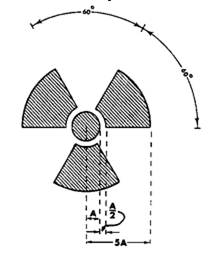
(d) Notwithstanding the requirements of He-P
4022.11, licensees or registrants are authorized to label sources, source holders, or device components
containing sources of radiation that are subjected to high temperatures, with
conspicuously etched or stamped radiation caution symbols and without a color
requirement.
(e) In
addition to the contents of signs and labels prescribed in He-P
4022, the licensee or registrant may provide, on or near the required signs and
labels, any additional information to make individuals aware of potential
radiation exposures and to minimize the exposures.
Source. #5903, eff 2-1-95; ss by #6827, eff 8-6-98;
ss by #8692, INTERIM, eff 7-27-06, EXPIRES: 2-2-07; ss by #8808, eff 1-24-07;
ss by #10805, eff 3-28-15; ss by #14303, eff 7-1-25, EXPIRES: 7-1-35
He-P 4022.12 Posting Requirements.
(a) The licensee or registrant shall post each radiation area with
a conspicuous sign or signs bearing the radiation symbol and the words:
“CAUTION, RADIATION AREA”.
(b) The
licensee or registrant shall post each high radiation area with a conspicuous
sign or signs bearing the radiation symbol and the words:
“CAUTION, HIGH RADIATION AREA”
or
“DANGER, HIGH RADIATION AREA”.
(c) The
licensee or registrant shall post each very high radiation area with a
conspicuous sign or signs bearing the radiation symbol
and words:
“GRAVE DANGER, VERY HIGH RADIATION AREA”.
(d) The
licensee shall post each airborne radioactivity area with a conspicuous sign or
signs bearing the radiation symbol and the words:
“CAUTION, AIRBORNE RADIOACTIVITY AREA”
or
“DANGER, AIRBORNE RADIOACTIVITY AREA”.
(e) The
licensee shall post each area or room in which there is used or stored an
amount of licensed material exceeding 10 times the
quantity of such material specified in He-P 4092 with a conspicuous sign or
signs bearing the radiation symbol and the words:
“CAUTION, RADIOACTIVE MATERIAL(S)”
or
“DANGER, RADIOACTIVE MATERIAL(S)”.
Source. #5903, eff 2-1-95; ss by #6827, eff 8-6-98;
ss by #8692, INTERIM, eff 7-27-06, EXPIRES: 2-2-07; ss by #8808, eff 1-24-07;
ss by #10805, eff 3-28-15; ss by #14303, eff 7-1-25,
EXPIRES: 7-1-35
He-P 4022.13 Exceptions to Posting Requirements.
(a) A
licensee or registrant shall not be required to post caution signs
in areas or rooms containing sources of radiation for periods of less than 8
hours, if each of the following conditions is met:
(1) The
sources of radiation are constantly attended during these periods by an
individual who takes the precautions necessary to prevent the exposure of
individuals to sources of radiation in excess of the limits
established in He-P 4020; and
(2) The area or room is subject to the licensee’s or registrant’s
control.
(b) Rooms
or other areas in hospitals that are occupied by patients shall not be required
to be posted with caution signs pursuant to He-P 4022.12 provided that the
patient could be released from licensee control pursuant to the requirements of
He-P 4035.42.
(c) Rooms
or other areas in hospitals that are occupied by patients shall not be required
to be posted with caution signs, provided that:
(1) A
patient being treated with a permanent implant could be released from
confinement pursuant to He-P 4035.25; or
(2) A
patient being treated with a therapeutic radiopharmaceutical could be released
from confinement pursuant to He-P 4035.25.
(d) A
room or area is not required to be posted with a caution sign because of the
presence of a sealed source provided the radiation level
at 30 centimeters from the surface of the sealed source container or housing
does not exceed 0.05 mSv (0.005 rem) per hour.
(e) A
room or area is not required to be posted with a caution sign
because of the presence of radiation machines used solely for diagnosis in the
healing arts.
(f) Rooms
in hospitals or clinics that are used for teletherapy are exempt from the
requirement to post caution signs under He-P 4022.12 if:
(1) Access to the room is controlled pursuant to
He-P 4035.51; and
(2) Personnel
in attendance take necessary precautions to prevent the inadvertent exposure of
workers, other patients, and members of the public to
radiation in excess of the limits established in this part.
Source. #5903, eff 2-1-95; ss by #6827, eff 8-6-98;
ss by #8488, eff 11-18-05; ss by #8808, eff 1-24-07; ss by #10805, eff 3-28-15;
ss by #14303, eff 7-1-25, EXPIRES: 7-1-35
He-P 4022.14 Labeling Containers and Radiation
Machines.
(a) The
licensee shall ensure that each container of licensed material bears a durable,
clearly visible label bearing the radiation symbol
and the words:
“CAUTION, RADIOACTIVE MATERIAL”
or
“DANGER, RADIOACTIVE MATERIAL”.
(b) The
licensee shall also provide information to permit individuals handling or using
the containers, or working in the vicinity of the containers, to take
precautions to avoid or minimize exposures, such as:
(1) The
radionuclides present;
(2) An estimate of the quantity of radioactivity;
(3) The date for which the activity is estimated;
(4) Radiation levels;
(5) Kinds of materials; and
(6) Mass enrichment.
(c) Each
licensee shall, prior to removal or disposal of empty
uncontaminated containers to unrestricted areas, remove or deface the
radioactive material label or otherwise clearly indicate that the container no
longer contains radioactive materials.
(d) Each
registrant shall ensure that each radiation machine is labeled in a conspicuous
manner which cautions individuals that radiation is produced when it is energized.
Source. #5903, eff 2-1-95; ss by #6827, eff 8-6-98;
ss by #8692, INTERIM, eff 7-27-06, EXPIRES: 2-2-07; ss by #8808, eff 1-24-07;
ss by #10805, eff 3-28-15; ss by #14303, eff 7-1-25, EXPIRES: 7-1-35
He-P 4022.15 Exemptions to Labeling Requirements. A licensee shall not be required to label:
(a) Containers
holding licensed material in quantities less than the quantities listed in
He-P 4092;
(b) Containers holding licensed material in
concentrations less than those specified in He-P 4090, Table 4090.1, Table III;
(c) Containers attended by an individual who
takes the precautions necessary to prevent the exposure of individual in excess
of the limits established by He-P 4020;
(d) Containers when they are in transport and
packaged and labeled in accordance with the regulations of the U.S. Department
of Transportation;
(e) Containers that are accessible only to
individuals authorized to handle or use them, or to work in the vicinity of the
containers, if the contents are identified to these individuals by a readily
available written record to be retained as long as the containers are in use
for the purpose indicated on the record; or
(f) Installed manufacturing or process equipment,
such as piping and tanks.
Source. #5903, eff 2-1-95; ss by #6827, eff 8-6-98;
ss by #8692, INTERIM, eff 7-27-06, EXPIRES: 2-2-07; ss by #8808, eff 1-24-07;
ss by #10805, eff 3-28-15; ss by #13371, eff 4-20-22; ss by #14303, eff 7-1-25,
EXPIRES: 7-1-35
He-P 4022.16 Procedures for Receiving and Opening
Packages.
(a) Each
licensee who expects to receive a package containing quantities of radioactive
material in excess of a Type A quantity, as
defined in 10 CFR 71.4 and Appendix A to 10 CFR 71, shall make arrangements to
receive:
(1) The
package when the carrier offers it for delivery; or
(2) The notification of the arrival of the package at the
carrier’s terminal and to take possession of the package expeditiously.
(b) Each licensee shall:
(1) Monitor
the external surfaces of a package labeled with a Radioactive White I, Yellow
II, or Yellow III label as specified in U.S. Department of Transportation
regulations 49 CFR 172.403 and 172.436-440 for radioactive contamination unless
the package contains only radioactive material in the form of gas or in special
form as defined in He-P 4003;
(2) Monitor
the external surfaces of a package labeled with a Radioactive White I, Yellow
II, or Yellow III label as specified in U. S. Department of Transportation
regulations 49 CFR 172.403 and 172.436-440 for radiation levels unless the package
contains quantities of radioactive material that are less than or equal to the
Type A quantity, as defined in 10 CFR 71.4 and appendix A to 10 CFR 71; and
(3) Monitor all packages known to contain radioactive material for
radioactive contamination and radiation levels if there is evidence of
degradation of package integrity, such as packages that are crushed, wet, or
damaged.
(c) The
licensee shall perform the monitoring required by He-P 4022.16(b) as soon as
practicable after receipt of the package, but not later than 3 hours after the
package is received at the licensee's facility if it is received during the licensee's normal working hours, or not later than 3
hours from the beginning of the next working day if it is received after
working hours.
(d) The
licensee shall immediately notify the final delivery carrier and
DHHS/RHS when:
(1) Removable radioactive surface contamination exceeds the limits of
He-P 4037.04(a); or
(2) External radiation levels exceed the limits of He-P 4037.04(a).
(e) Notification required by He-P 4022.16(d) shall occur by telephone.
(f) Each
licensee shall:
(1) Establish,
maintain, and retain written procedures for safely opening packages in which radioactive material is received; and
(2) Ensure
that the procedures are followed and that due consideration is given to special
instructions for the type of package being opened.
(g) Licensees
transferring special form sources in vehicles owned or operated by the licensee
to and from a work site are exempt from the contamination monitoring requirements
of He-P 4022.16(b), but shall not be exempt from the monitoring
requirement in He-P 4022.16(b) for measuring radiation levels that ensures that
the source is still properly lodged in its shield.
Source. #6827, eff 8-6-98; ss by #8692, INTERIM, eff
7-27-06, EXPIRES: 2-2-07; ss by #8808, eff 1-24-07; ss by #10805, eff 3-28-15;
ss by #14303, eff 7-1-25, EXPIRES: 7-1-35