CHAPTER Ins 300 LIFE INSURANCE
PART Ins 301 LIFE INSURANCE SOLICITATION
Statutory
Authority: RSA 400-A:15,
I
Ins 301.01
Purpose.
(a) The purpose of this
part is to require insurers to deliver to purchasers of life insurance,
information that will improve the buyer's ability to select the most
appropriate plan of life insurance for the buyer’s needs and improve the buyer's
understanding of the basic features of the policy that has been purchased or is
under consideration.
(b) This part does not prohibit the use of additional material that is
not a violation of this part or any other New Hampshire statute or rule.
Source. #5657, eff 7-1-93; ss by #7015, INTERIM, eff
7-1-99, EXPIRED: 10-29-99
New. #7450, eff 2-16-01, EXPIRED: 2-16-09
New. #9651, eff 2-5-10; ss by #12423, eff 2-5-18;
ss by #13691, eff 7-21-23
Ins 301.02 Scope.
(a) Except as hereafter
exempted, this part shall apply to any solicitation, negotiation, or
procurement of life insurance occurring within this
state. This part shall apply to any issuer of life insurance
contracts including fraternal benefit societies.
(b) This part shall not apply to:
(1) Individual and group annuity contracts;
(2) Credit life insurance;
(3)
Group life insurance, except for disclosures relating to preneed funeral
contracts or prearrangements; these disclosure requirements shall extend to the
issuance or delivery of certificates as well as to the master policy; or
(4) Life
insurance policies issued in connection with pension and welfare
plans as defined by and which are subject to the federal Employee Retirement
Income Security Act of 1974 (ERISA), 29 U.S.C. Section 1001 et seq. as
amended.
Source. #1900, eff 1-1-82; ss by #4287, eff 7-1-87;
ss by #5657, eff 7-1-93; ss by #7015, INTERIM, eff 7-1-99, EXPIRED: 10-29-99
New. #7450, eff 2-16-01, EXPIRED: 2-5-10
New. #9651, eff 2-5-10; ss by #12423, eff 2-5-18;
ss by #13691, eff 7-21-23
Ins 301.03 Definitions. For
the purposes of this part, the following definitions shall apply:
(a) “Buyer’s Guide” means
the National Association of Insurance Commissioner’s approved Life Insurance
Buyer’s Guide, available as referenced in Appendix B;
(b) “Current scale of
nonguaranteed elements” means a formula or other mechanism that produces values
for an illustration as if there is no change in the basis of those values
after the time of illustration;
(c) "Generic
name" means a short title which is descriptive of the premium and benefit
patterns of a policy or a rider;
(d) “Nonguaranteed
elements” means the premiums, credited interest rates, including any bonus,
benefits, values, non-interest based
credits, charges, or elements of formulas used to determine any of these, that
are subject to company discretion and are not guaranteed at
issue. An element is considered nonguaranteed if any of the
underlying nonguaranteed elements are used in its
calculation;
(e) “Policy data” means a
display or schedule of numerical values, both guaranteed and nonguaranteed for
each policy year, or a series of designated policy years, of the following
information:
(1) Illustrated annual, other periodic, and terminal
dividend;
(2) Premiums;
(3) Death
benefits;
(4) Cash
surrender values; and
(5) Endowment benefits;
(f) "Policy summary" means a written statement describing the
elements of the policy, including, but not limited to:
(1) A
prominently placed title as follows: “STATEMENT OF POLICY COST
AND BENEFIT INFORMATION”;
(2) The
name and address of the insurance producer or, if no producer is involved, a
statement of the procedure to be followed in order to
receive responses to inquiries regarding the policy summary;
(3) The
full name and home office or administrative office address of the company in
which the life insurance policy is to be or has been written;
(4) The
generic name of the basic policy and each rider;
(5) The
following amounts, where applicable, for the first 5 policy years and
representative policy years thereafter sufficient to
clearly illustrate the premium and benefit patterns, including at least one age
from 60 through 65 and policy maturity:
a. The
annual premium for the basic policy;
b. The
annual premium for each optional rider;
c. The
amount payable upon death at the beginning of the policy year regardless
of the cause of death, other than suicide or other specifically enumerated
exclusions, that is provided by the basic policy and each optional rider, with
benefits provided under the basic policy and each rider shown separately;
d. The
total guaranteed cash surrender values at the end of the year with values shown
separately for the basic policy and each rider; and
e. Any
endowment amounts payable under the policy that are not included under cash
surrender values above;
(6) The
effective policy loan annual percentage interest rate, if the policy contains
this provision, specifying whether this rate is applied in advance or in
arrears. If the policy loan interest rate is adjustable, the policy
summary shall also indicate that the annual percentage rate will be determined
by the company in accordance with the provisions of the policy and the
applicable law; and
(7) The
date on which the policy summary is prepared.
(g) "Preneed funeral
contract or prearrangement" means an agreement by or for an individual
before that individual's death relating to the purchase or provision of
specific funeral or cemetery merchandise or services.
Source. #1900, eff 1-1-82; ss by #4287, eff 7-1-87;
ss by #5657, eff 7-1-93; ss by #7015, INTERIM, eff 7-1-99, EXPIRED: 10-29-99
New. #7450, eff 2-16-01; amd
by #7536, eff 8-1-01; paragraphs (a)-(f) EXPIRED: 2-16-09; paragraph (g)
EXPIRED: 8-1-09
New. #9651, eff 2-5-10; ss by #12423, eff 2-5-18;
ss by #13691, eff 7-21-23
Ins 301.04 Duties
of Insurers.
(a) Requirements applicable generally shall be as follows:
(1) The
insurer shall provide a Buyer’s Guide to all prospective purchasers prior to
accepting the applicant's initial premium or premium deposit. Except, if the policy for which application
is made contains an unconditional refund provision of at least 10 days, the
Buyer’s Guide may be delivered with the policy or prior to delivery of the
policy; and
(2) The
insurer shall provide:
a. A policy summary to prospective purchasers
where the insurer has identified the policy form as one that will not be marketed with an illustration;
b. That the policy summary shall show guarantees only;
c. That the policy summary shall consist of a
separate document with all required information set out in a manner that does
not minimize or render any portion of the summary obscure;
d. That any amounts that remain level for 2 or
more years of the policy may be represented by a single number if it is clearly indicated what amounts are applicable for
each policy year. Amounts in Ins 301.03(f)(5) shall be listed in
total, not on a per thousand or per unit basis; and
e. If more than one insured is covered under one
policy or rider:
1. Death benefits shall
be displayed separately for each insured or for each class of insureds if death
benefits do not differ within the class;
2. Zero amounts shall be displayed as a blank
space; and
3. Delivery of the policy summary shall be
consistent with the time for delivery of the Buyer’s Guide as specified in
(a)(1) above;
(b) Requirements applicable to existing policies:
(1) Upon
request by the policy owner, the insurer shall furnish either policy data or an
in force illustration as
follows:
a. For
policies issued prior to the 2017 effective date of Ins 309, the insurer shall
furnish policy data or, at its option, an in force
illustration meeting the requirements of Ins 309;
b. For
policies issued after the 2017 effective date of Ins 309 that were declared not
to be used with an illustration, the insurer shall furnish policy data, limited
to guaranteed values, if it has chosen not to furnish an in
force illustration meeting the requirements of this rule;
c. If
the policy was issued after the 2017 effective date of Ins 309 and declared to
be used with an illustration, an in force illustration
shall be provided;
d. Unless
otherwise requested, the policy data shall be provided for 20 consecutive years
beginning with the previous policy anniversary. The statement of
policy data shall include nonguaranteed elements according to the current scale,
the amount of outstanding policy loans, and the current policy loan interest
rate. Policy values shown shall be based on the current application
of nonguaranteed elements in effect at
the time of the request. The insurer shall not charge a fee for the
preparation of the statement;
(2) If a life insurance company changes its
method of determining scales of nonguaranteed elements on existing policies, it shall, no later than when the first
payment is made on the new basis, advise each affected
policy owner residing in this state of this change and of its implication on
affected policies. This requirement shall not apply to policies for
which the amount payable upon death under the basic policy as of the date when
advice would otherwise be required does not exceed $5,000; and
(3) If
the insurer makes a material revision in the terms and conditions under which
it will limit its right to change any nonguaranteed factor, it shall, no later
than the first policy anniversary following the revision, advise each affected
policy owner residing in this state.
Source. #1900, eff 1-1-82; amd
by #2141, eff 1-1-83; ss by #4287, eff 7-1-87; ss by #5657, eff 7-1-93; ss by
#7015, INTERIM, eff 7-1-99, EXPIRED: 10-29-99
New. #7450, eff 2-16-01, EXPIRED: 2-16-09
New. #9651, eff 2-5-10; ss by #12423, eff 2-5-18;
ss by #13691, eff 7-21-23
Ins 301.05 Preneed Funeral Contracts or
Prearrangements Funded in Whole or in Part by Life Insurance. The
following information shall be adequately disclosed at the time an
application is made, prior to accepting the applicant's initial premium or
deposit, for a preneed funeral contract or prearrangement that is funded or to
be funded by a life insurance policy:
(a) The fact that a life insurance policy is involved or being used to fund
a prearrangement;
(b) The nature of the relationship among the soliciting producer or
producers, the provider of the funeral or cemetery merchandise or services, the
administrator, and any other person;
(c) The relationship of the
life insurance policy to the funding of the prearrangement, and the nature and
existence of any guarantees relating to the prearrangement;
(d) The impact on the prearrangement:
(1) Of
any changes in the life insurance policy, including but not
limited to changes in the assignment, beneficiary designation, or use of the
proceeds;
(2) Of any penalties
to be incurred by the policyholder as a result of
failure to make premium payments; and
(3) Of
any penalties to be incurred or monies to be received as a
result of cancellation or surrender of the life insurance policy.
(e) A list of the
merchandise and services which are applied or contracted for in the
prearrangement and all relevant information
concerning the price of the funeral services, including an indication that the
purchase price is either guaranteed at the time of purchase or to be determined
at the time of need;
(f) All relevant information concerning what occurs and whether any
entitlements or obligations arise if there is a difference between the proceeds
of the life insurance policy and the amount actually needed
to fund the prearrangement;
(g) Any penalties or
restrictions, including but not limited to geographic restrictions or the
inability of the provider to perform, on the delivery of merchandise, services,
or the prearrangement guarantee;
(h) If so, the fact that a sales commission or other form of compensation
is being paid and the identity of the individuals or entities to whom it is
paid; and
(i) Additional disclosure requirements:
(1) An
insurer issuing a small face amount policy, where over the term of the policy
the cumulative policy premiums paid may exceed the face amount of the policy,
shall clearly and prominently disclose, on or before
policy delivery, the length of time until the cumulative policy premiums paid
may exceed the face amount of the policy;
(2)
The insurer shall clearly and prominently disclose, on or before
policy delivery, available premium payment plans;
(3)
Cumulative premiums shall include premiums paid for riders except,
the face amount shall not include the benefit attributable to the riders;
(4)
Each policy subject to the disclosure requirements of this section shall
contain a provision that allows the policyholder to cancel the policy within 10
days following the delivery of the policy with full premium refund to the
consumer and with no charge or penalty. The free-look period shall be clearly
and prominently disclosed to the consumer; and
(5) If the policy uses graded benefits, they
shall be disclosed to the applicant prior to entry into the contract. The policy shall also provide that graded
death benefits life insurance policies shall pay the policy face value after 2
years of premium payments.
Source. #1900, eff 1-1-82; amd
by #2141, eff 1-1-83; ss by #4287, eff 7-1-87; ss by #5657, eff 7-1-93; ss by
#7015, INTERIM, eff 7-1-99, EXPIRED: 10-29-99
New. #7450, eff 2-16-01, EXPIRED: 2-16-09
New. #9651, eff 2-5-10; ss by #12423, eff 2-5-18;
ss by #13691, eff 7-21-23
Ins 301.06 Solicitation of Life Insurance General Rules.
(a) Each insurer shall
maintain at its home office or principal office a
complete file containing one copy of each document authorized and used by the insurer pursuant to this
part. The file shall contain one copy of each authorized form for a
period of 5 years following the date of its last authorized use unless
otherwise provided by Ins 301. Insurers must also comply with RSA
400-B:4 and Ins 2602.
(b) A producer shall inform
the prospective purchaser, prior to commencing a life insurance sales
presentation, that they are acting as a life insurance producer and inform the
prospective purchaser of the full name of the insurance company which the
producer is representing to the buyer. In
sales situations in which a producer is not involved, the insurer shall
identify its full name.
(c) An insurance producer
shall not use terms such as “financial planner”, “investment advisor”,
“financial consultant”, or “financial counseling” in such a way as to imply
that they are primarily engaged in an advisory business in which compensation
is unrelated to sales, unless that is actually the case and the producer
otherwise complies with RSA 402-J:3 and RSA 405:44-a. This provision
is not intended to:
(1) Preclude persons
who hold some form of formally recognized financial planning or consultant
designation from using this designation even when they are only selling
insurance;
(2) Preclude
persons who are members of a recognized trade or professional association
having such terms as part of its name from citing membership, providing that a
person citing membership, if authorized only to sell insurance products, shall
disclose that fact; or
(3) Permit
persons to charge an additional fee for services that
are customarily associated with the solicitation, negotiation, or servicing of
policies.
(d) Any reference to
nonguaranteed elements shall include a statement that the item is not
guaranteed and is based on the company's current scale
of nonguaranteed elements using the appropriate special term such as
"current dividend" or "current rate" scale. If a
nonguaranteed element would be reduced by the existence of a policy loan, a
statement to that effect shall be included in any reference to nonguaranteed
elements. A presentation or depiction of a policy issued after the
effective date of 2017 Ins 309 that includes nonguaranteed elements over a
period of years shall be governed by Ins 301. Solicitations
pertaining to nonguaranteed elements shall also comply with Ins
2602.05(o).
Source. #1900, eff 1-1-82; amd
by #2141, eff 1-1-83; ss by #4287, eff 7-1-87; ss by #5657, eff 7-1-93; ss by
#7015, INTERIM, eff 7-1-99, EXPIRED: 10-29-99
New. #7450, eff 2-16-01, EXPIRED: 2-16-09
New. #9651, eff 2-5-10; ss by #12423, eff 2-5-18;
ss by #13691, eff 7-21-23
Ins 301.07 Suitability
of Recommendation or Sale. Reasonable inquiry shall be made by
insurers and producers to determine the suitability of
any recommendations or sales, and all replacement of life insurance policies
shall comply with Ins 302.
Source. #1900, eff 1-1-82; amd
by #2141, eff 1-1-83; ss by #4287, eff 7-1-87; ss by #5657, eff 7-1-93; ss by
#7015, INTERIM, eff 7-1-99, EXPIRED: 10-29-99
New. #7450, eff 2-16-01; amd
by renumbering and deleting paragraph (h) and renumbering paragraphs (l) and
(m) as (k) and (l) #7536, eff 8-1-01 (formerly Ins
301.09); paragraphs (a)-(l) EXPIRED: 2-16-09
New. #9651, eff 2-5-10; ss by #12423, eff 2-5-18;
ss by #13691, eff 7-21-23
Ins 301.08 Failure to Comply. Failure of an
insurer to provide or deliver a Buyer’s Guide, an in force
illustration, a policy summary, and policy data as provided in Ins 301.04 shall
constitute an omission which misrepresents the benefits, advantages,
conditions, or terms of an insurance policy and be subject to the penalties contained
in RSA 400-A:15 and RSA 417:10.
Source. #9651, eff 2-5-10; ss by #12423, eff 2-5-18
(from Ins 301.07); 18; ss by #13691, eff 7-21-23
Ins 301.09 Electronic
Sales. Electronic sales of life
insurance as described in RSA 420-Q shall be subject to the identical
disclosure and record keeping requirements as non-electronic sales.
Source. #12423, eff 2-5-18 (from Ins 301.08); ss by
#13691, eff 7-21-23
Ins 301.10 Waiver or
Suspension of Rules.
(a) The commissioner, upon
the commissioner’s own initiative or upon request by an insurer, shall waive
any requirement of this chapter if such waiver does not contradict the objective
or intent of the rule and:
(1) Applying
the rule provision would cause confusion or would be misleading to
consumers;
(2) The rule provision is in whole or in part
inapplicable to the given circumstances;
(3) There
are specific circumstances unique to the situation such that strict compliance
with the rule would be onerous without promoting the objective or intent of the
rule provision; or
(4) Any
other similar extenuating circumstances exist such
that application of an alternative standard or procedure better promotes the
objective or intent of the rule provision.
(b) No requirement prescribed by statute shall be waived unless expressly
authorized by law.
(c) Any person or entity
seeking a waiver shall make a request in writing to the commissioner.
(d) A request for a waiver shall specify the basis for the waiver and
proposed alternative, if any.
(e)
Waivers that are granted shall be in effect for the period
of time requested and approved by the commissioner.
Source. #12423, eff 2-5-18; ss by #13691, eff 7-21-23
PART Ins 302 LIFE INSURANCE AND ANNUITIES REPLACEMENT
Statutory
Authority: RSA 400-A:15, I; RSA
402-J:18; RSA 408:52, II
Ins 302.01 Purpose.
(a)
The purpose of this part is:
(1) To regulate the activities of insurers and
producers with respect to the replacement of existing life insurance and
annuities; and
(2) To protect the interests of life insurance
and annuity purchasers by establishing minimum standards of conduct to be
observed in replacement or financed purchase transactions. It will:
a. Assure that purchasers receive information
with which a decision can be made in their own best interest;
b. Reduce the opportunity for misrepresentation
and incomplete disclosure; and
c. Establish penalties for failure to comply
with requirements of this part.
Source. #7537, eff 8-1-01; ss by #9571, eff 10-21-09;
ss by #12375, eff 10-21-17
Ins 302.02 Scope.
(a)
Unless otherwise specifically included, this part shall not apply to
transactions involving:
(1) Credit life insurance;
(2) Group life insurance or group annuities where
there is no direct solicitation of individuals by an insurance producer. Direct solicitation shall not include any
group meeting held by an insurance producer solely for the purpose of educating
or enrolling individuals or, when initiated by an individual member of the
group, assisting with the selection of investment options offered by a single
insurer in connection with enrolling that individual. Group life insurance or group annuity
certificates marketed through direct response solicitation shall be subject to
the provisions of Ins 302.08;
(3) Group life insurance and annuities used to
fund prearranged funeral contracts;
(4) An application to the existing insurer that
issued the existing policy or contract when a contractual change or a conversion
privilege is being exercised; or, when the existing policy or contract is being
replaced by the same insurer pursuant to a program filed with and approved by
the commissioner; or, when a term conversion privilege is exercised among
corporate affiliates;
(5) Proposed life insurance that is to replace
life insurance under a binding or conditional receipt issued by the same
company;
(6) Policies or contracts used to fund:
a. An employee pension or welfare benefit plan
that is covered by the Employee Retirement and Income Security Act (ERISA);
b. A plan described by Sections 401(a), 401(k)
or 403(b) of the Internal Revenue Code where the plan, for purposes of
ERISA, is established or maintained by an employer;
c. A governmental or church plan defined in
Section 414, a governmental or church welfare benefit plan, or a deferred
compensation plan of a state or local government or tax
exempt organization under Section 457 of the Internal Revenue Code; or
d. A nonqualified
deferred compensation arrangement established or maintained by an employer or
plan sponsor;
(7) Notwithstanding subparagraph (6) above, this
rule shall apply to policies or contracts used to fund any plan or arrangement
that is funded solely by contributions an employee elects to make, whether on a
pre-tax or after-tax basis, and where the insurer has been notified that plan
participants may choose from among 2 or more insurers and there is a direct
solicitation of an individual employee by an insurance producer for the
purchase of a contract or policy. As
used in this subsection, direct solicitation shall not include any group
meeting held by an insurance producer solely for the purpose of educating
individuals about the plan or arrangement or enrolling individuals in the plan
or arrangement or, when initiated by an individual employee, assisting with the
selection of investment options offered by a single insurer in connection with
enrolling that individual employee;
(8) Where new coverage is provided under a life
insurance policy or contract and the cost is borne wholly by the insured’s
employer or by an association of which the insured is a member;
(9) Existing life insurance that is a
non-convertible term life insurance policy that will expire in 5 years or less
and cannot be renewed; or
(10) Structured settlements.
(b)
Registered contracts shall be exempt from the requirements of Ins
302.06(a)(2) and Ins 302.07(a)(1) with respect to the provision of
illustrations or policy summaries; however, premium or contract contribution
amounts and identification of the appropriate prospectus or offering circular
shall be required instead.
Source. #7537, eff 8-1-01; ss by #9571, eff 10-21-09;
ss by #12375, eff 10-21-17
Ins 302.03 Definitions.
(a)
“Direct-response solicitation” means a solicitation through a sponsoring
or endorsing entity or individually solely through mails, telephone, the
Internet, or other mass communication media.
(b)
“Existing insurer” means the insurance company whose policy or contract
is or will be changed or affected in a manner described within the definition
of “replacement”.
(c)
“Existing policy or contract” means an individual life insurance policy
or annuity contract in force, including a policy under a binding or conditional
receipt or a policy or contract that is within an unconditional refund period.
(d)
“Financed purchase” means the purchase of a new policy involving the
actual or intended use of funds obtained by the withdrawal or surrender of, or
by borrowing from values of an existing policy to pay all or part of any
premium due on the new policy. For
purposes of a regulatory review of an individual transaction only, if a
withdrawal, surrender or borrowing involving the policy values of an existing
policy is used to pay premiums on a new policy owned by the same policyholder
and issued by the same company within 4 months before or 13 months after the
effective date of the new policy, it will be deemed prima facie evidence of the
policyholder’s intent to finance the purchase of the new policy with existing
policy values. This prima facie standard
is not intended to increase or decrease the monitoring obligations contained in
Ins 302.05(a)(5).
(e)
“Illustration” means a presentation or depiction that includes
non-guaranteed elements of a policy of life insurance over a period of years as
defined in Ins 309.
(f)
“Policy summary” means:
(1) For policies or contracts other than
universal life policies, means a written statement regarding a policy or
contract which shall contain to the extent applicable, but need not be limited
to, the following information:
a. Current death benefit;
b. Annual contract premium;
c. Current cash surrender value;
d. Current dividend;
e. Application of current dividend; and
f. Amount of outstanding loan;
(2) For universal life policies, means a written
statement that shall contain at least the following information:
a. The beginning and end date of the current
report period;
b. The policy value at the end of the previous
report period and at the end of the current report period;
c. The total amounts that have been credited or
debited to the policy value during the current report period, identifying each
type, such as interest, mortality, expense, and riders;
d. The current death benefit at the end of the
current report period on each life covered by the policy;
e. The net cash surrender value of the policy as
of the end of the current report period; and
f. The amount of
outstanding loans, if any, as of the end of the current report period.
(g)
“Producer” shall be defined to include agents, brokers, and producers.
(h)
“Replacing insurer” means the insurance company that issues or proposes
to issue a new policy or contract that replaces an existing policy or contract
or is a financed purchase.
(i) “Registered contract” means a variable
annuity contract or variable life insurance policy subject to the prospectus
delivery requirements of the Securities Act of 1933.
(j)
“Replacement” means a transaction in which a new policy or contract is
to be purchased, and it is known or should be known to the proposed producer,
or to the proposing insurer if there is no producer, that by reason of the
transaction, an existing policy or contract has been or is to be:
(1) Lapsed, forfeited, surrendered, or partially
surrendered, assigned to the replacing insurer or otherwise terminated;
(2) Converted to reduced paid-up insurance,
continued as extended term insurance, or otherwise reduced in value by the use of nonforfeiture benefits or other policy values;
(3) Amended so as to
effect either a reduction in benefits or in the term for which coverage would
otherwise remain in force or for which benefits would be paid;
(4) Reissued with any reduction in cash value; or
(5) Used in a financed purchase.
(k)
“Sales material” means a sales illustration and any other written,
printed, or electronically presented information created, or completed or
provided by the company or producer and used in the presentation to the policy
or contract owner related to the policy or contract purchased.
Source. #7537, eff 8-1-01; ss by #9571, eff 10-21-09;
ss by #12375, eff 10-21-17
Ins 302.04 Duties of Producers.
(a)
A producer who initiates an application shall submit to the insurer,
with or as part of the application, a statement signed by both the applicant
and the producer as to whether the applicant has existing policies or
contracts. If the answer is “no,” the
producer’s duties with respect to replacement are complete.
(b)
If the applicant answered “yes” to the question regarding existing
coverage referred to in (a) above, the producer shall present and read to the
applicant not later than at the time of taking the application, a notice
regarding replacements in the form as described in Appendix A or other
substantially similar form approved by the commissioner. However, no approval shall be required when
amendments to the notice are limited to the omission of references not
applicable to the product being sold or replaced. The notice shall be signed by both the
applicant and the producer attesting that the notice has been read aloud by the
producer or that the applicant did not wish the notice to be read aloud (in
which case the producer need not have read the notice aloud) and left with the
applicant.
(c)
The notice shall list all life insurance policies or annuities proposed
to be replaced, properly identified by name of insured, the insurer or
annuitant, and policy or contract number if available; and shall include a
statement as to whether each policy or contract will be replaced or whether a
policy will be used as a source of financing for the new policy or
contract. If a policy or contract number
has not been issued by the existing insurer, alternative identification, such
as an application or receipt number, shall be listed.
(d)
In connection with a replacement transaction the producer shall leave
with the applicant at the time an application for a new policy or contract is
completed the original or a copy of all sales material. With respect to electronically presented
sales material, it shall be provided to the policy or contract owner in printed
form no later than at the time of policy or contract delivery.
(e)
Except as provided in Ins 302.06(c), in connection with a replacement
transaction, the producer shall submit to the insurer, to which an application
for a policy or contract is presented, a copy of each document required by this
section, a statement identifying any preprinted or electronically presented
company approved sales materials used, and copies of any individualized sales
materials, including any illustrations related to the specific policy or
contract purchased.
Source. #7537, eff 8-1-01; ss by #9571, eff 10-21-09;
ss by #12375, eff 10-21-17
Ins 302.05 Duties of Insurers that Use Producers.
(a)
Each insurer shall maintain a system of supervision and control to insure compliance with the requirements of this rule that
shall include at least the following:
(1) Inform its producers of the requirements of
this rule and incorporate the requirements of this rule into all relevant
producer training manuals prepared by the insurer;
(2) Provide to each producer
a written statement of the company’s position with respect to the acceptability
of replacements providing guidance to its producer as to the appropriateness of
these transactions;
(3) A system to review the appropriateness of
each replacement transaction that the producer does not indicate is in accord
with paragraph (2) above;
(4) Procedures to confirm that the requirements
of this rule have been met; and
(5) Procedures to detect transactions that are
replacements of existing policies or contracts by the existing insurer, but
that have not been reported as such by the applicant or producer. Compliance with this rule may include, but
shall not be limited to, systematic customer surveys, interviews, confirmation
letters, or programs of internal monitoring.
(b)
Each insurer shall have the capacity to monitor
each producer’s life insurance policy and annuity contract replacements for
that insurer, and shall produce, upon request, and make such records available
to the department. The capacity to
monitor shall include the ability to produce records for each producer’s:
(1) Life replacements, including financed
purchases, as a percentage of the producer’s total annual sales for life
insurance;
(2) Number of lapses of policies by the producer
as a percentage of the producer’s total annual sales for life insurance;
(3) Annuity contract replacements as a percentage
of the producer’s total annual annuity contract sales;
(4) Number of transactions that are unreported
replacements of existing policies or contracts by the existing insurer detected
by the company’s monitoring system as required by (a)(5) above; and
(5) Replacements, indexed by replacing producer
and existing insurer.
(c)
Each insurer shall require with or as a part of each application for
life insurance or an annuity a signed statement by both the applicant and the
producer as to whether the applicant has existing policies or contracts.
(d)
Each insurer shall require with each application for life insurance or
an annuity that indicates an existing policy or contract a completed notice
regarding replacements as contained in Appendix A.
(e) When the applicant has existing policies or
contracts, each insurer shall be able to produce copies of any sales material
required by Ins 302.04(e), the basic illustration and any supplemental
illustrations related to the specific policy or contract that is purchased, and
the producer’s and applicant’s signed statements with respect to financing and
replacement for at least 5 years after the termination or expiration of the
proposed policy or contract.
(f)
Each insurer shall ascertain that the sales material and illustrations
required by Ins 302.04(e) of this rule meet the requirements of this rule and
are complete and accurate for the proposed policy or contract.
(g)
If an application does not meet the requirements of this rule, notify
the producer and applicant and fulfill the outstanding requirements.
(h)
Each insurer shall maintain records in paper, photograph, microprocess,
magnetic, mechanical, or electronic media or by any process that accurately
reproduces the actual document.
Source. #7537, eff 8-1-01; ss by #9571, eff 10-21-09;
ss by #12375, eff 10-21-17
Ins 302.06 Duties of Replacing Insurers that Use
Producers.
(a)
Where a replacement is involved in the transaction, the replacing
insurer shall:
(1) Verify that the required forms are received
and are in compliance with this rule;
(2) Notify any other existing insurer that may be
affected by the proposed replacement within 5 business days of receipt of a
completed application indicating replacement or when the replacement is
identified, if not indicated on the application, and mail a copy of the
available illustration or policy summary for the proposed policy or available
disclosure document for the proposed contract within 5 business days of a
request from an existing insurer;
(3) Be able to produce copies of the notification
regarding replacement required in Ins 302.04(b), indexed by producer, for at
least 5 years or until the next regular examination by the insurance department
of a company’s state of domicile, whichever is later; and
(4) Provide to the policy or contract owner
notice of the right to return the policy or contract within 30 days of the
delivery of the contract and receive an unconditional full refund of all
premiums or considerations paid on it, including any policy fees or charges or,
in the case of a variable or market value adjustment policy or contract, a
payment of the cash surrender value provided under the policy or contract plus
the fees and other charges deducted from the gross premiums or considerations
imposed under such policy or contract; such notice may be included in Appendix
A or C.
(b)
In transactions where the replacing insurer and the existing insurer are
the same or subsidiaries or affiliates under common ownership or control,
allow credit for the period of time that has elapsed
under the replaced policy’s or contract’s
incontestability and suicide period up to the face amount of the existing
policy or contract. With
regard to financed purchases, the credit may be limited to the
amount the face amount of the existing policy is reduced by
the use of existing policy values to fund the new policy or contract.
(c)
If an insurer prohibits the use of sales material other than that
approved by the company, as an alternative to the requirements made of an
insurer pursuant to Ins 302.04(e), the insurer may:
(1) Require with each application a statement
signed by the producer that:
a. Represents that the producer used only
company-approved sales material; and
b. States that copies of all sales material were
left with the applicant in accordance with Ins 302.04(d);
(2) Within 10 days of the issuance of the policy
or contract:
a. Notify the applicant by sending a letter or
by verbal communication with the applicant by a person whose duties are
separate from the marketing area of the insurer, that the producer has
represented that copies of all sales material have been left with the applicant
in accordance with Ins 302.04(d);
b. Provide the applicant with a toll free number to contact company personnel involved in
the compliance function if such is not the case; and
c. Stress the importance of retaining copies of
the sales material for future reference; and
(3) Be able to produce a copy of the letter or
other verification in the policy file for at least 5 years after the
termination or expiration of the policy or contract.
Source. #7537, eff 8-1-01; ss by #9571, eff 10-21-09;
ss by #12375, eff 10-21-17
Ins 302.07 Duties of the Existing Insurer.
(a)
Where a replacement is involved in the transaction, the existing insurer
shall:
(1) Retain and be able to produce all replacement
notifications received, indexed by replacing insurer, for at least 5 years or
until the conclusion of the next regular examination conducted by the insurance
department of its state of domicile, whichever is later;
(2) Send a letter to the policy or contract owner
of the right to receive information regarding the existing policy or contract
values including, if available, an in force
illustration or policy summary if an in force
illustration cannot be produced within 5 business days of receipt of a notice
that an existing policy or contract is being replaced. The information shall be provided within 5
business days of receipt of the request from the policy or contract owner; and
(3) Upon receipt of a request to borrow,
surrender or withdraw any policy values, send a notice, advising the policy
owner that the release of policy values may affect the guaranteed elements,
non-guaranteed elements, face amount or surrender value of the policy from
which the values are released. The
notice shall be sent separate from the check if the check is sent to anyone
other than the policy owner. In the case
of consecutive automatic premium loans, the insurer is only required to send
the notice at the time of the first loan.
Source. #7537, eff 8-1-01; ss by #9571, eff 10-21-09;
ss by #12375, eff 10-21-17
Ins 302.08 Duties of Insurers with Respect to Direct
Response Solicitations.
(a)
In the case of an application that is initiated as a result of a direct
response solicitation, the insurer shall require, with or as part of each
completed application for a policy or contract, a statement asking whether the
applicant, by applying for the proposed policy or contract, intends to replace,
discontinue or change an existing policy or contract. If the applicant indicates a replacement or
change is not intended or if the applicant fails to respond to the statement,
the insurer shall send the applicant, with the policy or contract, a notice
regarding replacement in Appendix B, or other substantially similar form
approved by the commissioner.
(b)
If the insurer has proposed the replacement or if the applicant
indicates a replacement is intended and the insurer continues with the replacement,
the insurer shall:
(1) Provide to applicants or prospective
applicants with the policy or contract a notice, as described in Appendix C, or
other substantially similar form approved by the commissioner. In these instances the insurer may delete the
references to the producer, including the producer’s signature, and references
not applicable to the product being sold or replaced, without having to obtain
approval of the form from the commissioner.
The insurer’s obligation to obtain the applicant’s signature shall be
satisfied if it can demonstrate that it has made a diligent effort to secure a
signed copy of the notice referred to in this paragraph. The requirement to make a diligent effort
shall be deemed satisfied if the insurer includes in the mailing a
self-addressed postage prepaid envelope with instructions for the return of the
signed notice referred to in this section; and
(2) Comply with the requirements of Ins
302.06(a)(2), if the applicant furnishes the names of the existing insurers, and
the requirements of Ins 302.06(a)(3), Ins 302.06(a)(4), and Ins 302.06(b).
Source. #7537, eff 8-1-01; ss by #9571, eff 10-21-09;
ss by #12375, eff 10-21-17
Ins 302.09 Violations and Penalties.
(a)
Any failure to comply with this rule shall be considered a violation of
RSA 417:4. Examples of violations
include:
(1) Any deceptive or misleading information set
forth in sales material;
(2) Failing to ask the applicant in completing
the application the pertinent questions regarding the possibility of financing
or replacement;
(3) The intentional incorrect recording of an
answer;
(4) Advising an applicant to respond negatively
to any questions regarding replacement in order to
prevent notice to the existing insurer; or
(5) Advising a policy or contract owner to write
directly to the company in such a way as to attempt to obscure the identity of
the replacing producer or company.
(b)
Policy and contract owners have the right to replace existing life
insurance policies or annuity contracts after indicating in or as a part of
applications for new coverage that replacement is not their intention; however,
patterns of such action by policy or contract owners of the same producer shall
be deemed prima facie evidence of the producer’s knowledge that replacement was
intended in connection with the identified transactions, and these patterns of
action shall be deemed prima facie evidence of the producer’s intent to violate
this rule.
(c)
Where it is determined that the requirements of this rule have not been
met, the replacing insurer shall provide to the policy owner an in force illustration, if available, or policy summary for
the replacement policy or available disclosure document for the replacement
contract and the appropriate notice regarding replacements in Appendix A or C.
(d)
Any violations of these rules shall be subject to the penalties imposed
by RSA 402-J:12 and RSA 417:10 or subject to such suspension or revocation of
certificate of authority or license, or administrative fine not to exceed
$2,500 per violation, as may be applicable under Title XXXVII.
Source. #7537, eff 8-1-01; ss by #9571, eff 10-21-09;
ss by #12375, eff 10-21-17
Ins 302.10 Waiver or Suspension of Rules.
(a)
The commissioner, upon the commissioner’s own initiative or upon request
by an insurer, shall waive any requirement of Ins 302 if such waiver does not
contradict the objective or intent of the rule and:
(1) Applying the rule provision would cause
confusion or would be misleading to consumers;
(2) The rule provision is in whole or in part
inapplicable to the given circumstances;
(3) There are specific circumstances unique to
the situation such that strict compliance with the
rule would be onerous without promoting the objective or intent of the rule
provision; or
(4) Any other similar extenuating circumstances exist such that application of an alternative
standard or procedure better promotes the objective or intent of the rule
provision.
(b)
No requirement prescribed by statute shall be waived unless expressly
authorized by law.
(c)
Any person or entity seeking a waiver shall make a request in writing.
(d)
A request for a waiver shall specify the basis for the waiver and
proposed alternative, if any.
Source. #12375, eff 10-21-17
APPENDIX A
IMPORTANT NOTICE:
REPLACEMENT OF LIFE INSURANCE OR ANNUITIES
This document must
be signed by the applicant and the producer, if there is one,
and a copy left
with the applicant.
You are
contemplating the purchase of a life insurance policy or annuity contract. In some cases this purchase may involve
discontinuing or changing an existing policy or contract. If so, a replacement is occurring. Financed
purchases are also considered replacements.
A replacement
occurs when a new policy or contract is purchased and, in connection with the
sale, you discontinue making premium payments on the existing policy or
contract, or an existing policy or contract is surrendered, forfeited, assigned
to the replacing insurer, or otherwise terminated or used in a financed purchase.
A financed
purchase occurs when the purchase of a new life insurance policy involves the
use of funds obtained by the withdrawal or surrender of or by borrowing some or
all of the policy values, including accumulated
dividends, of an existing policy to pay all or part of any premium or payment
due on the new policy. A financed
purchase is a replacement.
You should
carefully consider whether a replacement is in your best interests. You will pay acquisition costs and there may
be surrender costs deducted from your policy or contract. You may be able to make changes to your
existing policy or contract to meet your insurance needs at less cost. A financed purchase will reduce the value of
your existing policy and may reduce the amount paid upon the death of the
insured.
We want you to
understand the effects of replacements before you make your purchase decision
and ask that you answer the following questions and consider the questions on
the back of this form.
1. Are you considering discontinuing making
premium payments, surrendering, forfeiting, assigning to the insurer, or
otherwise terminating your existing policy or contract? ___YES ___NO
2. Are you considering using funds from your
existing policies or contracts to pay premiums due on
the new policy or contract? ___YES ___NO
If you answered
“yes” to either of the above questions, list each existing policy or contract
you are contemplating replacing (include the name of the insurer, the insured
or annuitant, and the policy or contract number if available) and whether each
policy or contract will be replaced or used as a source of financing:
INSURER NAME CONTRACT OR INSURED OR REPLACED
(R) OR
POLICY # ANNUITANT FINANCING (F)
1.
2.
3.
Make sure you know
the facts. Contact your existing company
or its agent for information about the old policy or contract. If you request one,
an in force illustration, policy summary or available
disclosure documents must be sent to you by the existing insurer. Ask for and retain all sales material used by
the agent in the sales presentation. Be
sure that you are making an informed decision.
The existing
policy or contract is being replaced because
_____________________________________
I certify that the
responses herein are, to the best of my knowledge, accurate:
_________________________________________ ______________________
Applicant’s
Signature and Printed Name Date
_________________________________________ ______________________
Producer’s
Signature and Printed Name Date
I do not want this
notice read aloud to me.____ (Applicants must initial only if they do not want
the notice read aloud.)
A replacement may
not be in your best interest, or your decision could be a good one. You should make a careful comparison of the
costs and benefits of your existing policy or contract and the proposed policy
or contract. One way to do this is to
ask the company or agent that sold you your existing policy or contract to
provide you with information concerning your existing policy or contract. This may include an illustration of how your
existing policy or contract is working now and how it would perform in the
future based on certain assumptions.
Illustrations should not, however, be used as a sole basis to compare
policies or contracts. You should
discuss the following with your agent to determine whether replacement or
financing your purchase makes sense:
PREMIUMS: Are
they affordable?
Could they change?
You’re older – are
premiums higher for the proposed new policy?
How long will you have
to pay premiums on the new policy? On
the old policy?
POLICY VALUES: New policies usually take longer to build
cash values and to pay dividends.
Acquisition
costs for the old policy may have been paid, you will
incur costs for the new one.
What surrender
charges do the policies have?
What expense
and sales charges will you pay on the new policy?
Does the new
policy provide more insurance coverage?
INSURABILITY: If your health has changed since you
bought your old policy, the new one could cost you more, or you could be turned
down.
You may need a
medical exam for a new policy.
Claims on most
new policies for up to the first two years can be denied based
on inaccurate
statements.
Suicide
limitations may begin anew on the new coverage.
IF YOU ARE KEEPING
THE OLD POLICY AS WELL AS THE NEW POLICY:
How are premiums for
both policies being paid?
How will the premiums
on your existing policy be affected?
Will a loan be
deducted from death benefits?
What values from the
old policy are being used to pay premiums?
IF YOU ARE
SURRENDERING AN ANNUITY OR INTEREST SENSITIVE LIFE PRODUCT:
Will you pay surrender
charges on your old contract?
What are the interest
rate guarantees for the new contract?
Have you compared the
contract charges or other policy expenses?
OTHER ISSUES TO
CONSIDER FOR ALL TRANSACTIONS:
What are the tax
consequences of buying the new policy?
Is this a tax free exchange?
(See your tax advisor.)
Is there a benefit
from favorable “grandfathered” treatment of the old policy under the federal
tax code?
Will the existing
insurer be willing to modify the old policy?
How does the
quality and financial stability of the new company compare with your existing
company?
APPENDIX B
NOTICE REGARDING REPLACEMENT
REPLACING YOUR LIFE INSURANCE POLICY OR ANNUITY?
Are you thinking
about buying a new life insurance policy or annuity and discontinuing or
changing an existing one? If you are,
your decision could be a good one – or a mistake. You will not know for sure unless you make a
careful comparison of your existing benefits and the proposed policy or
contract’s benefits.
Make sure you
understand the facts. You should ask the
company or agent that sold you your existing policy or contract to give you
information about it.
Hear both sides
before you decide. This way you can be
sure you are making a decision that is in your best interest.
APPENDIX C
IMPORTANT NOTICE:
REPLACEMENT OF LIFE INSURANCE OR ANNUITIES
You are
contemplating the purchase of a life insurance policy or annuity contract. In some cases this purchase may involve
discontinuing or changing an existing policy or contract. If so, a replacement is occurring. Financed
purchases are also considered replacements.
A replacement
occurs when a new policy or contract is purchased and, in connection with the
sale, you discontinue making premium payments on the existing policy or
contract, or an existing policy or contract is surrendered, forfeited, assigned
to the replacing insurer, or otherwise terminated or used in a financed
purchase.
A financed
purchase occurs when the purchase of a new life insurance policy involves the
use of funds obtained by the withdrawal or surrender of or by borrowing some or
all of the policy values, including accumulated
dividends, of an existing policy to pay all or part of any premium or payment
due on the new policy. A financed
purchase is a replacement.
You should
carefully consider whether a replacement is in your best interests. You will pay acquisition costs and there may
be surrender costs deducted from your policy or contract. You may be able to make changes to your
existing policy or contract to meet your insurance needs at less cost. A financed purchase will reduce the value of
your existing policy and may reduce the amount paid upon the death of the
insured.
We want you to
understand the effects of replacements before you make your purchase decision
and ask that you answer the following questions and consider the questions on
the back of this form.
1. Are you considering discontinuing making
premium payments, surrendering, forfeiting, assigning to the insurer, or
otherwise terminating your existing policy or contract? ___YES ___NO
2. Are you considering using funds from your existing
policies or contracts to pay premiums due on the new
policy or contract? ___YES ___NO
If you answered
“yes” to either of the above questions, list each existing policy or contract
you are contemplating replacing (include the name of the insurer, the insured
or annuitant, and the policy or contract number if available) and whether each
policy or contract will be replaced or used as a source of financing:
INSURER NAME CONTRACT OR INSURED OR REPLACED
(R) OR
POLICY # ANNUITANT FINANCING (F)
1.
2.
3.
Make sure you know
the facts. Contact your existing company
or its agent for information about the old policy or contract. If you request one,
an in force illustration, policy summary or available
disclosure documents must be sent to you by the existing insurer. Ask for and retain all sales material used by
the agent in the sales presentation. Be
sure that you are making an informed decision.
I certify that the
responses herein are, to the best of my knowledge, accurate:
_________________________________________ ______________________
Applicant’s
Signature and Printed Name Date
A replacement may
not be in your best interest, or your decision could be a good one. You should make a careful comparison of the
costs and benefits of your existing policy or contract and the proposed policy
or contract. One way to do this is to
ask the company or agent that sold you your existing policy or contract to
provide you with information concerning your existing policy or contract. This may include an illustration of how your
existing policy or contract is working now and how it would perform in the
future based on certain assumptions.
Illustrations should not, however, be used as a sole basis to compare
policies or contracts. You should
discuss the following with your agent to determine whether replacement or
financing your purchase makes sense:
PREMIUMS: Are
they affordable?
Could they change?
You’re older – are
premiums higher for the proposed new policy?
How long will you have
to pay premiums on the new policy? On
the old policy?
POLICY VALUES: New policies usually take longer to build
cash values and to pay dividends.
Acquisition
costs for the old policy may have been paid, you will
incur costs for the new one.
What surrender
charges do the policies have?
What expense
and sales charges will you pay on the new policy?
Does the new
policy provide more insurance coverage?
INSURABILITY: If your health has changed since you
bought your old policy, the new one could cost you more, or you could be turned
down.
You may need a
medical exam for a new policy.
Claims on most
new policies for up to the first two years can be denied based on inaccurate
statements.
Suicide
limitations may begin anew on the new coverage.
IF YOU ARE KEEPING
THE OLD POLICY AS WELL AS THE NEW POLICY:
How are premiums for
both policies being paid?
How will the premiums
on your existing policy be affected?
Will a loan be
deducted from death benefits?
What values from the
old policy are being used to pay premiums?
IF YOU ARE
SURRENDERING AN ANNUITY OR INTEREST SENSITIVE LIFE PRODUCT:
Will you pay surrender
charges on your old contract?
What are the interest
rate guarantees for the new contract?
Have you compared the
contract charges or other policy expenses?
OTHER ISSUES TO
CONSIDER FOR ALL TRANSACTIONS:
What are the tax
consequences of buying the new policy?
Is this a tax free exchange?
(See your tax advisor.)
Is there a benefit
from favorable “grandfathered” treatment of the old policy under the federal
tax code?
Will the existing
insurer be willing to modify the old policy?
How does the quality
and financial stability of the new company compare with your existing company?
PART Ins 303 DEPOSIT TERM LIFE INSURANCE
Ins 303.01 Purpose. The purpose of this part is to require
insurance companies and agents to disclose certain information to purchasers of
deposit term life insurance products prior to the consummation of the sale in order to guarantee that deposit term life insurance
products are properly sold by the agent and fully explained to the buyer.
Source. #7450, eff 2-16-01
Ins 303.02 Scope.
(a)
This part shall apply to all policies or plans of life insurance defined
in Ins 303.03(a) as deposit term life insurance.
(b)
This part does not prohibit the use of additional material which is not
in violation of this part or any other statute or part.
Source. #1900, eff 1-1-82; ss by #4287, eff 7-1-87;
ss by #5657, eff 7-1-93; ss by #7015, INTERIM, eff 7-1-99, EXPIRED: 10-29-99
New. #7450, eff 2-16-01
Ins 303.03 Definitions.
(a)
"Commissioner" means the insurance commissioner of the state
of New Hampshire.
(b)
"Deposit term life insurance" means those policies or plans
which provide that an additional first year premium shall be paid in order that
certain values and options will be available at the end of the initial term
period or upon a specific policy anniversary and which additional first year
premium is typically forfeited, in whole or in part, if the policy terminates
for any reason in its early years other than for death of the insured deposit
term life insurance includes term insurance, modified premium term insurance
and modified premium whole life insurance.
(c)
"Policy" means the entire contract between the insured and the
insurer.
Source. #1900, eff 1-1-82; ss by #4287, eff 7-1-87;
ss by #5657, eff 7-1-93; ss by #7015, INTERIM, eff 7-1-99, EXPIRED: 10-29-99
New. #7450, eff 2-16-01
Ins 303.04 Advertising and Solicitation Requirements.
(a)
No insurer, agent, broker or any such person shall make any statement in
any form in any sales presentation or advertisement for a deposit term life
insurance policy which:
(1) Indicates or implies that the additional
first year premium is or resembles a form of interest-bearing savings or
investment;
(2) Indicates or implies that the pure endowment
benefit of any such policy is or resembles a return of the additional first
year premium together with an accumulation of interest;
(3) Describes the additional first year premium
as a deposit; or
(4) Depicts a deposit term policy as a low cost policy or as a policy that will enable the
purchaser to save money unless actual premiums or cost indexes are shown or
presented in conjunction with that statement.
(b)
Any written material presented in conjunction with a sales presentation
or proposal coupling a deposit term life insurance policy with any form of side
investment, including but not limited to deferred annuity contract, retirement
deposit fund rider, and mutual funds, and which shows figures illustrating the
premiums payable, the cash values and the death benefits shall show the figures
for the deposit term life
insurance policy
and the side investment in separate and distinct columns. Where the above figures are shown in separate
and distinct columns, it shall be permissible to include columns combining
these figures.
Source. #1900, eff 1-1-82; ss by #4287, eff 7-1-87;
ss by #5657, eff 7-1-93; ss by #7015, INTERIM, eff 7-1-99, EXPIRED: 10-29-99
New. #7450, eff 2-16-01
Ins 303.05 Disclosure Requirements.
(a)
Prior to taking an application for a deposit term life insurance policy,
the insurer, agent, broker or any other such person shall present to the
applicant a completed Disclosure Statement for Policy with an Additional First
Year Premium, the substance and format of which shall be substantially the same
as that shown in Table 303-1. One copy
of this statement, signed by the agent, shall be left with the applicant for
the applicant’s records. Another copy of
this statement shall be signed by the applicant as an acknowledgement of
receipt and submitted with the application to the insurer.
(b)
The Disclosure Statement for Policy with an Additional First Year
Premium shown in Table 303-1 shall be used with the modified premium whole life
type of deposit term policy on the market at the time this part became
effective. It shall be appropriately
altered to adapt it to other types of deposit term policies.
(c)
Any such adaptation shall:
(1) Comply with the intent and spirit of this
part; and
(2) Include a full disclosure of the following
items:
a. With respect to the additional first year
premium, its amount, forfeiture details, guaranteed values and ultimate
disposition;
b. Face amount and premium information for at
least the first 20 years;
c. Representative cash value information for the
first 20 years; and
d. A complete description of each option
existing under the policy at the maturity date of the pure endowment,
typically, the end of the 10th policy year, to include a designation of the
automatic option, if any.
Source. #1900, eff 1-1-82; ss by #4287, eff 7-1-87;
ss by #5657, eff 7-1-93; ss by #7015, INTERIM, eff 7-1-99, EXPIRED: 10-29-99
New. #7450, eff 2-16-01
Ins 303.06 Penalty.
(a)
Failure of an insurer or agent to comply with any of the requirements
contained in Ins 303.04 or Ins 303.05 of this part shall be a violation of the
part, subject to the penalties provided in RSA 400-A:15, subject to the
requirements therein, in addition to any other penalties provided by the laws
of this state.
(b)
After appropriate notice and hearing, an administrative fine of $2,500
shall be levied for each finding of violation of RSA 400-A:15, III if the
penalty of suspension or revocation as specified below is not appropriate.
(c)
The insurer or agent may request at hearing a
reduced fine or no fine imposed under (b) above
through successful demonstration that:
(1) There is no or minimal damage or costs to
consumers, the State or other insurance entities as a result
of the violation; and
(2) The insurer or agent has not committed
multiple or repeated violations.
(d)
Insurers and agents shall be subject to suspension pursuant to RSA
400-A:15,III if one of the following occurs:
(1) The violation is continuing; or
(2) There is a high probability the violation
will be repeated, based on findings of record; and
(3) Imposition of a penalty other than
suspension, such as a fine, will not be a sufficient deterrent.
(e)
Insurers and agents shall be subject to revocation pursuant to RSA
400-A:15, III if:
(1) The violative act or omission was intentional
or committed in bad faith; or
(2) There was significant damage or cost to
consumers, the State or other insurance entities as a result
of the violation.
(f)
Repeated or multiple violations of this part shall constitute separate
violations subject to penalty.
Table 303-1 Disclosure Statement for Policy with an
Additional First
Year Premium
You are invited to
determine if your needs for a life insurance program can be adequately served
by the (insert policy description) life policy being proposed. Note that this policy is designed to provide
individuals with an incentive to maintain the policy in force for at least 10
full years. Conversely, it may be said
that the policy design includes disincentives or penalties for individuals who
lapse the policy prior to the 10 anniversary.
The premium
payable in the first year is $ ,
and the premium payable in years two through ten is $ .
The difference
between these amounts, $ ,
is the additional first year premium.
The cash values
payable at the end of policy years one through ten under this policy are:
Policy Year Cash Value
1 $
_________________
2 $
_________________
3 $
_________________
4 $
_________________
5 $
_________________
6 $
_________________
7 $
_________________
8 $
_________________
9 $
_________________
10 $
_________________
If you choose to
terminate this policy, only the cash value, less any policy loans, will be paid
to you.
*Optional Benefits
Included:
Premium Years Payable
Waiver of Premium $
_________ __________
Accidental Death
Indemnity $ _________ __________
$
_________ __________
$
_________ __________
$
_________ __________
Policy options at the end of the 10th
policy year are:
(a) Continue in 11th year as whole life policy
(b) Renew MPWL for second ten years
(c) Convert to decreasing term to 100
If the person
insured or policyowner does not elect an option, the terms of the policy
designate option no. ______ above as the automatic option.
The following is a
brief outline of each option listed above:
Option 1. Continue as whole life insurance $ __________
face amount.
Premiums 11th year and thereafter $
__________
Cash values
10th year $
_________
15th year $
_________
20th year $
_________
Age 65 $ _________
Interest adjusted surrender cost
______%
10 years _____ 20 years _____
Disposition of pure endowment
_____
Or tenth year cash value
__________
Option 2. ** Renew MPWL for another 10 year $ __________
period for face
amount.
* Premiums per year 11th through 20th
year $
_________
** Additional first year
premium 11th year $ _________
only
Ten year
total premiums $ _________
Guaranteed cash value after 10
years $ _________
Interest adjusted surrender cost _________%
10 years ________ 20 years _________
Disposition of pure endowment
or tenth
year cash value: $ _________
*Includes rider
benefits
**Death benefit is
increased by additional first year premium
Option 3. Convert to decreasing term to age $
_________
100 for face
amount.
* Level premiums $
_________
Additional 11th year premium $
_________
Interest adjusted surrender cost %
10 years _________ 20 years _________
Disposition of pure endowment or tenth
year cash value: $ _________
You will have ten
days from the day the (insert policy description) life policy is delivered to
you to return it for cancellation.
Should you elect to cancel, all premiums paid by you will be returned.
 Insurance Company
(Insert Name)
 Address:

Telephone No.

Agent's
Signature
I acknowledge that
I received a copy of this disclosure statement for policy with an additional
first year premium on the date indicated below.

Applicant's Signature
Date
Source. #1900, eff 1-1-82; ss by #4287, eff 7-1-87;
ss by #5657, eff 7-1-93; ss by #7015, INTERIM, eff 7-1-99, EXPIRED: 10-29-99
New. #7450, eff 2-16-01
PART Ins 304 FINANCING OF LIFE INSURANCE PREMIUMS
Statutory
Authority RSA 400-A:15, I and RSA 415-B:12
Ins 304.01 Premium Financing Requirements.
(a)
If a note is taken to finance less than the full first year premium, the
balance shall be paid by the applicant at the time the application is taken.
(b)
If a note is taken to finance all or part of the first year's premium,
said note may be sold or otherwise negotiated or transferred by the payee with
recourse only.
(c)
One who becomes a payee of the note, whether that is the premium finance
company, or any affiliate thereof, note purchaser, or any assignee of the note,
shall notify the notemaker, the insured, and all
co-makers of the note about the purchase or transfer of the note. In providing such notification, the life
insurance policy, which is used as collateral for the note, shall be identified
by policy number, named insured, and life insurance company.
(d)
The giving of a promissory note in connection with the first premium
shall be set out in the application over the applicant's signature, showing the
amount of the note, the true annual rate of interest, and the amount of any
downpayment made to the agent at the time of sale and, if applicable, the fact
that the note becomes due and payable in full upon any default in premium
payment.
(e)
Any note may contain an acceleration clause to become operable not less
than 31 days after default in the payment of any renewal premium. The obligation evidenced by a promissory note
may be satisfied in advance of the maturity date without penalty. Where the applicant is an undergraduate
college student, the maturity date of any promissory note payable in one lump
sum at maturity, or the maturity date of any installment type note which
provides for a balloon payment, shall not be less than 90 days after the
anticipated graduation date from college of the applicant.
(f)
Any downpayment shall be paid by the applicant, and any payment or
reimbursement to or for the benefit of the applicant in connection with the
sale, directly or indirectly, shall be presumed to be a rebate or an improper
inducement.
(g)
Any premium financing arrangement shall be fully set forth and described
in the policy or policy rider, and a copy of any promissory note executed by
the insured and any assignment thereof shall be attached to the policy.
(h) Upon delivery of the policy to the
insured, a receipt or acceptance form shall be executed which recites that:
(1) The policy has been issued as represented;
and
(2) The insured
acknowledges and understands the obligation of the premium financing
arrangement and the financial indebtedness that they have incurred.
(i) The premium finance company shall request the
insured to sign and return the policy receipt or acceptance form to the company
within 14 days of receipt by the insured.
Such receipt or acceptance form outlined in Ins 304.01(h) shall be
identified by number with the corresponding life insurance policy number and
kept with other policy records of the insured in the company’s principal place
of business.
(j)
The blank receipts or acceptance forms referred to in Ins 304.01(h)
shall not be made available to field representatives, agents, or producers but
shall be furnished by the company only in transmittal of the policy to the
writing agent.
(k)
Until the executed policy receipt or acceptance form has been received
and filed with the company, no promissory note executed by the insured shall be
sold or otherwise transferred or assigned, and no commission on such sale shall
be paid to any agent or producer.
(l)
The maximum amount of any such premium financing arrangement which may
be entered into in connection with the purchase of the policy shall be in
accordance with reasonable and sound underwriting practices as determined by
the company.
(m)
Producers and companies shall comply with Ins 302 as to any partial or
total replacement of an existing life policy that is associated with a premium
finance arrangement.
(n)
Producers of the company who are licensed by this state to represent the
company as licensed life producers shall not represent, refer to, or hold
themselves out to the public under any special title or as representatives of
any special policy or company division unless otherwise identified as a
licensed producer of the company for which they hold a license.
(o)
In the case of a request being made by an insured expressing a desire to
cancel such a policy and premium financing arrangement, the company, its
agents, and its producers shall cooperate with the insured to work towards a
satisfactory resolution of the matter.
If such matter cannot be resolved in a timely manner, the premium
finance company shall provide a notice to the insured that the insured may
contact the consumer services division of the New Hampshire insurance
department for assistance. Consumer
services may be reached by phone at (800) 852-3416 or by email at consumerservices@ins.nh.gov.
(p) If, at the time the receipt or
acceptance form is presented with the policy to the applicant for signature,
the applicant decides not to proceed with the premium finance arrangement, the
policy shall be returned to the company with the applicant’s signed request for
release. The policy and note shall then
be cancelled and the applicant released from any liability relative
to the application and a refund made of any downpayment.
(q)
If it is determined that the company or producer has violated this part,
or if it is determined that there has been a material misrepresentation of the
contract, then the policy shall be returned to the company with a signed
request for release. The policy and note
shall then be cancelled and the applicant released from any liability and refund
made of any downpayment.
(r) Any cash value of the life insurance
policy shown at the time of presentation of the premium finance arrangement
shall be based upon the face amount of the policy being offered. For example, if a $10,000 policy is being
sold, the value for this $10,000 policy, and not the values for a $50,000 or
$75,000 policy, shall be given. If a
sales presentation was made for an amount of insurance greater than what the
applicant decided to purchase, an appropriate summary shall be given to the
applicant for the correct cash value of the policy sold not
later than the time that the applicant signs the application for the note.
(s)
Companies shall notify their agents and producers of the requirements
set forth in this part.
Source. #7450, eff 2-16-01, EXPIRED: 2-16-09
New. #12399, eff 9-30-17
Ins 304.02 Exemption. Premium financing plans requiring the
delivery of the prospectus filed with the Securities and Exchange Commission
under the Securities Act of 1933 shall be exempt from the provisions and
requirements of this part.
Source. #1942, eff 2-1-82; ss by #4287, eff 7-1-87;
ss by #5657, eff 7-1-93; ss by #7015, INTERIM, eff 7-1-99, EXPIRED: 10-29-99
New. #7450, eff 2-16-01, EXPIRED: 2-16-09
New. #12399, eff 9-30-17
Ins 304.03 Waiver or Suspension of Rules.
(a) The
commissioner, upon the commissioner’s own initiative or upon request by an
insurer, shall waive any requirement of this part if such waiver does not
contradict the objective or intent of the rule and:
(1) Applying the rule provision
would cause confusion or would be misleading to consumers;
(2) The rule provision is in
whole or in part inapplicable to the given circumstances;
(3) There are specific
circumstances unique to the situation such that strict compliance with the rule
would be onerous without promoting the objective or intent of the rule
provision; or
(4) Any other similar
extenuating circumstances exist such that application
of an alternative standard or procedure better promotes the objective or intent
of the rule provision.
(b) No requirement
prescribed by statute shall be waived unless expressly authorized by law.
(c) Any person or
entity seeking a waiver shall make a request in writing.
(d) A request for a waiver shall specify the
basis for the waiver and proposed alternative, if any.
Source. #12399, eff 9-30-17
PART Ins 305 SUITABILITY IN ANNUITY TRANSACTIONS
Statutory
Authority: RSA
400-A:15, I; RSA 408:1
Ins
305.01 Purpose.
(a) The
purpose of this rule is to require producers, as defined in this rule, to act
in the best interest of the consumer when making a recommendation of an annuity
and to require insurers to establish and maintain a system to supervise
recommendations so that the insurance needs and financial objectives of
consumers at the time of the transaction are effectively addressed.
(b) Nothing
herein shall be construed to create or imply a private cause of action for a
violation of this rule or to subject a producer to civil liability under the
best interest standard of care outlined in Ins 305.05
of this rule or under standards governing the conduct of a fiduciary or a
fiduciary relationship.
Source. #9374, eff 1-30-09; ss by #10654, eff 1-1-15;
ss by #13873, eff 2-16-24
Ins
305.02 Applicability
and Scope. This rule shall
apply to any sale or recommendation of an annuity.
Source. #9374, eff 1-30-09; ss by #10654, eff 1-1-15;
ss by #13873, eff 2-16-24
(a) Direct
response solicitations where there is no recommendation based on information
collected from the consumer pursuant to this rule;
(b) Contracts
used to fund:
(1) An
employee pension or welfare benefit plan that is covered by the Employee
Retirement and Income Security Act (ERISA);
(2) A
plan
described by Sections 401(a), 401(k), 403(b), 408(k) or 408(p) of the Internal
Revenue Code (IRC), as amended, if established or maintained by an employer;
(3) A
government or church plan defined in Section 414 of the IRC, a government or
church welfare benefit plan, or a deferred compensation plan of a state or local
government or tax exempt organization under Section
457 of the IRC; or
(4) A
nonqualified deferred compensation arrangement
established or maintained by an employer or plan sponsor;
(c) Settlements of
or assumptions of liabilities associated with personal injury litigation or any
dispute or claim resolution process; or
(d) Formal prepaid
funeral contracts.
Source. #9374, eff 1-30-09; ss by #10654, eff 1-1-15;
ss by #13873, eff 2-16-24
Ins 305.04 Definitions.
(a)
"Annuity" means an annuity that is an insurance product under
state law that is individually solicited, whether the product is classified as an individual or group annuity.
(b) “Cash compensation”
means any discount, concession, fee, service fee, commission, sales charge,
loan, override, or cash benefit received by a producer in connection with the
recommendation or sale of an annuity from an insurer, intermediary, or directly
from the consumer.
(c) “Consumer
profile information” means information that is reasonably appropriate to
determine whether a recommendation addresses the consumer’s financial
situation, insurance needs and financial objectives, including, at a minimum,
the following:
(1) Age;
(2) Annual income;
(3) Financial situation and needs,
including debts and other obligations;
(4) Financial experience;
(5) Insurance needs;
(6) Financial objectives;
(7) Intended use of the annuity;
(8) Financial time horizon;
(9) Existing assets or financial products,
including investment, annuity and insurance holdings;
(10) Liquidity needs;
(11) Liquid net worth;
(12) Risk
tolerance, including but not limited to, willingness to accept non-guaranteed
elements in the annuity;
(13) Financial resources used to fund the annuity; and
(14) Tax status.
(d) “Continuing
education credit” or “CE credit” means one continuing education credit as
described in Ins 1300.
(e) “Continuing education
provider” or “CE provider” means an individual or entity that is approved to
offer continuing education courses pursuant to Ins 1303.
(f) “FINRA”
means the Financial Industry Regulatory Authority or a succeeding agency.
(g) "Insurer"
means a company required to be licensed under the laws of this state to provide
insurance products, including annuities.
(h) “Intermediary”
means an entity contracted directly with an insurer or with another entity
contracted with an insurer to facilitate the sale of the insurer’s annuities by
producers.
(i) “Material
conflict of interest” means a financial interest of the producer in the sale of
an annuity that a reasonable person would expect to influence the impartiality
of a recommendation. “Material conflict
of interest” does not include cash compensation or non-cash compensation.
(j) “Non-cash
compensation” means any form of compensation that is not cash compensation,
including, but not limited to, health insurance, office rent, office support
and retirement benefits.
(k) “Non-guaranteed
elements” means the premiums, credited interest rates (including any bonus),
benefits, values, dividends, non-interest based
credits, charges or elements of formulas used to determine any of these, that
are subject to company discretion and are not guaranteed at issue. An element
is considered nonguaranteed if any of the underlying
non-guaranteed elements are used in its calculation.
(l) “Producer"
means a person or entity required to be licensed under the laws of this state
to sell, solicit or negotiate insurance, including annuities. For purposes of this rule, “producer”
includes an insurer where no producer is involved.
(m)
"Recommendation" means advice provided by a producer to an
individual consumer that was intended to result or does result in a purchase,
an exchange, or a replacement of an annuity in accordance with that
advice. “Recommendation” does not
include general communication to the public, generalized customer services
assistance or administrative support, general educational information and tools, prospectuses, or other product and
sales material.
(n)
“Replacement” means a transaction in which a new annuity is to be
purchased, and it is known or should be known to the proposing producer, or to
the proposing insurer whether or not a producer is involved, that by reason of
the transaction, an existing annuity or other insurance policy has been or is
to be any of the following:
(1) Lapsed,
forfeited, surrendered or partially surrendered, assigned to the replacing
insurer or
otherwise terminated;
(2) Converted to reduced paid-up insurance, continued
as extended term insurance, or otherwise
reduced in value by the use of nonforfeiture benefits or other policy values;
(3) Amended so as to effect either a reduction in benefits or in the
term for which coverage would otherwise remain in force or for which benefits
would be paid;
(4) Reissued with
any reduction in cash value; or
(5) Used in a
financed purchase.
(o) “SEC” means the United States Securities and
Exchange Commission.
Source. #9374, eff 1-30-09; ss by #10654, eff 1-1-15;
ss by #13873, eff 2-16-24
Ins
305.05 Duties of Insurers and Producers.
(a) Best
Interest Obligations. A producer, when making a recommendation of an annuity,
shall act in the best interest of the consumer under the circumstances known at
the time the recommendation is made, without placing the producer’s or the
insurer’s financial interest ahead of the consumer’s interest. The specific
requirements of this subsection are established and described in their entirety
in paragraphs (1)-(5), and a producer has acted in the best interest of the
consumer if they are in compliance with this
subsection. A producer has acted in the best interest of the consumer if they
have satisfied the following obligations regarding care, disclosure, conflict
of interest and documentation:
(1) a. Care
Obligation. The producer, in making a recommendation
shall exercise reasonable diligence, care and skill to:
1. Know the consumer’s
financial situation, insurance needs and financial objectives;
2. Understand the available recommendation
options after making a reasonable inquiry into options available to the
producer;
3. Have a reasonable basis
to believe the recommended option effectively addresses the consumer’s
financial situation, insurance needs and
financial objectives over the life of the product, as evaluated in light of the consumer profile information; and
4. Communicate the
basis or bases of the recommendation.
b. The requirements under subparagraph a. of
this paragraph include making reasonable
efforts to obtain consumer profile information from the consumer prior to the
recommendation of an annuity.
c. The requirements under subparagraph a. of
this paragraph require a producer to consider the types of products the
producer is authorized and licensed to recommend or sell that address the
consumer’s financial situation, insurance needs and financial objectives. This
does not require analysis or consideration of any
products outside the authority and license of the producer or other possible
alternative products or strategies available in the market at the time of the
recommendation. Producers shall be held to standards applicable to producers
with similar authority and licensure.
d. The requirements under this subsection do not
create a fiduciary obligation or relationship and only create a regulatory obligation as established in this rule.
e. The consumer profile information,
characteristics of the insurer, and product costs, rates, benefits and features
are those factors generally relevant in making a determination whether an
annuity effectively addresses the consumer’s financial situation, insurance
needs and financial objectives, but the level of importance of each factor
under the care obligation of this paragraph may vary depending on the facts and
circumstances of a particular case. However, each factor may not be considered
in isolation.
f. The requirements
under subparagraph a. of this paragraph include having a reasonable
basis to believe the consumer would benefit from certain features of the
annuity, such as annuitization, death or living benefit or other
insurance-related features.
g. The requirements
under subparagraph a. of this paragraph apply to the particular
annuity as a whole and the underlying subaccounts to which funds are
allocated at the time of purchase or exchange of an annuity, and riders and
similar product enhancements, if any.
h. The requirements under subparagraph a. of
this paragraph do not mean the annuity with the lowest one-time or multiple occurrence compensation structure shall
necessarily be recommended.
i. The requirements under
subparagraph a. of this paragraph do not mean the producer has ongoing monitoring obligations under the care obligation under this
paragraph, although such an obligation may be separately owed under the terms
of a fiduciary, consulting, investment advising or financial planning agreement
between the consumer and the producer.
j. In the case of an
exchange or replacement of an annuity, the producer shall consider the whole transaction, which includes taking into consideration whether:
1. The consumer will incur a surrender charge,
be subject to the commencement of a new surrender period, lose existing
benefits, such as death, living or other contractual
benefits, or be subject to increased fees, investment advisory fees or charges
for riders and similar product enhancements;
2. The replacing
product would substantially benefit the consumer in comparison to the replaced
product over the life of the product; and
3. The consumer has had another annuity exchange
or replacement and, in particular, an exchange or replacement within the preceding 60 months.
k. Nothing in this rule shall be construed to
require a producer to obtain any license other than a producer license with the
appropriate line of authority to sell, solicit or negotiate insurance in this
state, including but not limited to any securities license, in order to fulfill
the duties and obligations contained in this rule; provided the producer does
not give advice or provide services that
are otherwise subject to securities laws or engage in any other activity
requiring other professional licenses.
(2) Disclosure obligation.
a. Prior to the recommendation or sale of an
annuity, the producer shall prominently disclose to the consumer on a form
substantially similar to Appendix A:
1. A description of the scope and terms of the
relationship with the consumer and the role of the producer in the transaction;
2. An affirmative statement on whether the
producer is licensed and authorized to sell the following products:
(i) Fixed annuities;
(ii) Fixed indexed
annuities;
(iii) Variable annuities;
(iv) Life insurance;
(v) Mutual funds;
(vi) Stocks and bond; and
(vii) Certificates of deposit;
3. An affirmative statement describing the
insurers the producer is authorized, contracted, or otherwise able to sell
insurance products for, using the following descriptions:
(i) From one insurer;
(ii) From two or more insurers; or
(iii) From two or more insurers
although primarily contracted with one insurer.
4. A description of the sources and types of
cash compensation and non-cash compensation to be received by the producer,
including whether the producer is to be compensated for the sale of a
recommended annuity by commission as part of premium or other remuneration
received from the insurer, intermediary or other producer or by fee as a result
of a contract for advice or consulting services; and
5. A notice of the consumer’s right to request
additional information regarding cash compensation described in subparagraph b.
of this paragraph;
b. Upon request of the consumer or the
consumer’s designated representative, the producer shall disclose:
1. A reasonable estimate of the amount of cash
compensation to be received by the producer, which may be stated as a range of
amounts or percentages; and
2. Whether the cash compensation is a one-time
or multiple occurrence amount, and if a multiple occurrence amount, the
frequency and amount of the occurrence, which may be stated as a range of
amounts or percentages; and
c. Prior to or at the time of the recommendation
or sale of an annuity, the producer shall have a reasonable basis to believe
the consumer has been informed of various features of the annuity, such as the
potential surrender period and surrender charge, potential tax penalty if the
consumer sells, exchanges, surrenders or annuitizes the annuity, mortality and
expense fees, investment advisory fees, any annual fees, potential charges for
and features of riders or other options of the annuity, limitations on interest
returns, potential changes in non-guaranteed elements of the annuity, insurance
and investment components and market risk. The requirements of this section are
intended to supplement and not replace the disclosure requirements of section
Ins 306.
(3) Conflict of interest obligation. A producer
shall identify and avoid or reasonably manage and disclose material conflicts
of interest, including material conflicts of interest related to an ownership
interest.
(4) Documentation obligation. A producer shall at
the time of recommendation or sale:
a. Make a written record of any recommendation
and the basis for the recommendation subject to this rule;
b. Obtain a consumer signed statement on a form
substantially similar to Appendix B
documenting:
1. A customer’s refusal to provide the consumer
profile information, if any; and
2. A customer’s understanding of the
ramifications of not providing his or her consumer profile information or
providing insufficient consumer profile information; and
c. Obtain a consumer signed statement on a form
substantially similar to Appendix C
acknowledging the annuity transaction is not recommended if a customer decides
to enter into an annuity transaction that is not based
on the producer’s recommendation.
(5) Application of the best interest obligation.
Any requirement applicable to a producer under this subsection shall apply to
every producer who has exercised material control or influence in the making of
a recommendation and has received direct compensation as a
result of the recommendation or sale, regardless of whether the producer
has had any direct contact with the consumer. Activities such as providing or
delivering marketing or educational materials, product wholesaling or other back office product support, and general supervision of a
producer do not, in and of themselves, constitute material control or influence.
(b) Transactions
not based on a recommendation.
(1) Except as provided under paragraph (2), a
producer shall have no obligation to a consumer under subsection (a)(1) related to any annuity transaction if;
a. No recommendation is made;
b. A recommendation was made and was later found
to have been prepared based on materially inaccurate information provided by
the consumer;
c. A consumer refuses to provide relevant
consumer profile information and the annuity
transaction is not recommended; or
d. A consumer decides to enter
into an annuity transaction that is not based on a recommendation of the
producer.
(2) An insurer’s issuance of an annuity subject
to Paragraph (1) shall be reasonable under all the circumstances actually known to the insurer at
the time the annuity is issued.
(c) Supervision
system.
(1)
Except as permitted under subsection
(b), an insurer may not issue an annuity recommended to a consumer unless there
is a reasonable basis to believe the annuity would effectively address the particular consumer’s financial situation, insurance needs
and financial objectives based on the consumer’s consumer profile information;
(2) An
insurer shall establish and maintain a supervision system that is reasonably
designed to achieve the insurer’s and its producers’
compliance with this rule, including, but not limited to, the following:
a. The insurer shall establish and maintain
reasonable procedures to inform its producers of the requirements of this rule
and shall incorporate the requirements of this rule into relevant producer
training manuals;
b. The insurer shall establish and maintain
standards for producer product training and shall establish and maintain
reasonable procedures to require its producers to comply with the requirements
of Section 305.06 of this rule;
c. The insurer shall provide product-specific
training and training materials which explain all material features of its
annuity products to its producers;
d. The
insurer shall establish and maintain procedures for the review of each
recommendation prior to issuance of an annuity that are designed to ensure
there is a reasonable basis to determine that the recommended annuity would
effectively address the particular consumer’s
financial situation, insurance needs and financial objectives. Such review
procedures may apply a screening system for the
purpose of identifying selected transactions for additional review and may be
accomplished electronically or through other means including, but not limited
to, physical review. Such an electronic or other system may be designed to
require additional review only of those transactions identified for additional
review by the selection criteria;
e. The
insurer shall establish and maintain reasonable procedures to detect
recommendations that are not in compliance with subsections (a), (b), (d), and
(e). This may include, but is not limited to, confirmation of the consumer’s
consumer profile information, systematic customer surveys, producer and
consumer interviews, confirmation letters, producer statements or attestations
and programs of internal monitoring. Nothing in this subparagraph prevents an
insurer from complying with this subparagraph by applying sampling procedures,
or by confirming the consumer profile information or other required information
under this section after issuance or delivery of the annuity;
f. The insurer shall establish and maintain
reasonable procedures to assess, prior to or upon issuance or delivery of an
annuity, whether a producer has provided to the consumer
the information required to be provided under this section;
g. The insurer shall establish and maintain
reasonable procedures to identify and address suspicious consumer refusals to
provide consumer profile information;
h. The insurer shall establish and maintain
reasonable procedures to identify and eliminate any sales contests, sales
quotas, bonuses, and non-cash compensation that are based on the sales of
specific annuities within a limited period of time.
The requirements of this subparagraph are not intended to prohibit the receipt
of health insurance, office rent, office support, retirement benefits or other
employee benefits by employees as long as those
benefits are not based upon the volume of sales of a specific annuity within a
limited period of time; and
i. The insurer shall
annually provide a written report to senior management, including to the senior
manager responsible for audit functions, which details a review, with
appropriate testing, reasonably designed to determine the effectiveness of the
supervision system, the exceptions found, and corrective action taken or
recommended, if any.
(3) a. Nothing
in this subsection restricts an insurer from contracting for performance of a
function (including maintenance of procedures) required under this subsection.
An insurer is responsible for taking appropriate corrective action and may be
subject to sanctions and penalties in this rule regardless of whether the
insurer contracts for performance of a function and regardless of the insurer’s
compliance with subparagraph b. of this paragraph.
b. An insurer’s supervision system under this
subsection shall include supervision of contractual performance under this
subsection. This includes, but is not limited to, the following:
1. Monitoring and, as
appropriate, conducting audits to assure that the
contracted function is properly performed; and
2. Annually obtaining
a certification from a senior manager who has responsibility for the contracted
function that the manager has a reasonable basis to represent, and does represent, that the function is properly performed.
(4) An insurer is not required to include in its system of supervision:
a. A producer’s recommendations to consumers of
products other than the annuities offered by the insurer; or
b. Consideration of or comparison to options
available to the producer or compensation relating to those options other than
annuities or other products offered by the insurer.
(d) Prohibited
Practices. Neither a producer nor an insurer shall dissuade, or attempt to
dissuade, a consumer from:
(1) Truthfully
responding to an insurer’s request for confirmation of the consumer profile
information;
(2) Filing a complaint; or
(3) Cooperating with the investigation of a complaint.
(e) Safe
harbor.
(1) Recommendations and sales of annuities made
in compliance with comparable standards shall satisfy the requirements under
this rule. This subsection applies to all recommendations and sales of
annuities made by financial professionals in compliance with business rules,
controls and procedures that satisfy a comparable standard even if such
standard would not otherwise apply to the product or recommendation at issue.
However, nothing in this subsection shall limit the insurance commissioner’s
ability to investigate and enforce the provisions of this rule.
(2) Nothing in paragraph (1) shall
limit the insurer’s obligation to comply with Ins 305.05(c)(1) of this rule,
although the insurer may base its analysis on information received from either
the financial professional or the entity supervising the financial
professional.
(3) For paragraph (1) to apply, an insurer shall:
a. Monitor the relevant conduct of the financial
professional seeking to rely on paragraph (1) or the entity responsible for supervising the financial professional,
such as the financial professional’s broker-dealer or an investment adviser
registered under federal or New Hampshire securities laws using information
collected in the normal course of an insurer’s business; and
b. Provide to the entity
responsible for supervising the financial professional seeking to rely on
paragraph (1), such as the financial professional’s broker-dealer or investment
adviser registered under federal or New Hampshire securities laws, information
and reports that are reasonably appropriate to assist such entity to maintain
its supervision system.
(4) For purposes of
this subsection, “financial professional” means a producer that is regulated and
acting as:
a. A broker-dealer registered under federal or
New Hampshire securities laws or a registered representative of a
broker-dealer;
b. An investment adviser registered under federal or New Hampshire securities laws or an investment
adviser representative associated with the federal or New Hampshire registered
investment adviser; or
c. A plan fiduciary under Section 3(21) of the
Employee Retirement Income Security Act of 1974 (ERISA) or fiduciary under
Section 4975(e)(3) of the Internal Revenue Code (IRC) or any amendments or
successor statutes thereto.
(5) For purposes of this subsection, “comparable
standards” means:
a. With respect to broker-dealers and registered
representatives of broker-dealers, applicable SEC and FINRA rules pertaining to
best interest obligations and supervision of annuity recommendations and sales,
including, but not limited to, Rule Best Interest and any amendments or
successor rules thereto;
b. With respect to investment advisers
registered under federal or state securities laws or investment adviser
representatives, the fiduciary duties and all other requirements imposed on
such investment advisers or investment adviser representatives by contract or
under the Investment Advisers Act of 1940 or applicable state securities law,
including but not limited to, the Form ADV and interpretations; and
c. With respect to plan
fiduciaries or fiduciaries, the duties, obligations, prohibitions and all other
requirements attendant to such status under ERISA or
the IRC and any amendments or successor statutes thereto.
Source. #9374, eff 1-30-09; ss by #10654, eff 1-1-15; ss by #13873, eff 2-16-24
Ins
305.06 Producer Training.
(a) A
producer shall not solicit the sale of an annuity product unless the producer
has adequate knowledge of the product to recommend the annuity and the producer
is in compliance with the insurer’s standards for
product training. A producer may rely on insurer-provided
product-specific training standards and materials to comply with this
subsection.
(b) (1) a. A producer who engages in the
sale of annuity products shall complete a one-time four (4) credit training course approved by the department of insurance and provided by a
department of insurance-approved education provider.
b. Producers
who hold a life insurance line of authority on the effective date of this rule
and who desire to sell annuities shall complete the requirements of this
subsection within six (6) months after the effective date of this
rule. Individuals who obtain a life insurance line of authority on
or after the effective date of this rule may not engage in the sale of annuities until the annuity training course required under
this subsection has been completed.
(2) The minimum
length of the training required under this subsection shall be sufficient to
qualify for at least four (4) CE credits but may be longer.
(3) The training
required under this subsection shall include information on the following
topics:
a. The types of annuities and various classifications
of annuities;
b. Identification of the parties to an
annuity;
c. How product specific annuity contract features
affect consumers;
d. The application of income taxation of qualified and
non-qualified annuities;
e. The primary uses of annuities; and
f. Appropriate standard of conduct, sales practices,
replacement and disclosure requirements.
(4) Providers of
courses intended to comply with this subsection shall cover all topics listed
in the prescribed outline and shall not present any marketing information or
provide training on sales techniques or provide
specific information about a particular insurer’s
products. Additional topics may be offered in conjunction with and
in addition to the required outline.
(5) A provider of
an annuity training course intended to comply with this subsection shall
register as a CE provider in this state and comply with the rules and guidelines
applicable to producer continuing education courses as set forth in Ins 1303.
(6) A producer who
has completed an annuity training course approved by the department of
insurance prior to January 1, 2024 shall, within six
(6) months after the effective date of this rule, complete either:
a. A
new four (4) credit training course approved by the department of insurance
after January 1, 2024; or
b. An additional one-time one (1) credit training course
approved by the department of insurance
and provided by a department of insurance-approved education provider on appropriate sales
practices, replacement and disclosure requirements under this amended rule.
(7) Annuity
training courses may be conducted and completed by classroom or self-study
methods in accordance with Ins 1303.
(8) Providers of
annuity training shall comply with the reporting requirements and shall issue
certificates of completion in accordance with Ins 1303.
(9) The
satisfaction of the training requirements of another state that are
substantially similar to the provisions of this subsection shall be deemed to
satisfy the training requirements of this subsection in this state.
(10) The
satisfaction of the components of the training requirements of any course or
courses with components substantially similar to the
provisions of this subsection shall be deemed to satisfy the training
requirements of this subsection in this state.
(11) An insurer
shall verify that a producer has completed the annuity training course required
under this subsection before allowing the producer to sell an annuity product
for that insurer. An insurer may satisfy its responsibility under
this subsection by obtaining certificates of completion of the training course
or obtaining reports provided by commissioner-sponsored database systems or
vendors or from a reasonably reliable commercial database vendor that has a
reporting arrangement with approved insurance education providers.
Source. #9374, eff 1-30-09; ss by #10654, eff 1-1-15;
ss by #13873, eff 2-16-24
Ins
305.07 Compliance Mitigation; Penalties; Enforcement.
(a) An
insurer is responsible for compliance with this rule. If a violation
occurs, either because of the action or inaction of the insurer or its
producer, the commissioner may order:
(1) An insurer to
take reasonably appropriate corrective action for any consumer harmed by a
failure to comply with this rule by the insurer, an entity contracted to
perform the insurer’s supervisory duties or by the producer;
(2) A general
agency, independent agency or the producer to take reasonably appropriate
corrective action for any consumer harmed by the producer's violation of this
rule; and
(3) Appropriate
penalties and sanctions.
(b) Any
applicable penalty under RSA 400-A:15, III for a violation of this rule may be
reduced or eliminated if corrective action for the consumer was taken promptly
after a violation was discovered or the violation was not part of a pattern or
practice.
(c) The
authority to enforce compliance with this rule is vested exclusively with the
commissioner.
Source. #9374, eff 1-30-09; ss by #10654, eff 1-1-15;
ss by #13873, eff 2-16-24
Ins
305.08 Recordkeeping.
(a) Insurers,
general agents, independent agencies and producers shall maintain or be able to
make available to the commissioner records of the information collected from
the consumer, disclosures made to the consumer, including summaries of oral
disclosures, and other information used in making the recommendations that were
the basis for insurance transactions for the same length of time as set forth
in RSA 400-B:4, I.
(b) Records
required to be maintained by this rule may be maintained in paper,
photographic, microprocess, magnetic, mechanical or electronic media or by any
process that accurately reproduces the actual document.
Source. #10654, eff
1-1-15 (from Ins 305.07); ss by #13873, eff 2-16-24
Ins 305.09 Waiver or Suspension of Rules.
(a)
The commissioner, upon the commissioner’s own initiative or upon request
by an insurer, shall waive any requirement of this chapter if such waiver does
not contradict the objective or intent of the rule and:
(1) Applying the rule provision would cause
confusion or would be misleading to consumers;
(2) The rule provision is in whole or in part
inapplicable to the given circumstances;
(3) There are specific circumstances unique to
the situation such that strict compliance with the rule would be onerous
without promoting the objective or intent of the rule provision; or
(4) Any other similar extenuating circumstances exist such that application of an alternative
standard or procedure better promotes the objective or intent of the rule
provision.
(b)
No requirement prescribed by statute shall be waived unless expressly
authorized by law.
(c)
Any person or entity seeking a waiver shall make a request in writing to
the commissioner.
(d)
A request for a waiver shall specify the basis for the waiver and
proposed alternative, if any.
(e)
Waivers that are granted shall be in effect for the period
of time requested and approved by the commissioner.
Source. #13873, eff 2-16-24
PART Ins 306 ANNUITY DISCLOSURE
Statutory
Authority RSA 400-A:15, I; RSA 408:52, II
Ins 306.01 Purpose. The purpose of this part is to provide
standards for the disclosure of certain minimum information about annuity
contracts to protect consumers and foster consumer education. The rule specifies the minimum information
which must be disclosed, the method for disclosing it, and the use and content
of illustrations, if used, in connection with the sale of annuity
contracts. The goal of this rule is to
ensure that purchasers of annuity contracts understand certain basic features
of annuity contracts.
Source. #2143, eff 1-1-83; ss by #4287, eff 7-1-87;
ss by #5657, eff 7-1-93; ss by #7015, INTERIM, eff 7-1-99, EXPIRED: 10-29-99
New. #7450, eff 2-16-01, EXPIRED: 2-16-09
New. #12521, eff 4-28-18
Ins 306.02 Applicability and Scope. This part applies to all group and individual
annuity contracts and certificates, including annuity riders to any life
insurance policy, regardless of the issuer.
This part does not apply to the following:
(a)
Immediate and deferred annuities that do not contain any non-guaranteed
elements.
(b)
(1) Annuities used to fund:
a. An employee pension plan which is covered by
the Employee Retirement Income Security Act (ERISA);
b. A plan described by Sections 401(a), 40l(k)
or 403(b) of the Internal Revenue Code, where the plan, for purposes of ERISA,
is established or maintained by an employer;
c. A governmental or church plan defined in
Section 414 or a deferred compensation plan of a state or local government or a
tax exempt organization under Section 457 of the
Internal Revenue Code; or
d. A nonqualified deferred compensation arrangement established
or maintained by an employer or plan sponsor; and
(2) Notwithstanding paragraph (b)(1), this part
shall apply to annuities used to fund a plan or arrangement that is funded
solely by contributions an employee elects to make, whether on a pre-tax or
after-tax basis, and where the insurance company has been notified that plan
participants may choose from among 2 or more fixed annuity providers, and there
is a direct solicitation of an individual employee by a producer for the
purchase of an annuity contract. As used
in this section, direct solicitation shall not include any meeting held by a
producer solely for the purpose of educating or enrolling employees in the plan
or arrangement.
(c)
Non-registered variable annuities issued exclusively to an accredited
investor or qualified purchaser, as those terms are defined by the Securities
Act of 1933 (15 U.S.C. Section 77a et seq.), the Investment Company Act of 1940
(15 U.S.C. Section 80a·l et seq.), or the rules promulgated under either of
those acts, and offered for sale and sold in a transaction that is exempt from
registration under the Securities Act of 1933 (15 U.S.C. Section 77a et seq.).
(d)
(1) Transactions involving
variable annuities and other registered products in compliance with Securities
and Exchange Commission (SEC) rules and Financial Industry Regulatory Authority
(FINRA) rules relating to disclosures and illustrations, provided that
compliance with Ins 306.04 shall be required after the 2018 effective date of
this part, unless or until such time as the SEC has adopted a summary
prospectus rule or FINRA has approved for use a simplified disclosure form
applicable to variable annuities or other registered products; and
(2) Notwithstanding paragraph (d)(1),
the delivery of the Buyer’s Guide is required in sales of variable annuities
and, when appropriate, in sales of other registered products.
(e)
Structured settlement annuities.
(f)
Charitable gift annuities.
(g)
Funding agreements.
Source. #2143, eff 1-1-83; ss by #4287, eff 7-1-87;
ss by #5657, eff 7-1-93; ss by #7015, INTERIM, eff 7-1-99, EXPIRED: 10-29-99
New. #7450, eff 2-16-01, EXPIRED: 2-16-09
New. #12521, eff 4-28-18
Ins 306.03 Definitions. For the purposes of this part:
(a)
"Buyer's Guide" means the National Association of Insurance
Commissioner's approved Annuity Buyer's Guide, available as referenced in
Appendix B.
(b)
"Charitable gift annuity" means a transfer of cash or other
property by a donor to a charitable organization in return for an annuity
payable over one or 2 lives, under which the actuarial value of the annuity is less than the value of the cash or
other property transferred and the difference in value constitutes a charitable
deduction for federal tax purposes, as defined in RSA 403-E:1, but does not
include a charitable remainder trust or a charitable lead trust or other
similar arrangement where the charitable organization does not issue an annuity
and incur a financial obligation to guarantee annuity payments.
(c)
"Contract owner" means the owner named in the annuity contract
or certificate holder in the case of a group annuity contract.
(d) "Determinable elements"
means elements that are derived from processes or methods that are guaranteed
at issue and not subject to company discretion, but where the values or amounts
cannot be determined until some point after issue. These elements include the
premiums, credited interest rates (including any bonus), benefits, values, non-interest based credits, charges, or elements of formulas
used to determine any of these. These elements may be described as guaranteed
but not determined at issue. An element is considered determinable if it was
calculated from underlying determinable elements only or from both determinable
and guaranteed elements.
(e)
"Funding agreement" means “funding agreement” as defined in
RSA 408-E:2.
(f) "Generic name" means a
short title descriptive of the annuity contract being applied for or
illustrated such as "single premium deferred annuity".
(g)
"Guaranteed elements'' means the premiums,
credited interest rates (including any bonus), benefits, values, non-interest based credits, charges, or elements of formulas used
to determine any of these, that are guaranteed or have determinable elements at
issue. An element is considered guaranteed if all of
the underlying elements that go into its calculation are guaranteed.
(h) "Illustration" means a
personalized presentation or depiction prepared for and provided to an
individual consumer that includes non-guaranteed elements of an annuity
contract over a period of years.
(i) "Market Value Adjustment" or
"MVA" feature is a positive or negative adjustment that may be applied
to the account value and/or cash value of the annuity upon withdrawal,
surrender, contract annuitization, or death benefit payment based on either the
movement of an external index or on the company's current guaranteed interest
rate being offered on new premiums or new rates for renewal periods, if that
withdrawal, surrender, contract annuitization, or death benefit payment occurs
at a time other than on a specified guaranteed benefit date.
(j)
"Non-guaranteed elements" means the premiums, credited
interest rates (including any bonus), benefits, values, dividends, non-interest based credits, charges, or elements of formulas
used to determine any of these, that are subject to company discretion and are
not guaranteed at issue. An element is considered non-guaranteed if any of the
underlying non-guaranteed elements are used in its calculation.
(k)
"Registered product" means an annuity contract or life
insurance policy subject to the prospectus delivery requirements of the
Securities Act of 1933.
(l)
''Structured settlement annuity" means a "qualified funding
asset" as defined in section 130(d) of the Internal Revenue Code or an
annuity that would be a qualified funding asset under section 130(d) but for
the fact that it is not owned by an assignee under a qualified assignment.
Source. #2143, eff 1-1-83; ss by #4287, eff 7-1-87;
ss by #5657, eff 7-1-93; ss by #7015, INTERIM, eff 7-1-99, EXPIRED: 10-29-99
New. #7450, eff 2-16-01, EXPIRED: 2-16-09
New. #12521, eff 4-28-18
Ins 306.04 Standards for the Disclosure Document and
Buyer's Guide.
(a)
(1) Where the application for an
annuity contract is taken in a face-to-face meeting, the applicant shall, at or
before the time of application, be given both the disclosure document described
in Ins 306.04(b) and the Buyer's Guide, if any; or
(2) Where the application for an annuity contract
is taken by means other than in a face-to-face meeting, the applicant shall be
sent both the disclosure document and the Buyer's Guide no later than 5
business days after the completed application is received by the insurer; and:
a. With respect to an
application received as a result of a direct
solicitation through the mail:
1. Providing a Buyer's Guide in a mailing,
inviting prospective applicants to apply for an annuity contract, shall be
deemed to satisfy the requirement that
the Buyer's Guide be provided no later than 5 business days after receipt of
the application; and
2. Providing a disclosure document in a mailing,
inviting a prospective applicant to apply for an annuity contract, shall be
deemed to satisfy the requirement that the disclosure document be provided no
later than 5 business days after receipt of the application;
b. With respect to an application received via
the Internet:
1. Taking reasonable steps to make the Buyer's
Guide available for viewing and printing on the insurer's website shall be
deemed to satisfy the requirement that the Buyer's Guide be provided no later
than 5 business days after receipt of the application; and
2. Taking reasonable steps to make the
disclosure document available for viewing and printing on the insurer's website
shall be deemed to satisfy the requirement that the disclosure document be
provided no later than 5 business days after receipt of the application;
c. A solicitation for an annuity contract
provided in other than a face-to-face meeting shall include a statement that
the proposed applicant may contact the New Hampshire insurance department for a
free annuity Buyer's Guide, available at
https://www.nh.gov/insurance/consumers/annuitieslife.htm. In lieu of the
foregoing statement, an insurer may include a statement that the prospective
applicant may contact the insurer for a free annuity Buyer's Guide; and
d. Where the Buyer's Guide and disclosure
document are not provided at or before the time of application, a free look
period of no less than 15 days shall be provided for the applicant to return the annuity
contract without penalty. This free look shall run concurrently with any other
free look as provided under state law or rule.
(b)
Aside from the foregoing, an insurer, including direct response
insurers, shall provide a disclosure document to any prospective purchaser upon
request.
(c)
At a minimum, the following information shall be included in the
disclosure document required to be provided under this regulation:
(1) The generic name of the contract, the company
product name, if different, and form number, and the fact that it is an
annuity;
(2) The insurer's legal name, physical address,
website address, and telephone number;
(3) A description of the contract and its
benefits, emphasizing its long-term nature, including
examples where
appropriate, for:
a. The guaranteed and non-guaranteed elements of
the contract, and their limitations, if any, including for fixed indexed
annuities, the elements used to determine the index-based interest, such as the
participation rates, caps, or spread, and an explanation of how they operate;
b. An explanation of the initial crediting rate
or, for fixed indexed annuities, an explanation of how the index-based interest
is determined, specifying any bonus or introduction portion, the duration of
the rate, and the fact that rates may change from time to time and are not
guaranteed;
c. Periodic income options, both on a guaranteed
and non-guaranteed basis;
d. Any value reductions caused by withdrawals
from or surrender of the contract;
e. How values in the contract can be accessed;
f. The death benefit, if available, and how it
will be calculated;
g. A summary of the federal tax status of the
contract and any penalties applicable on
withdrawal of
values from the contract; and
h. Impact of any rider, including, but not
limited to, a guaranteed living benefit or long-
term care rider;
(4) Specific dollar amount or percentage charges
and fees shall be listed with an explanation of how they apply; and
(5) Information about the current guaranteed rate
or indexed crediting rate formula, if applicable, for new contracts that
contains a clear notice that the rate is subject to
change.
(d) Insurers shall define terms used
in the disclosure statement in
language that facilitates the understanding by a
typical person within the segment of the public to which the disclosure
statement is directed.
(e)
The name, age, and sex of the proposed annuitant and the date on which
the disclosure document was prepared.
Source. #2143, eff 1-1-83; ss by #4287, eff 7-1-87;
ss by #5657, eff 7-1-93; ss by #7015, INTERIM, eff 7-1-99, EXPIRED: 10-29-99
New. #7450, eff 2-16-01, EXPIRED: 2-16-09
New. #12521, eff 4-28-18
Ins 306.05 Standards for Annuity Illustrations. Please see Appendix I for an example.
(a)
An insurer or producer may elect to provide a consumer
an illustration at any time, provided that the illustration is
in compliance with this section and:
(1) Clearly labeled as an illustration;
(2) Includes a
statement referring consumers to
the disclosure document and Buyer's Guide provided to them at time of purchase
for additional information about their annuity; and
(3) Is prepared by the insurer or third party using software that is authorized by the insurer
prior to its use, provided that the insurer maintains a system of control over
the use of
illustrations.
(b)
An illustration furnished to an applicant for a group annuity contract
or contracts issued to a single applicant on multiple lives may be either an
individual or composite illustration representative of the coverage on the
lives of members of the group or the multiple lives covered.
(c)
The illustration shall not be provided unless accompanied by the
disclosure document referenced in Ins 306.04.
(d)
When using an illustration, the illustration shall not:
(1) Describe non-guaranteed elements in a manner
that is misleading or has the capacity or tendency to mislead;
(2) State or imply that the payment or amount of
non-guaranteed elements is guaranteed; or
(3) Be incomplete.
(e)
Costs and fees of any type shall be individually noted and explained.
(f)
An illustration shall conform to the following requirements:
(1) The illustration shall be labeled with the
date on which it was prepared;
(2) Each page,
including any explanatory notes or pages, shall be numbered and show its
relationship to the total number of pages in the disclosure document (e.g., the
fourth page of a seven-page disclosure document shall be labeled
''page 4 of 7 pages");
(3) The assumed
dates of premium receipt and benefit payout within a contract year shall be
clearly identified;
(4) If the age of the proposed insured is shown
as a component of the tabular detail, it shall be issue age plus the numbers of
years the contract is assumed to have been in force;
(5) The assumed premium on which the illustrated
benefits and values are based shall be clearly identified, including rider
premium for any benefits being illustrated;
(6) Any charges for riders or other contract
features assessed against the account value or the crediting rate shall be
recognized in the illustrated values and shall be accompanied by a statement
indicating the nature of the rider benefits or the contract features, and whether or not they are included in the illustration;
(7) Guaranteed death benefits and values
available upon surrender, if any, for the illustrated contract premium shall be
shown and clearly labeled “guaranteed”;
(8) The
non-guaranteed elements underlying the non-guaranteed illustrated values shall
be no more favorable than current non-guaranteed elements and shall not include
any assumed future improvement of such elements. Additionally, non-guaranteed
elements used in calculating non-guaranteed illustrated values at any future
duration shall reflect any planned changes, including any planned changes that
may occur after expiration of an initial guaranteed or bonus period;
(9) In determining the non-guaranteed illustrated
values for a fixed indexed annuity:
a. The index-based interest rate and account
value shall be calculated for three different scenarios:
1. One to reflect historical performance of the
index for the most recent 10 calendar years;
2. One to reflect the historical performance of
the index for the continuous period of 10 calendar years out of the last 20
calendar years that would result in the least index value growth (the ''low scenario"); and
3. One to reflect
the historical performance of the index for the continuous period of 10
calendar years out of the last 20 calendar years that would result in the most
index value growth (the "high scenario"); and
b. The following requirements apply:
1. The most recent 10 calendar years and the
last 20 calendar years are defined to end on the prior December 31, except for illustrations prepared during
the first 3 months of the year, for which the end date of the calendar year
period may be the December 31 prior to the last full
calendar year;
2. If any index utilized in determination of an
account value has not been in existence for at least 10 calendar years, indexed
returns for that index shall not be illustrated. If the fixed indexed annuity provides an
option to allocate account value to more than one indexed or fixed declared
rate account, and one or more of those indexes has not been in existence for at
least 10 calendar years, the allocation to such indexed account(s) shall be
assumed to be zero;
3. If any index utilized in determination of an
account value has been in existence for at least 10 calendar years but less
than 20 calendar years, the 10 calendar year periods that define the low and
high scenarios shall be chosen from the exact number of years the index has
been in existence;
4. The non-guaranteed element(s), such as caps,
spreads, participation rates or other interest crediting adjustments, used in
calculating the non-guaranteed index-based interest rate shall be no more
favorable than the corresponding current element(s);
5. If a fixed indexed annuity provides an option
to allocate the account value to more than one indexed or fixed declared rate
account:
(i) The allocation
used in the illustration shall be the same for all three scenarios; and
(ii) The 10 calendar year periods resulting in the
least and greatest index growth periods shall be determined independently for
each indexed account option;
6. The geometric mean annual effective rate of
the account value growth over the 10 calendar year
period shall be shown for each scenario;
7. If the most recent 10 calendar year
historical period experience of the index is shorter than the number of years
needed to fulfill the requirement of Ins 306.05(h), the most recent 10 calendar
year historical period experience of the index shall be used for each
subsequent 10 calendar year period beyond the initial period for the purpose of
calculating the account value for the remaining years of the illustration;
8. A graphical presentation shall also be
included comparing the movement of the account value over the 10 calendar year period for the low scenario, the high
scenario, and the most recent 10 calendar year scenario. The low and high
scenarios:
(i) Need not show
surrender values, if different than account values;
(ii) Shall not extend beyond 10 calendar years,
and therefore are not subject to the requirements of Ins 306.05(h) beyond Ins
306.05(h)(1)a.; and
(iii) May be shown on a separate page; and
9. The low and
high scenarios should reflect the irregular nature of the index performance and
should trigger every type of adjustment to the index-based interest rate under
the contract. The effect of the adjustments should be clear; for example,
additional columns showing how the adjustment applied may be included. If an adjustment to the index-based interest
rate is not triggered in the illustration, because no historical values of the
index in the required illustration range would have triggered it, the
illustration shall so state;
(10) The guaranteed elements, if any, shall be
shown before corresponding nonguaranteed elements and shall be specifically
referred to on any page of an illustration that shows or describes only the
non-guaranteed elements, e.g., "see page 1 for guaranteed elements";
(11) The account or accumulation value of a
contract, if shown, shall be identified by the name this value is given in the
contract being illustrated and shown in close proximity to
the corresponding value available upon surrender;
(12) The value available upon surrender shall be
identified by the name this value is given in the contract being illustrated
and shall be the amount available to the
contract owner in a lump sum after deduction
of surrender charges, bonus forfeitures, contract loans,
contract loan interest, and application of any market value adjustment, as
applicable;
(13) Illustrations may show contract benefits and
values in graphic or chart form in addition to the tabular form;
(14) Any illustration of non-guaranteed elements
shall be accompanied by a statement indicating that:
a. The benefits and values are not guaranteed;
b. The assumptions on which they are based are
subject to change by the insurer; and
c. Actual results may be higher or lower;
(15) Illustrations based on non-guaranteed
credited interest and non-guaranteed annuity income rates shall contain equally
prominent comparisons to guaranteed credited interest and guaranteed annuity
income rates, including any guaranteed and non-guaranteed participation rates,
caps, or spreads for fixed indexed annuities;
(16) The annuity income rate illustrated shall not
be greater than the current annuity income rate unless the contract guarantees
are, in fact, more favorable;
(17) Illustrations shall be concise and easy to
read;
(18) Key terms shall be defined and then used
consistently throughout the illustration;
(19) Illustrations shall not depict values beyond
the maximum annuitization age or date;
(20) Annuitization benefits shall be based on
contract values that reflect surrender charges or any other adjustments, if
applicable; and
(21) Illustrations shall show both annuity income
rates per $1000.00 and the dollar
amounts of the periodic income payable.
(g)
An annuity illustration shall include a narrative summary that includes
the following, unless provided at the same time in a disclosure document:
(1) A brief
description of any contract features, riders, or options, guaranteed and/or
non-guaranteed, shown in the basic illustration and the impact they may have on
the benefits and values of the contract;
(2) A brief description of any other optional
benefits or features that are selected, but not shown in the illustration, and
the impact they have on the benefits and values of the contract;
(3) Identification and a brief definition of
column headings and key terms used in the illustration;
(4) A statement containing, in substance, the
following:
a. For other than fixed indexed annuities:
“This illustration
assumes the annuity's current non-guaranteed elements will not change. It is
likely that they will change and actual values will be higher or lower than
those in this illustration but will not be less than the minimum guarantees.
“The values in
this illustration are not guarantees
or even estimates of the amounts you can expect from your annuity. Please
review the entire Disclosure Document and Buyer's Guide provided with your
Annuity Contract for more detailed information”; or
b. For fixed indexed annuities:
This illustration
assumes the index will repeat historical performance and that the annuity's
current non-guaranteed elements, such as caps, spreads, participation rates, or
other interest crediting adjustments, will not change. It is likely that the
index will not repeat historical performance, the non-guaranteed elements will
change, and actual values will be higher or lower than those in this
illustration but will not be less than the minimum guarantees.
“The values in
this illustration are not guarantees or even estimates of the amounts you can
expect from your annuity. Please review the entire Disclosure Document and
Buyer's Guide provided with your Annuity Contract for more detailed
information”; and
(5) Additional explanations as follows:
a. Minimum guarantees shall be clearly
explained;
b. The effect on contract values of contract
surrender prior to maturity shall be explained;
c. Any conditions on the payment of bonuses
shall be explained;
d. For annuities
sold as an IRA, qualified plan, or in another arrangement subject to the
required minimum distribution (RMD) requirements of the Internal Revenue Code,
the effect of RMDs on the contract values shall be explained;
e. For annuities with recurring surrender charge
schedules, a clear and concise
explanation of
what circumstances will cause the surrender charge to recur; and
f. A brief description of the types of annuity
income options available shall be explained,
including:
1. The earliest or only maturity date for
annuitization, as the term is defined in the
contract;
2. For contracts with an optional maturity date,
the periodic income amount for at least one of the annuity income options
available, based on the guaranteed rates in the contract, at the later of age 70 or 10 years after issue, but in no case later than the maximum annuitization age or date in the
contract;
3. For contracts with a fixed maturity date, the
periodic income amount for at least one of the annuity income options
available, based on the guaranteed rates in the contract at the fixed maturity
date; and
4. The periodic income amount based on the
currently available periodic income rates for the annuity income option in item
2. or item 3., above, if desired.
(h)
Following the narrative summary, an illustration shall include a numeric
summary which shall include at minimum, numeric values at the following
durations:
(1) First 10
contract years or surrender charge period, if longer than 10 years, including
any renewal surrender charge period(s);
(2) Every tenth contract year, up to the later of
30 years or age 70;
(3) Required annuitization age or required
annuitization date.
(i) If the annuity contains a market value
adjustment, hereafter referred to as MVA, the following provisions apply to the
illustration:
(1) The MVA shall be referred to as such
throughout the illustration;
(2) The narrative shall include an explanation,
in simple terms, of the potential effect of the
MVA on the value
available upon surrender;
(3) The narrative shall include an explanation,
in simple terms, of the potential effect of the
MVA on the death
benefit;
(4) A statement shall be included, containing, in
substance, the following:
“When you make a
withdrawal, the amount you receive may be increased or decreased by a Market
Value Adjustment (MVA). If interest rates on which the MVA is based go up after
you buy your annuity, the MVA likely will decrease the amount you receive. If interest rates go down, the MVA will
likely increase the amount you receive”;
(5) Illustrations shall describe both the upside
and the downside aspects of the contract features relating to the market value
adjustment;
(6) The illustrative effect of the MVA shall be
shown under at least one positive and one negative scenario. This demonstration
shall appear on a separate page and be clearly labeled that it is information
demonstrating the potential impact of a MVA, as the example in Appendix II
shows;
(7) Actual MVA floors and ceilings as listed in
the contract shall be illustrated; and
(8) If the MVA has significant characteristics not
addressed by subparagraphs (1) – (6) above, the effect of such characteristics
shall be shown in the illustration.
(j)
Unless provided at the same time in a disclosure document, a narrative
summary for a fixed indexed annuity illustration shall also include the
following:
(1) An explanation, in simple terms, of the
elements used to determine the index-based interest, including but not limited
to the following elements:
a. The Index(es) which will be used to determine
the index-based interest;
b. The Indexing Method, such as point-to-point,
daily averaging, or monthly averaging;
c. The Index Term, which is the period over
which indexed-based interest is calculated;
d. The Participation Rate, if applicable;
e. The Cap, if applicable; and
f. The Spread, if applicable;
(2) The narrative shall include an explanation,
in simple terms, of how index-based interest is
credited in the
indexed annuity;
(3) The narrative shall include a brief
description of the frequency with which the company can re-set the elements
used to determine the index-based credits, including the participation rate,
the cap, and the spread, if applicable; and
(4) If the product allows the contract holder to
make allocations to declared-rate segment, then the narrative shall include a
brief description of:
a. Any options to make allocations to a
declared-rate segment, both for new premiums and for transfers from the
indexed-based segments; and
b. Differences in guarantees applicable to the
declared-rate segment and the indexed-based segments.
(k)
A numeric summary for a fixed indexed annuity illustration shall
include, at a minimum, the following elements:
(1) The assumed growth rate of the index in
accordance with Ins 306.05(f)(9);
(2) The assumed values for the participation
rate, cap and spread, if applicable; and
(3) The assumed
allocation between indexed-based segments and declared-rate segments, if
applicable, in accordance with Ins 306.05(f)(9).
(l)
If the contract is issued other
than as applied for, a revised illustration conforming to the contract as
issued shall be sent with the contract, except that non-substantive changes,
including but not limited to changes in the amount of expected initial or
additional premiums, any changes in amounts of exchanges pursuant to Section
1035 of the Internal Revenue Code, and rollovers or transfers which do not
alter the key benefits and features of the annuity as applied for, will not
require a revised illustration unless requested by the applicant.
Source. #2143, eff 1-1-83; ss by #4287, eff 7-1-87;
ss by #5657, eff 7-1-93; ss by #7015, INTERIM, eff 7-1-99, EXPIRED: 10-29-99
New. #7450, eff 2-16-01, EXPIRED: 2-16-09
New. #12521, eff 4-28-18
Ins 306.06 Report to Contract Owners. For annuities in the payout period that
include non-guaranteed elements, and for deferred annuities in the accumulation
period, the insurer shall provide each contract owner with a report on the status
of the contract, at least annually, that contains at least the following
information:
(a)
The beginning and the end date of the current report period;
(b)
The accumulation and cash surrender value;
(c)
The total amounts, if any, that have been credited, charged to the
contract value, or paid during the current report period; and
(d)
The amount of outstanding loans, if any, as of the end of the current
report period.
Source. #2143, eff 1-1-83; ss by #4287, eff 7-1-87;
ss by #5657, eff 7-1-93; ss by #7015, INTERIM, eff 7-1-99, EXPIRED: 10-29-99
New. #7450, eff 2-16-01, EXPIRED: 2-16-09
New. #12521, eff 4-28-18
Ins 306.07 Penalties. In addition to any other penalties provided
by RSA 400-A15, III, an insurer or producer that violates a requirement of Ins
306 shall also be subject to the provisions of RSA 417:3
and 4.
Source. #2143, eff 1-1-83; ss by #4287, eff 7-1-87;
ss by #5657, eff 7-1-93; ss by #7015, INTERIM, eff 7-1-99, EXPIRED: 10-29-99
New. #7450, eff 2-16-01, EXPIRED: 2-16-09
New. #12521, eff 4-28-18
Ins 306.08 Waiver or Suspension of Rules.
(a)
The commissioner, upon the commissioner’s own initiative or upon request
by an insurer, shall waive any requirement of Ins 306 if such waiver does not
contradict the objective or intent of the rule and:
(1) Applying the rule provision would cause
confusion or would be misleading to consumers;
(2) The rule provision is in whole or in part
inapplicable to the given circumstances;
(3) There are specific circumstances unique to
the situation such that strict compliance with the rule would be onerous
without promoting the objective or intent of the rule provision; or
(4) Any other similar extenuating circumstances exist such that application of an alternative
standard or procedure better promotes the objective or intent of the rule
provision.
(b)
No requirement prescribed by statute shall be waived unless expressly
authorized by law.
(c)
Any person or entity seeking a waiver shall make a request in writing.
(d)
A request for a waiver shall specify the basis for the waiver and
proposed alternative, if any
Source. #2143, eff 1-1-83; ss by #4287, eff 7-1-87;
ss by #5657, eff 7-1-93; ss by #7015, INTERIM, eff 7-1-99, EXPIRED: 10-29-99
New. #7450, eff 2-16-01, EXPIRED: 2-16-09
New. #12521, eff 4-28-18
PART Ins 307 MORTALITY TABLES FOR USE IN DETERMINING
RESERVE LIABILITIES FOR ANNUITIES
Statutory
Authority: RSA 400-A:15, I; RSA 410:3 -
7
Ins 307.01 Purpose. The purpose of this part is to recognize the
following mortality tables, which are available as referenced in Appendix B,
for use in determining the minimum standard of valuation for annuity and pure
endowment contracts:
(a)
The 1983 Table "a";
(b)
The 1983 Group Annuity Mortality (1983 GAM) Table;
(c)
The Annuity 2000 Mortality Table;
(d)
The 2012 Individual Annuity Reserving (2012 IAR) Mortality Table; and
(e)
The 1994 Group Annuity Reserving (1994 GAR) Table.
Source. #3163, eff 12-24-85; ss by #4287, eff 7-1-87;
ss by #5657, eff 7-1-93; ss by #7015, INTERIM, eff 7-1-99, EXPIRED: 10-29-99
New. #7450, eff 2-16-01; ss by #9494, eff 6-29-09;
ss by #12034, eff 12-31-16
Ins 307.02 Scope.
The provisions of this part shall be used by insurers to determine
minimum standards of valuation for annuity and pure endowment contracts,
subject to RSA 410:3.
Source. #3163, eff 12-24-85; ss by #4287, eff 7-1-87;
ss by #5657, eff 7-1-93; ss by #7015, INTERIM, eff 7-1-99, EXPIRED: 10-29-99
New. #7450, eff 2-16-01; ss by #9494, eff 6-29-09;
ss by #12034, eff 12-31-16
Ins 307.03 Definitions.
(a)
“Annuity 2000 Mortality Table” means that mortality table developed by
the Society of Actuaries Committee on Life Insurance Research.
(b)
“Annuity 2012 IAR Mortality Table” means that Generational mortality
table developed by the Society of Actuaries Committee on Life Insurance
Research and containing rates, qx2012+n, derived from a combination of the 2012
IAM Period Table and Projection Scale G2, using the methodology stated in Ins
307.07.
(c)
“Generational Mortality Table” means a mortality table containing a set
of mortality rates that decrease for a given age from one year to the next,
based on a combination of a Period table and a projection scale containing
rates of mortality improvement.
(d)
"1983 Table 'a'" means that mortality table developed by the
Society of Actuaries Committee to Recommend a New Mortality Basis for
Individual Annuity Valuation and adopted as a recognized mortality table for
annuities in June 1982 by the National Association of Insurance
Commissioners.
(e)
"1983 GAM Table" means that mortality table developed by the
Society of Actuaries Committee on Annuities and adopted as recognized mortality
tables for annuities in December 1983 by the National Association of Insurance
Commissioners.
(f)
“1994 GAR Table” means that mortality table developed by the Society of
Actuaries Group Annuity Valuation Table Task Force.
(g)
“Period table” means a table of mortality rates applicable to a given
calendar year known as the Period.
(h)
“Projection Scale G2 (Scale G2)” is a table of annual rates, G2x, of
mortality improvement by age for projecting future mortality rates beyond
calendar year 2012. This table was
developed by the Society of Actuaries Committee on Life Insurance Research and
is available as referenced in Appendix B.
(i) “2012 Individual Annuity Mortality Period
Life (2012 IAM Period) Table” means the Period table containing loaded
mortality rates for calendar year 2012.
This table contains rates, qx2012, developed by the Society of Actuaries
Committee on Life Insurance Research and is available as referenced in Appendix
B.
Source. #3163, eff 12-24-85; ss by #4287, eff 7-1-87;
ss by #5657, eff 7-1-93; ss by #7015, INTERIM, eff 7-1-99, EXPIRED: 10-29-99
New. #7450, eff 2-16-01; ss by #9494, eff 6-29-09;
ss by #12034, eff 12-31-16
Ins 307.04 Individual Annuity or Pure Endowment
Contracts.
(a)
Expect as provided in (b) and (c) below, the 1983 Table “a” is recognized and approved as an
individual annuity mortality table for valuation and, at the option of the
company, may be used for purposes of determining the minimum standard of
valuation for any individual annuity or pure endowment contract issued on or
after August 1, 1979, but before December 31, 1985.
(b)
Except as provided in (c) below,
either the 1983 Table “a” or
the Annuity 2000 Mortality Table shall be used for determining the minimum
standard of valuation for any individual annuity or pure endowment contract
issued on or after December 31, 1985 and before July
1, 2000.
(c)
Except as provided in (d) below, the Annuity 2000 Mortality Table shall
be used for determining the minimum standard of valuation for any individual
annuity or pure endowment contract issued on or after July 1, 2000.
(d) Except as provided in (e) below, the
2012 IAR Mortality Table shall be used for determining the minimum standard of
valuation for any individual annuity or pure endowment contract issued on or
after January 1, 2017.
(e)
The 1983 Table "a" without
projection is to be used for determining the minimum standards of valuation for
any individual annuity or pure endowment contract issued on or after July 1,
2000, solely when the contract is based on life contingencies and is
issued to fund periodic benefits arising from:
(1) Settlements of various forms of claims
pertaining to court settlements or out of court settlements from tort actions;
(2) Settlements involving similar actions such as
workers' compensation claims; or
(3) Settlements of long-term disability claims
where a temporary or life annuity has been used in lieu of continuing
disability payments.
Source. #3163, eff 12-24-85; ss by #4287, eff 7-1-87;
ss by #5657, eff 7-1-93; ss by #7015, INTERIM, eff 7-1-99, EXPIRED: 10-29-99
New. #7450, eff 2-16-01; amd
by #7614, eff 12-24-01; ss by #9494, eff 6-29-09; ss by #12034, eff 12-31-16
Ins 307.05 Group Annuity or Pure Endowment Contracts.
(a)
Except as provided in (b) and (c) below, the 1983 GAM Table, the 1983
Table “a” and the 1994 GAR Table are
recognized and approved as group annuity mortality tables for valuation and, at
the option of the company, any one of these tables may be used for purposes of
valuation for any annuity or pure endowment purchased on or after August 1,
1979, but before December 31, 1985, under a group annuity or pure endowment
contract.
(b)
Except as provided in (c) below, either the 1983 GAM Table or the 1994
GAR Table shall be used for
determining the minimum standard of valuation for any annuity or pure endowment
purchased on or after December 31, 1985 and before
July 1, 2000, under a group annuity or pure endowment contract.
(c)
The 1994 GAR Table shall be used for determining the minimum standard of
valuation for any annuity or pure endowment purchased on or after July 1, 2000 under a group annuity or pure endowment contract.
Source. #3163, eff 12-24-85; ss by #4287, eff 7-1-87;
ss by #5657, eff 7-1-93; ss by #7015, INTERIM, eff 7-1-99, EXPIRED: 10-29-99
New. #7450, eff 2-16-01; ss by #9494, eff 6-29-09;
ss by #12034, eff 12-31-16
Ins 307.06 Application of the 1994 GAR Table. In using the 1994 GAR Table, the mortality
rate for a person age x in years (1994 + n) is calculated as follows:
qx 1994+n = qx1994
(1 - AAx) n
where the qx1994
and AAxs are as specified in the 1994 GAR Table.
Source. #9494, eff 6-29-09; ss by #12034, eff
12-31-16
Ins 307.07 Application of the 2012 IAR Mortality
Table. In using the 2012 IAR
Mortality Table, the mortality rate for a person age x in years (2012+n) is
calculated as follows:
qx2012+n =
qx2012(1 - G2x)n
The resulting
qx2012+n shall be rounded to three decimal places per 1,000, e.g., 0.741 deaths
per 1,000. Also, the rounding shall
occur according to the formula above, starting at the 2012 period table rate.
For example, for a
male age 30, qx2012 = 0.741:
(a)
qx2013 = 0.741 * (1 - 0.010) ^ 1 = 0.73359, which is rounded to 0.734;
and
(b)
qx2014 = 0741 * (1 - 0.010) ^ 2 = 0.7262541, which is rounded to 0.726.
A method leading
to incorrect rounding would be to calculate qx2014 as qx2013 * (1 - 0.010), or
0.734 * 0.99 =
0.727. It is incorrect to use the
already rounded qx2013 to calculate qx2014.
Source. #12034, eff 12-31-16
PART Ins 308 LIFE AND HEALTH REINSURANCE AGREEMENTS
Statutory Authority: RSA 400-A:15, I; RSA 405:51; RSA
405:52
Ins 308.01 Preamble.
(a) The New
Hampshire insurance department recognizes that licensed insurers routinely
enter into reinsurance agreements. These agreements
can yield legitimate relief to the ceding insurer. A “ceding insurer” is an insurance company
that passes a part or all of its risks from its
insurance policy portfolio to another insurer (reinsurer).
(b) However,
it is improper for a licensed insurer, in the capacity of a ceding insurer, to
enter into reinsurance agreements for the principal purpose of producing
significant surplus for the ceding insurer, typically on a temporary basis, while not transferring all of
the significant risks inherent in the business being reinsured. In
substance or effect, the expected potential liability to the ceding insurer
remains basically unchanged by the reinsurance transaction, notwithstanding
certain risk elements contained in the reinsurance agreement, such as catastrophic
mortality or extraordinary survival. The terms of such agreements
referred to herein and described in Ins 308.05 violate:
(1) RSA 400-A:36 and RSA 405:47 relating to financial
statements which do not properly reflect the financial condition of the ceding
insurer;
(2) RSA
405:47 relating to reinsurance reserve credits, thus resulting in a ceding
insurer improperly reducing liabilities or establishing assets for reinsurance
ceded; and
(3) RSA 400-A:36,
RSA 405:45, RSA 405:47 and Ins 1500 relating to creating a situation that may
be hazardous to policyholders and the people of this state.
Source. #5480, eff 10-1-92; ss by #6522, eff 6-6-97;
ss by #8239, eff 1-3-05; ss by #10196, eff 1-3-13; ss by #13494, eff 11-22-22
Ins
308.02 Purpose. The purpose of this
rule is to establish requirements for life, accident and health insurers that
cede insurance
to reinsurers to assure that their financial statements properly reflect
their financial condition thereby protecting
policyholders and the public from possible future hazardous financial
conditions.
Source. #5480, eff 10-1-92; ss by #6522, eff 6-6-97;
ss by #8239, eff 1-3-05; ss by #10196, eff 1-3-13 (from Ins 308.01); ss by
#13494, eff 11-22-22
Ins
308.03 Scope. This rule shall apply
to all domestic life and accident and health insurers and to all other licensed
life and accident and health insurers that are
not subject to a substantially similar regulation in their domiciliary
state. This rule shall also similarly apply to licensed property and
casualty insurers with respect to their accident and health business. This
rule shall not apply to assumption reinsurance, yearly renewable term
reinsurance or certain nonproportional reinsurance such as stop
loss or catastrophe reinsurance.
Source. #5480, eff 10-1-92; ss by #6522, eff 6-6-97;
ss by #8239, eff 1-3-05; ss by #10196, eff 1-3-13 (from Ins 308.02); ss by
#13494, eff 11-22-22
Ins
308.04 Accounting Requirements.
(a) No ceding
insurer subject to this rule shall reduce any liability or establish any asset
in any financial statement whether or not filed with the
insurance department if, by the terms of the reinsurance agreement, in
substance or effect, any of the following conditions exist:
(1) Renewal
expense allowances provided or to be provided to the ceding insurer by the
reinsurer in any accounting period, are not sufficient to cover anticipated
allocable renewal expenses of the ceding insurer on the portion of the business
reinsured, unless a liability is established for the present value of the
shortfall (using assumptions equal to the applicable statutory reserve basis on
the business reinsured). Those expenses include commissions, premium
taxes and direct expenses including, but not limited to, billing, valuation,
claims and maintenance expected by the ceding insurer at the time the business is
reinsured;
(2) The
ceding insurer can be deprived of surplus or assets at the reinsurer's option
or automatically upon the occurrence of some event, such as the insolvency of
the ceding insurer, except that termination of the reinsurance agreement by the
reinsurer for nonpayment of reinsurance premiums or other amounts due, such as
modified coinsurance reserve adjustments, interest and adjustments on funds
withheld, and tax reimbursements, shall not be considered to be such a
deprivation of surplus or assets;
(3) The
ceding insurer is required to reimburse the reinsurer for negative experience
under the reinsurance agreement. Negative
experience shall not include (1) offsetting experience refunds against
current and prior years' losses under the agreement or (2) payment by the ceding insurer
of an amount equal to the current and prior years' losses under the agreement
upon voluntary termination of in force reinsurance by the ceding
insurer. Voluntary termination does not include situations where
termination occurs because of unreasonable provisions that allow the reinsurer
to reduce its risk under the agreement. An example of such a
provision is the right of the reinsurer to increase reinsurance premiums or
risk and expense charges to excessive levels forcing the ceding insurer to
prematurely terminate the reinsurance treaty;
(4) The
ceding insurer shall, at specific points in time scheduled in the agreement or otherwise,
terminate or automatically recapture all or part of the reinsurance ceded;
(5) The
reinsurance agreement involves the possible payment by the ceding insurer to
the reinsurer of amounts realized from the reinsured policies other than from
income. For example, it is improper for a ceding insurer to
pay reinsurance premiums, or other fees or charges to a reinsurer that are
greater than the direct premiums collected by the ceding insurer;
(6) The
treaty does not transfer all of the significant risk
inherent in the business being reinsured. The following table
identifies a representative sampling of products or
type of business, the risks that are considered to be
significant. For products not specifically included, the risks
determined to be significant shall be consistent with this table:
Table 308.1 Risk Categories
Risk categories:
a. Morbidity;
b. Mortality;
c. Lapse
This
is the risk that a policy will voluntarily terminate prior to the recoupment of
a statutory surplus strain experienced at issue of the policy;
d. Credit
Quality (C1)
This
is the risk that invested assets supporting the reinsured business will
decrease in value. The main hazards are that assets will default or
that there will be a decrease in earning power. It excludes market
value declines due to changes in interest rate;
e. Reinvestment
(C3)
This
is the risk that interest rates will fall and funds reinvested (coupon payments
or monies received upon asset maturity or call) will therefore earn less than
expected. If asset durations are less than liability durations, the
mismatch will increase;
f. Disintermediation
(C3)
This
is the risk that interest rates rise and policy loans and surrenders increase
or maturing contracts do not renew at anticipated rates of
renewal. If asset durations are greater than the liability
durations, the mismatch will increase. Policyholders will move their
funds into new products offering higher rates. The company may have
to sell assets at a loss to provide for these withdrawals;
+ - Significant 0 – Insignificant
|
|
a |
b |
c |
d |
e |
f |
|
|
|
|
|
|
|
|
|
Health Insurance – other than LTC/LTD* |
+ |
0 |
+ |
0 |
0 |
0 |
|
Health Insurance – LTC/LTD* |
+ |
0 |
+ |
+ |
+ |
0 |
|
Immediate Annuities |
0 |
+ |
0 |
+ |
+ |
0 |
|
Single Premium Deferred Annuities |
0 |
0 |
+ |
+ |
+ |
+ |
|
Flexible Premium Deferred Annuities |
0 |
0 |
+ |
+ |
+ |
+ |
|
Guaranteed Interest Contracts |
0 |
0 |
0 |
+ |
+ |
+ |
|
Other Annuity Deposit Business |
0 |
0 |
+ |
+ |
+ |
+ |
|
Single Premium Whole Life |
0 |
+ |
+ |
+ |
+ |
+ |
|
Traditional Non-Par Permanent |
0 |
+ |
+ |
+ |
+ |
+ |
|
Traditional Non-Par Term |
0 |
+ |
+ |
0 |
0 |
0 |
|
Traditional Par Permanent |
0 |
+ |
+ |
+ |
+ |
+ |
|
Traditional Par Term |
0 |
+ |
+ |
0 |
0 |
0 |
|
Adjustable Premium Permanent |
0 |
+ |
+ |
+ |
+ |
+ |
|
Indeterminate Premium Permanent |
0 |
+ |
+ |
+ |
+ |
+ |
|
Universal Life Flexible Premium |
0 |
+ |
+ |
+ |
+ |
+ |
|
Universal Life Fixed Premium |
0 |
+ |
+ |
+ |
+ |
+ |
|
Universal Life Fixed Premium dump-in premiums allowed |
0 |
+ |
+ |
+ |
+ |
+ |
|
|
*LTC = Long Term Care Insurance
LTD = Long Term Disability Insurance
(7) Assets:
a. The
credit quality, reinvestment, or disintermediation risk is significant for the
business reinsured and the ceding insurer does not (other than for the
classes of business excepted in b. below) either
transfer the underlying assets to the reinsurer or legally segregate such
assets in a trust or escrow account or otherwise establish a mechanism
satisfactory to the commissioner that legally segregates, by contract or
contract provision, the underlying assets;
b. Notwithstanding
the requirements of paragraph a. above, the assets supporting the reserves for
the following classes of business and any classes of business that do not have
a significant credit quality, reinvestment or disintermediation risk may
be held by the ceding insurer without segregation of such assets:
1. Health
Insurance – LTC/LTD
2. Traditional Non-Par Permanent
3. Traditional Par Permanent
4. Adjustable Premium Permanent
5. Indeterminate Premium Permanent
6. Universal
Life Fixed Premium (no dump-in premiums allowed)
c. The
associated formula for determining the reserve interest rate adjustment shall
use a formula that reflects the ceding insurer’s investment earnings and
incorporates all realized and unrealized gains and losses reflected in the
statutory statement. The following is an acceptable formula:
Rate
= 2 (I + CG)
X
+ Y – I – CG
Where:
I is the net investment income (Exhibit
2, Line 16, Column 7)
CG is the capital gains less capital
losses (Exhibit 4, Line 10, Column 6)
X is the current year cash and invested
assets (Page 2, Line 10A, Column 1) plus investment income due and accrued
(Page 2, Line 16, Column 1) less borrowed money (Page 3, Line 22, Column 1)
Y is the same as X but for the prior year
(8) Settlements
are made less frequently than quarterly or payments due from the reinsurer are
not made in cash within 90 days of the settlement date;
(9) The
ceding insurer is required to make representations or warranties not reasonably
related to the business being reinsured;
(10)
The ceding insurer is required to make representations or warranties about
future performance of the business being reinsured; and
(11) The
reinsurance agreement is entered into for the principal purpose of producing
significant surplus aid for the ceding insurer, typically on a temporary basis,
while not transferring all of the significant risks
inherent in the business required and, in substance or effect, the expected
potential liability to the ceding insurer remains basically unchanged.
(b) Notwithstanding (a) above, a ceding insurer subject to this rule may,
with the prior approval of the commissioner, take such reserve credit or
establish such asset as the commissioner may deem consistent with RSA 405:47,
including actuarial interpretations or standards adopted by the department.
(c)
Agreements.
(1) Agreements
entered into after the effective date of this rule
that involve the reinsurance of business along with any subsequent amendments
thereto, shall be filed by the ceding insurer with the commissioner within 30
days from its date of execution. Each filing shall include data
detailing the financial impact of the transaction. The ceding
insurer's actuary who signs the financial statement actuarial opinion with
respect to valuation of reserves shall consider this rule and any applicable
actuarial standards of practice when determining the proper credit in financial
statements filed with this department. The actuary should maintain
adequate documentation and be prepared upon request to describe the actuarial
work performed for inclusion in the financial statements and to demonstrate
that such work conforms to this rule; and
(2) Any
increase in surplus net of federal income tax resulting from arrangements
described in (c)(1) shall be identified separately on the insurer's statutory
financial statement as a surplus item (aggregate write-ins for gains and losses
in surplus in the Capital and Surplus Account, page 4 of the Annual Statement)
and recognition of the surplus increase as income shall be reflected on a net
of tax basis in the "Reinsurance ceded" line, page 4 of the Annual
Statement as earnings emerge from the business reinsured.
For
example, on the last day of calendar year N, company XYZ pays a $20 million
initial commission and expense allowance to company ABC for reinsuring an
existing block of business. Assuming a 34% tax rate, the net
increase in surplus at inception is $13.2 million ($20 million - $6.8 million)
that is reported on the "Aggregate write-ins for gains and losses in
surplus" line in the Capital and Surplus account. $6.8 million
(34% of $20 million) is reported as income on the "Commissions and expense
allowances on reinsurance ceded" line of the Summary of Operations.
At the
end of year N+1 the business has earned $4
million. ABC has paid $.5 million in profit and risk charges in
arrears for the year and has received a $1 million experience
refund. Company ABC's annual statement would report $1.65 million
(66% of ($4 million - $1 million - $.5 million) up to a maximum of $13.2
million) on the "Commissions and expense allowance on reinsurance
ceded" line of the Summary of Operations, and -$1.65 million on the
"Aggregate write-ins for gains and losses in surplus" line of the
Capital and Surplus account. The experience refund would be reported
separately as a miscellaneous income item in the Summary of Operations.
Source. #5480, eff 10-1-92; ss by #6522, eff 6-6-97;
ss by #8239, eff 1-3-05; ss by #10196, eff 1-3-13 (from Ins 308.03); ss by
#13494, eff 11-22-22
Ins 308.05 Written Agreements.
(a)
No reinsurance agreement or amendment to any agreement may be used to
reduce any liability or to establish any asset in any financial statement filed
with the department, unless the agreement, amendment or a binding letter of
intent has been duly executed by both parties no later than the "as of
date" of the financial statement.
(b)
In the case of a letter of intent, a reinsurance agreement or an
amendment to a reinsurance agreement shall be executed within a reasonable period of time, not exceeding 90 days from the execution
date of the letter of intent, in order for credit to
be granted for the reinsurance ceded.
(c)
The reinsurance agreement shall contain provisions that
provide that:
(1) The agreement shall constitute the entire
agreement between the parties with respect to the business being reinsured
thereunder and that there are no understandings between the parties other than
as expressed in the agreement; and
(2) Any change or modification to the agreement
shall be null and void unless made by amendment to the agreement and signed by
both parties.
Source. #5480, eff 10-1-92; ss by #6522, eff 6-6-97;
ss by #8239, eff 1-3-05; ss by #10196, eff 1-3-13 (from Ins 308.04); ss by
#13494, eff 11-22-22
Ins 308.06 Existing Agreements. Insurers
subject to this rule shall reduce to zero by December 31, 1998
any reserve credits or assets established with respect to reinsurance
agreements entered into prior to the effective date of this rule that, under
the provisions of this rule would not be entitled to recognition of the reserve
credits or assets; provided, however, that the reinsurance agreements shall
have been in compliance with laws or rules in existence immediately preceding
the effective date of this rule.
Source. #10196, eff 1-3-13 (from Ins 308.05); ss by
#13494, eff 11-22-22
Ins
308.07 Waiver or Suspension of Rules.
(a) The commissioner, upon the commissioner’s own
initiative or upon request by an insurer, shall waive any requirement of this
chapter if such waiver does not contradict the objective or intent of the rule
and:
(1) Applying the rule provision would cause confusion or would be
misleading to consumers;
(2) The rule provision is in whole or in part inapplicable to the
given circumstances;
(3) There are specific circumstances unique to the situation such
that strict compliance with the rule would be onerous without promoting the
objective or intent of the rule provision; or
(4) Any other similar
extenuating circumstances exist such that application
of an alternative standard or procedure better promotes the objective or intent
of the rule provision.
(b) No requirement prescribed by statute shall be waived unless expressly authorized
by law.
(c) Any person
or entity seeking a waiver shall make a request in writing to the commissioner.
(d) A request
for a waiver shall specify the basis for the waiver and proposed alternative,
if any.
(e) Waivers that are
granted shall be in effect for the period of time
requested and approved by the commissioner.
Source. #13494, eff 11-22-22
PART Ins 309 LIFE INSURANCE ILLUSTRATIONS
Statutory
Authority: RSA 400-A:15 and RSA 417:4
Ins 309.01 Purpose. The purpose of this part is to provide rules
for life insurance policy illustrations that will protect consumers and foster
consumer education. The part provides
illustration formats, prescribes standards to be followed when illustrations
are used, and specifies the disclosures that are required in connection with illustrations. The goals of this part are to ensure that
illustrations do not mislead purchasers
of life insurance
and to make illustrations more understandable.
Insurers will, as far as possible, eliminate the use of footnotes and
caveats and define terms used in the illustration in language that would be
understood by a typical person within the segment of the public to which the
illustration is directed.
Source. #7195, eff 4-1-00, EXPIRED: 4-1-08
New. #9401, eff 3-9-09; ss by #12097, eff 3-9-17
Ins 309.02 Applicability and Scope.
(a)
This part applies to all group and individual life insurance policies
and certificates except:
(1) Variable life insurance;
(2) Individual and group annuity contracts;
(3) Credit life insurance; or
(4) Life insurance policies with no illustrated
death benefits on any individual exceeding $10,000.
(b)
If an illustration is required to be used in the sale of a policy under
this part, the insurer shall not be required to also provide a policy summary
under Ins 301.
Source. #7195, eff 4-1-00, EXPIRED: 4-1-08
New. #9401, eff 3-9-09; ss by #12097, eff 3-9-17
Ins 309.03 Definitions. For the purposes of this part:
(a)
“Actuarial Standards Board” means the board established by the American
Academy of Actuaries to develop and promulgate standards of actuarial practice.
(b)
"Contract premium" means the gross premium that is required to
be paid under a fixed premium policy, including the premium for a rider for
which benefits are shown in the illustration.
(c)
“Currently payable scale” means a scale of non-guaranteed elements in
effect for a policy form as of the preparation date of the illustration or
declared to become effective within 95 days.
(d)
“Disciplined current scale” means a scale of non-guaranteed elements
constituting a limit on illustrations currently being illustrated by an insurer
that is reasonably based on actuarial recent historical experience, as
certified annually by an illustration actuary designated by the insurer. Further guidance in determining the
disciplined current scale as contained in the standards established by the
Actuarial Standards Board may be relied upon if the standards:
(1) Are consistent with all provisions of this
part;
(2) Limit a disciplined current scale to reflect
only actions that have already been taken or events that have already occurred;
(3) Do not permit a disciplined current scale to
include any projected trends of improvements in experience or any assumed
improvements in experience beyond the illustration date; and
(4) Do not permit assumed expenses to be less
than minimum assumed expenses.
(e)
“Generic name” means a short title descriptive of the policy being
illustrated such as “whole life”, “term life” or “flexible premium adjustable
life”.
(f)
“Guaranteed elements” and "non-guaranteed elements":
(1) "Guaranteed elements" means the
premiums, benefits, values, credits, or charges under a policy of life
insurance that are guaranteed and determined at issue; and
(2) "Non-guaranteed elements" means the
premiums, benefits, values, credits, or charges under a policy of life
insurance that are not guaranteed or not determined at issue.
(g)
“Illustrated scale” means a scale of non-guaranteed elements currently
being illustrated that is not more favorable to the policy owner than the
lesser of:
(1) The disciplined current scale; or
(2) The currently payable scale.
(h)
“Illustration” means a presentation or depiction that includes
non-guaranteed elements of a policy of life insurance over a period of years
and that is one of the 3 types defined below:
(1) "Basic illustration" means a ledger
or proposal used in the sale of a life insurance policy that shows both
guaranteed and non-guaranteed elements;
(2) "Supplemental illustration" means
an illustration furnished in addition to a basic illustration that meets the
applicable requirements of this part, and that may be presented in a format
differing from the basic illustration, but may only depict a scale of
non-guaranteed elements that is permitted in a basic illustration; or
(3) "In force illustration" means an
illustration furnished at any time after the policy that it depicts has been in
force for one year or more.
(i) “Illustration actuary” means an actuary
meeting the requirements of Ins 309.10, who certifies to illustrations based on the standards of practice promulgated by
the Actuarial Standards Board.
(j)
"Lapse-supported illustration" means an illustration of a
policy form failing the test of self-supporting as defined in this part, under
a modified persistency rate assumption using persistency rates underlying the
disciplined current scale for the first 5 years and 100 percent policy
persistency thereafter.
(k)
“Minimum assumed expenses” means the minimum expenses that may be used
in the calculation of the disciplined current scale for a policy form. The insurer may choose to designate each year
the method of determining assumed expenses for all policy forms from the
following:
(1) Fully allocated expenses;
(2) Marginal expenses; or
(3) A generally recognized expense table based on
fully allocated expenses representing a significant portion of insurance
companies and published by the National Association of Insurance Commissioners
and approved by the commissioner.
(l)
Marginal expenses may be used only if greater than a generally
recognized expense table. If no
generally recognized expense table is approved, fully allocated expenses shall
be used.
(m)
“Non-term group life” means a group policy or individual policies of
life insurance issued to members of an employer group or other permitted group
where:
(1) Every plan of coverage was selected by the
employer or other group representative;
(2) Some portion of the
premium is paid by the group or through payroll
deduction; and
(3) Group underwriting or simplified underwriting
is used.
(n)
“Policy owner” means the owner named in the policy or the certificate
holder in the case of a group policy.
(o)
“Premium outlay” means the amount of premium assumed to be paid by the
policy owner or other premium payer out-of-pocket.
(p) "Self-supporting
illustration" means an illustration of a policy form for which it can be
demonstrated that, when using experience assumptions underlying the disciplined
current scale, for all illustrated points in time on or after the 15th policy
anniversary or the 20th policy anniversary for second-or-later-to-die policies,
or upon policy expiration if sooner, the accumulated value of all policy cash
flows equals or exceeds the total policy owner value available. For this purpose, policy owner value will
include cash surrender values and any other illustrated
benefit amounts available at the policy owner's election.
Source. #7195, eff 4-1-00, EXPIRED: 4-1-08
New. #9401, eff 3-9-09; ss by #12097, eff 3-9-17
Ins 309.04 Policies to be Illustrated.
(a)
Each insurer marketing policies to which this
part is applicable shall notify the commissioner whether a policy form is to be
marketed with or without an illustration.
For all policy forms being actively marketed on the effective date of
this part, the insurer shall identify in writing those forms and whether or not an illustration will be used with them. For policy forms filed after the effective
date of this part, the identification shall be made at the time of filing. Any previous identification may be changed by
notice to the commissioner.
(b)
If the insurer identifies a policy form as one to be marketed without an
illustration, any use of an illustration for any policy using that form prior
to the first policy anniversary is prohibited.
(c)
If a policy form is identified by the insurer as one to be marketed with
an illustration, a basic illustration prepared and delivered in accordance with
this part is required, except that a basic illustration need not be provided to
individual members of a group or to individuals insured under multiple lives
coverage issued to a single applicant, unless the coverage is marketed to these
individuals. The illustration furnished to
an applicant for a group life insurance policy or policies issued to a single
applicant on multiple lives shall be either an individual or composite
illustration, representative of the coverage on the lives of members of the
group or the multiple lives covered.
(d)
Potential enrollees of non-term group life subject to this part shall be
furnished a quotation with the enrollment
materials. The quotation shall show
potential policy values for sample ages and policy years on a guaranteed and
non-guaranteed basis appropriate to the group and the coverage. This quotation shall not be considered an
illustration for purposes of this part, but all information provided shall be
consistent with the illustrated scale. A
basic illustration shall be provided at delivery of the certificate to
enrollees for non-term group life who enroll for more than the minimum premium
necessary to provide pure death benefit protection. In addition, the insurer shall make a basic
illustration available to any non-term group life enrollee who requests it.
Source. #7195, eff 4-1-00, EXPIRED: 4-1-08
New. #9401, eff 3-9-09; ss by #12097, eff 3-9-17
Ins 309.05 General Rules and Prohibitions.
(a)
An illustration used in the sale of a life insurance policy shall
satisfy the applicable requirements of this part, be clearly labeled "life
insurance illustration", and contain the following basic information:
(1) Name of insurer;
(2) Name and business address of producer or
insurer’s authorized representative, if any;
(3) Name, age, and sex of proposed insured,
except where a composite illustration is permitted under this part;
(4) Underwriting or rating classification upon
which the illustration is based;
(5) Generic name of policy, the company product
name, if different, and form number;
(6) Initial death benefit; and
(7) Dividend option election or application of
non-guaranteed elements, if applicable.
(b)
When using an illustration in the sale of a life insurance policy, an
insurer or its producers or other authorized representatives shall not:
(1) Represent the policy as anything other than a
life insurance policy;
(2) Use or describe non-guaranteed elements in a
manner that is misleading or has the capacity or tendency to mislead;
(3) State or imply that the payment or amount of
non-guaranteed elements is guaranteed;
(4) Use an illustration that does not comply with
the requirements of this part;
(5) Use an illustration that at any policy
duration depicts policy performance more favorable to the policy owner than
that produced by the illustrated scale of the insurer whose policy is being
illustrated;
(6) Provide an applicant with an incomplete
illustration;
(7) Represent in any way that premium payments
will not be required for each year of the policy in order to
maintain the illustrated death benefits, unless that is the fact;
(8) Use the term “vanish” or “vanishing premium”
or a similar term that implies the policy becomes paid up to describe a plan
for using non-guaranteed elements to pay a portion of future premiums;
(9) Except for policies that can never develop
non-forfeiture values, use an illustration that is "lapse-supported";
or
(10) Use an illustration that is not
"self-supporting".
(c)
If an interest rate used to determine the illustrated non-guaranteed
elements is shown, it shall not be greater than the earned interest rate
underlying the disciplined current scale.
Source. #7195, eff 4-1-00, EXPIRED: 4-1-08
New. #9401, eff 3-9-09; ss by #12097, eff 3-9-17
Ins 309.06 Standards for Basic Illustrations.
(a)
Format. A basic illustration
shall conform to the following requirements:
(1) The illustration shall be labeled with the
date on which it was prepared;
(2) Each page, including any explanatory notes or
pages, shall be numbered and show its relationship to the total number of pages
in the illustration (e.g., the 4th page of a 7-page illustration shall be labeled
"page 4 of 7 pages");
(3) The assumed dates of payment receipt and
benefit pay-out within a policy year shall be clearly identified;
(4) If the
age of the proposed insured is shown as a component of the tabular detail, it
shall be issue age plus the number of years the policy is assumed to have been
in force;
(5) The assumed payments on which the illustrated
benefits and values are based shall be identified as premium outlay or contract
premium, as applicable. For policies that do not require a specific contract
premium, the illustrated payments shall be identified as premium outlay;
(6) Guaranteed death benefits and values
available upon surrender, if any, for the illustrated premium outlay or
contract premium shall be shown and clearly labeled guaranteed;
(7) If the illustration shows any non-guaranteed
elements, they cannot be based on a scale more favorable to the policy owner
than the insurer's illustrated scale at any duration. These elements shall be clearly labeled
non-guaranteed;
(8) The guaranteed elements, if any, shall be
shown before corresponding non-guaranteed elements and shall be specifically
referred to on any page of an illustration that shows or describes only the
non-guaranteed elements (e.g., "see
page one for guaranteed elements");
(9) The account
or accumulation value of a policy, if shown, shall be identified by the name
this value is given in the policy being illustrated and shown in close proximity to the corresponding value available upon
surrender;
(10) The value available upon surrender shall be
identified by the name this value is given in the policy being illustrated and
shall be the amount available to the policy owner in a lump sum after deduction
of surrender charges, policy loans, and policy loan interest, as applicable;
(11) Illustrations may show policy benefits and values in graphic or chart form in addition to
the tabular form;
(12) Any illustration of non-guaranteed elements
shall be accompanied by a statement indicating that:
a. The benefits and values are not guaranteed;
b. The assumptions on which they are based are
subject to change by the insurer; and
c. Actual results may be more
or less favorable;
(13) If the illustration shows that the premium
payer may have the option to allow policy charges to be paid using
non-guaranteed values, the illustration must clearly disclose that a charge
continues to be required and that, depending on actual results, the premium
payer may need to continue or resume premium outlays. Similar disclosure shall be made for premium
outlay of lesser amounts or shorter durations than the contract premium. If a contract premium is due, the premium
outlay display shall not be left blank or show zero unless accompanied by an
asterisk or similar mark to draw attention to the fact that the policy is not
paid up; and
(14) If the applicant plans to use dividends or
policy values, guaranteed or non-guaranteed, to pay all or a portion of the
contract premium or policy charges, or for any other purpose, the illustration
may reflect those plans and the impact on future policy benefits and values.
(b)
Narrative Summary. A basic
illustration shall include the following:
(1) A brief
description of the policy being illustrated, including a statement that it is a
life insurance policy;
(2) A brief description of the premium outlay or
contract premium, as applicable for the policy. For a policy that does not require payment of a specific contract
premium, the illustration shall show the premium outlay that must be paid
to guarantee coverage for the term of the contract, subject to maximum premiums
allowable to qualify as a life insurance policy under the applicable provisions
of the internal revenue code;
(3) A brief description of any policy features,
riders or options, guaranteed or non-guaranteed, shown in the basic illustration and the impact they may have on the benefits and values of the
policy;
(4) Identification
and a brief definition of column headings and key terms used in the
illustration; and
(5) A statement containing in substance the
following: "This illustration
assumes that the currently illustrated
non-guaranteed elements will continue unchanged for all years shown. This is not likely to occur, and actual
results may be more or less favorable than those shown."
(c)
Numeric Summary.
(1) Following the narrative summary, a basic
illustration shall include a numeric summary of the death benefits and values
and the premium outlay and contract premium, as applicable. For a policy that provides
for a contract premium, the guaranteed death benefits and values shall be based
on the contract premium. This summary
shall be shown for at least policy years 5, 10, and 20, and at age 70, if
applicable, on the 3 bases shown below.
For multiple life policies, the summary shall show policy years 5, 10,
20, and 30:
a. Policy guarantees;
b. Insurer’s illustrated scale;
c. Insurer's illustrated scale used but with the
non-guaranteed elements reduced as follows:
1. Dividends at 50% of the dividends contained
in the illustrated scale used;
2. Non-guaranteed credited interest at rates that
are the average of the guaranteed rates and the rates contained in the
illustrated scale used; and
3. All non-guaranteed charges, including but not
limited to term insurance charges, mortality and expense charges, at rates that
are the average of the guaranteed rates and the rates contained in the
illustrated scale used; and
(2) In addition, if coverage would cease prior to
policy maturity or age 100, the year in which coverage ceases shall be
identified for each of the 3 bases.
(d)
Statements. Statements
substantially similar to the following shall be
included on the same page as the numeric summary and signed by the applicant,
or the policy owner in the case of an illustration provided at time of
delivery, as required in this part:
(1) A statement to be signed and dated by the
applicant or policy owner reading as follows: “I have received a copy of this
illustration and understand that any non-guaranteed elements illustrated are
subject to change and could be either higher or lower. The agent has told me they are not
guaranteed.”; or
(2) A statement to be signed and dated by the
insurance producer or other authorized representative of the insurer reading as
follows: "I certify that this
illustration has been presented to the applicant and that I have explained that
any non-guaranteed elements illustrated are subject to change. I have made no statements that are
inconsistent with the illustration”.
(e)
Tabular Detail.
(1) A basic illustration shall include the
following for at least each policy year from one to 10 and for every 5th
policy year thereafter ending at age 100, policy maturity, or final expiration
and,
except for term insurance beyond the 20th year, for any year in
which the premium outlay and contract premium, if applicable, is to change:
a. The premium outlay and mode the applicant
plans to pay and the contact premium, as applicable;
b. The corresponding guaranteed death benefit,
as provided in the policy; and
c. The corresponding guaranteed value available
upon surrender, as provided in the policy;
(2) For a policy that provides for a contract
premium, the guaranteed death benefit and value available upon surrender shall correspond to the contract
premium; and
(3) Non-guaranteed elements may be shown if
described in the contract. In the case
of an illustration for a policy on which the insurer intends to credit terminal
dividends, they may be shown if the insurer's current practice is to pay
terminal dividends. If any non-guaranteed elements are shown they must be shown
at the same durations as the corresponding guaranteed elements, if any. If no guaranteed benefit or value is
available at any duration for which a non-guaranteed benefit or value is shown,
a zero shall be displayed in the guaranteed column.
Source. #7195, eff 4-1-00, EXPIRED: 4-1-08
New. #9401, eff 3-9-09; ss by #12097, eff 3-9-17
Ins 309.07 Standards for Supplemental Illustrations.
(a)
A supplemental illustration may be provided so long as:
(1) It is appended to, accompanied by, or
preceded by a basic illustration that complies with this part;
(2) The non-guaranteed elements shown are not
more favorable to the policy owner than the corresponding elements based on the
scale used in the basic illustration;
(3) It contains the same statement required of a
basic illustration that non-guaranteed elements are not guaranteed; and
(4) For a policy that has a contract premium, the
contract premium underlying the supplemental illustration is equal to the
contract premium shown in the basic illustration. For policies that do not require a contract
premium, the premium outlay underlying the supplemental illustration shall be
equal to the premium outlay shown in the basic illustration.
(b)
The supplemental illustration shall include a notice referring to the
basic illustration for guaranteed elements and other important information.
Source. #7195, eff 4-1-00, EXPIRED: 4-1-08
New. #9401, eff 3-9-09; ss by #12097, eff 3-9-17
Ins 309.08 Delivery of Illustration and Record
Retention.
(a) (1) If
a basic illustration is used by an insurance producer or other authorized
representative of the insurer in the sale of a life insurance policy and the
policy is applied for as illustrated, a copy of that illustration, signed in
accordance with this part, shall be submitted to the insurer at the time of
policy application. A copy also shall be
provided to the applicant; and
(2) If the policy is issued other than as applied
for, a revised basic illustration conforming to the policy as issued shall be
sent with the policy. The revised
illustration shall conform to the requirements of this part, shall be labeled
"Revised Illustration" and shall be signed and dated by the applicant
or policy owner and producer or other authorized representative of the insurer
no later than the time the policy is delivered.
A copy shall be provided to the insurer and the policy owner.
(b)
(1) If no illustration is used by
an insurance producer or other authorized representative in the sale of a life
insurance policy or if the policy is applied for other than as illustrated, the
producer or representative shall certify to that effect in writing on a form
provided by the insurer. On the same form the applicant shall
acknowledge that no illustration conforming to the policy applied for was
provided and shall further acknowledge an understanding that an illustration
conforming to the policy as issued will be provided no later than at the time
of policy delivery. This form shall be
submitted to the insurer at the time of policy application; and
(2) If the policy is issued, a basic illustration
conforming to the policy as issued shall be sent with the policy and signed no
later than the time the policy is delivered.
A copy shall be provided to the insurer and the policy owner.
(c)
If the basic illustration or revised illustration is sent to the
applicant or policy owner by mail from the insurer, it shall include
instructions for the applicant or policy owner to sign the duplicate copy of the
numeric summary page of the illustration for the policy issued and return the
signed copy to the insurer. The
insurer's obligation under this subsection shall be satisfied if it can
demonstrate that it has made a
diligent effort to secure a signed copy of the numeric summary page. The requirement to make a diligent effort
shall be deemed satisfied if the insurer includes in the mailing a
self-addressed postage paid envelope with instructions
for the return of the signed numeric summary page.
(d)
A copy of the basic illustration and a revised basic illustration, if
any, signed as applicable, along with any certification that either no
illustration was used or that the policy was applied for other than as illustrated,
shall be retained by the insurer until 3 years after the policy is no longer in
force. A copy need not be retained if no
policy is issued.
Source. #7195, eff 4-1-00; amd
by #7565, eff 1-1-02; EXPIRED: 4-1-08 except for paras. (a) intro, and
paragraphs (a)(1)-(5); ss by #9401, eff 3-9-09; ss by #12097, eff 3-9-17
Ins 309.09 Annual Report; Notice to Policy Owners.
(a)
In the case of a policy designated as one for which illustrations will
be used, the insurer shall provide
each policy owner with an annual report on the status of the policy that shall
contain at least the following information:
(1) For universal life policies, the report shall
include the following:
a. The beginning and end date of the current
report period;
b. The policy value at the end of the previous
report period and at the end of the current report period;
c. The total amounts that have been credited or
debited to the policy value during the current report period, identifying each
by type (e.g., interest, mortality, expense and rider);
d. The current death benefit at the end of the
current report period on each life covered by the policy;
e. The net cash surrender value of the policy as
of the end of the current report period;
f. The amount of outstanding loans, if any, as
of the end of the current report period;
g. For fixed premium policies, if, assuming
guaranteed interest, mortality and expense loads, and continued scheduled
premium payments, the policy’s net cash surrender value is such that it would
not maintain insurance in force until the end of the next reporting period, a
notice to this effect shall be included in the report; and
h. For flexible premium policies, if, assuming
guaranteed interest, mortality and expense loads, the policy’s net cash
surrender value will not maintain insurance in force until the end of the next
reporting period unless further premium payments are made, a notice to this
effect shall be included in the report;
(2) For all other policies, where applicable:
a. Current death benefit;
b. Annual contract premium;
c. Current cash surrender value;
d. Current dividend;
e. Application of current dividend; and
f. Amount of outstanding loan.
(b)
Insurers writing life insurance policies that do not build
non-forfeiture values shall only be required to provide an annual report with
respect to these policies for those years when a change has been made to non-guaranteed
policy elements by the insurer.
(c)
If the annual report does not include an in force
illustration, it shall contain the following notice displayed prominently: “IMPORTANT POLICY OWNER NOTICE: You should
consider requesting more detailed information about your policy to understand
how it may perform in the future. You
should not consider replacement of your policy or make changes in your coverage without requesting a current
illustration. You may annually request,
without charge, such an illustration by calling (insurer's phone number),
writing to (insurer's name) at (insurer's address) or contacting your
agent. If you do not receive a current
illustration of your policy within 30 days from your
request, you should contact your state insurance department." The insurer may vary the sequential order of
the methods for obtaining an in force illustration.
(d)
Upon request of the policy owner the insurer shall furnish an in force illustration of current and future benefits and
values based on the insurer's present illustrated scale. This illustration shall comply with the
requirements of Ins 309.05(a), Ins 309.05(b), Ins 309.05(c), Ins 309.06(a), and
Ins 309.06(d). No signature or other
acknowledgment of receipt of this illustration shall be required.
(e)
If an adverse change in non-guaranteed elements that could affect the
policy has been made by the insurer since the last annual report, the annual
report shall contain a notice of that fact and the nature of the change
prominently displayed.
Source. #7195, eff 4-1-00, EXPIRED: 4-1-08
New. #9401, eff 3-9-09; ss by #12097, eff 3-9-17
Ins 309.10 Annual Certifications.
(a)
The board of directors of each insurer shall appoint one or more
illustration actuaries.
(b)
The illustration actuary shall certify that the disciplined current
scale used in illustrations is in conformity with the Actuarial Standards of
Practice for Compliance with the NAIC Model Regulation on Life Insurance
Illustrations promulgated by the Actuarial Standards Board, No. 24, available
as indicated in Appendix B, and that the illustrated scales used in
insurer-authorized illustrations meet the requirements of this part.
(c)
The illustration actuary shall:
(1) Be a member in good standing of the American
Academy of Actuaries;
(2) Be familiar with the standards
of practice regarding life insurance policy illustrations;
(3) Not have been found
by the commissioner, following appropriate notice and hearing, to have:
a. Violated any provision of, or any obligation
imposed by, the insurance laws or other laws in the course of
his or her dealings as an illustration actuary;
b. Been found guilty of fraudulent or dishonest
practices;
c. Demonstrated his or her incompetence, lack of
cooperation, or untrustworthiness to act as an illustration actuary; or
d. Resigned or been removed as an illustration
actuary within the past 5 years as a result of acts or
omissions indicated in any adverse report or examination or as
a result of a failure to adhere to generally acceptable actuarial
standards;
(4) Not fail
to notify the commissioner of any action taken by a commissioner of another
state similar to that under paragraph (3) above;
(5) Disclose in the annual certification whether,
since the last certification, a currently payable scale applicable for business
issued within the previous five years and within the scope of the certification
has been reduced for reasons other than changes in the experience factors
underlying the disciplined current scale.
If non-guaranteed elements
illustrated for new policies are not consistent with those illustrated for
similar in force policies, this must be disclosed in the annual certification.
If non-guaranteed elements illustrated for both new and in force policies are
not consistent with the non-guaranteed elements actually
being paid, charged, or credited to the same or similar forms, this must
be disclosed in the annual certification; and
(6) Disclose in the annual certification the
method used to allocate overhead expenses for all illustrations:
a. Fully allocated expenses;
b. Marginal expenses; or
c. A generally recognized expense table based on
fully allocated expenses representing a significant portion of insurance
companies and published by the NAIC and approved by the commissioner.
(d)
The illustration actuary shall file a certification with the board and
with the commissioner:
(1) Annually for all policy forms for
which illustrations are used; and
(2) Before a new policy form is illustrated.
(e)
If an error in a previous certification is discovered, the illustration
actuary shall notify the board of directors of the insurer and the commissioner
promptly.
(f) If an illustration actuary is unable
to certify the scale for any policy form illustration the insurer intends to
use, the actuary shall notify the board of directors of the insurer and the
commissioner promptly of his or her inability to certify.
(g)
A responsible officer of the insurer, other than the illustration
actuary, shall certify annually:
(1) That the illustration formats meet the
requirements of this part and that the scales used in insurer authorized
illustrations are those scales certified by the illustration actuary; and
(2) That the company has provided its agents with
information about the expense allocation method used by the company in its
illustrations and disclosed as required in Ins 309.10(c)(6).
(h)
The annual certifications shall be provided to the commissioner each year by a date determined by the
insurer.
(i) If the insurer changes the
illustration actuary responsible for all or a portion of the company's policy
forms, the insurer shall notify the commissioner of that fact promptly and
disclose the reason for the change.
Source. #7195, eff
4-1-00; amd by #7565, eff 1-1-02; EXPIRED: 4-1-08,
except for para. (d); ss by #9401, eff 3-9-09; ss by #12097, eff 3-9-17
Ins 309.11 Penalties. In addition to any other penalties provided
by the laws of this state, an insurer or producer that violates a requirement
of this rule shall be guilty of a violation of RSA 417.
Source. #7195, eff 4-1-00, EXPIRED: 4-1-08
New. #9401, eff 3-9-09 (formerly Ins 309.12); ss
by #12097, eff 3-9-17
Ins 309.12 Effective Date and Policy Sales. All policies sold on or after the effective
date of this part shall be subject to the provisions herein.
Source. #7195, eff 4-1-00; amd
by #7565, eff 1-1-02; EXPIRED: 4-1-08 except for paras. (a), (b), (d), (g),
& (i); ss by #9401, eff 3-9-09 (formerly Ins
309.11); ss by #12097, eff 3-9-17
PART Ins 310 MILITARY SALES
PRACTICES
Statutory
Authority: RSA 400-A:15, I; RSA 408:1
Ins 310.01 Purpose.
(a) The purpose of this part is to set forth
standards to protect active duty service members of
the United States armed forces from dishonest and predatory insurance sales
practices by declaring certain identified practices to be false, misleading,
deceptive or unfair.
(b) Nothing herein shall be construed to create
or imply a private cause of action for a violation of this part.
Source. #9042, eff 12-1-07, EXPIRED: 12-1-15
New. #11078, eff 4-22-16; ss by #14639, eff
6-27-26, EXPIRES: 6-27-36
Ins 310.02 Scope.
This part shall apply only to the solicitation or sale of any life
insurance or annuity product by an insurer or insurance producer to an active duty service member of the United States armed
forces.
Source. #9042, eff 12-1-07, EXPIRED: 12-1-15
New. #11078, eff 4-22-16; ss by #14639, eff
6-27-26, EXPIRES: 6-27-36
Ins 310.03 Exemptions.
(a) This part shall not apply to solicitations or
sales involving:
(1)
Credit insurance;
(2)
Group life insurance or group annuities where there is no in-person,
face-to-face solicitation of individuals by an insurance producer or where the
contract or certificate does not include a side fund;
(3)
An application to the existing insurer that issued the existing policy
or contract when a contractual change or a conversion privilege is being
exercised; or, when the existing policy or contract is being replaced by the
same insurer pursuant to a program filed and approved by the commissioner; or,
when a term conversion privilege is exercised among corporate affiliates;
(4)
Individual stand-alone health policies, including disability income
policies;
(5) Contracts offered by Servicemembers' Group
Life Insurance (SGLI) or Veterans' Group Life Insurance (VGLI), as authorized
by 38 U.S.C. section 1965 et seq.;
(6)
Life insurance contracts offered through or by a non-profit military
association, qualifying under section 501 (c)(23) of the Internal Revenue Code
(IRC), and which are not underwritten by an insurer; or
(7)
Contracts used to fund:
a. An employee pension or welfare benefit plan
that is covered by the Employee Retirement and Income Security Act (ERISA);
b. A plan described by sections 401(a), 401(k),
403(b), 408(k) or 408(p) of the IRC, as amended, if established or maintained
by an employer;
c. A government or church plan defined by
section 414 of the IRC, a government or church welfare benefit plan, or a
deferred compensation plan of a state or local government or tax
exempt organization under section 457 of the IRC;
d. A nonqualified
deferred compensation arrangement established or maintained by an employer or
plan sponsor;
e. Settlements of or assumptions of liabilities
associated with personal injury litigation or any dispute or claim resolution
process; or
f. Prearranged funeral contracts.
(b) Nothing herein shall be construed to abrogate
the ability of nonprofit organizations, and/or other organizations, to educate
members of the United States Armed Forces in accordance with Department of
Defense DoD Instruction 1344.07 - PERSONAL COMMERCIAL SOLICITATION ON DoD
INSTALLATIONS or successor directive.
(c) For purposes of this part, general
advertisements, direct mail and internet marketing shall not constitute
"solicitation." Telephone
marketing shall not constitute "solicitation" provided the caller
explicitly and conspicuously discloses that the product concerned is life
insurance and makes no statements that avoid a clear and unequivocal statement
that life insurance is the subject matter of the solicitation. Provided however, nothing in this subsection
shall be construed to exempt an insurer or insurance producer from this part in
any in-person, face-to-face meeting established as a result
of the "solicitation" exemptions identified in this
subsection.
Source. #9042, eff 12-1-07, EXPIRED: 12-1-15
New. #11078, eff 4-22-16; ss by #14639, eff
6-27-26, EXPIRES: 6-27-36
Ins 310.04 Definitions.
(a) "Active Duty" means full-time duty
in the active military service of the United States and includes members of the
reserve component, National Guard and Reserve, while serving under published
orders for active duty or full-time training.
The term does not include members of the reserve component who are
performing active duty or active duty for training under military calls or
orders specifying periods of less than 31 calendar days.
(b) "Department of Defense (DoD)
Personnel" means all active duty service members
and all civilian employees, including non-appropriated
fund employees and special government employees, of the Department of Defense.
(c) "Door to Door" means a solicitation
or sales method whereby an insurance producer proceeds randomly or selectively
from household to household without prior specific appointment.
(d) "General Advertisement" means an
advertisement having as its sole purpose the promotion of the reader's or
viewer's interest in the concept of insurance, or the promotion of the insurer
or the insurance producer.
(e) "Insurer" means an insurance
company required to be licensed under the laws of this state to provide life
insurance products, including annuities.
(f) "Insurance producer" means a person
required to be licensed under the laws of this state to sell, solicit or
negotiate life insurance, including annuities.
(g) "Known" or "Knowingly"
means, depending on its use herein, the insurance producer or insurer had
actual awareness, or in the exercise of ordinary care should have known, at the
time of the act or practice complained of, that the
person solicited is a service member.
(h) "Life insurance" means insurance
coverage on human lives including benefits of endowment and annuities,
and may include benefits in the event of death or dismemberment by
accident and benefits for disability income and unless otherwise specifically
excluded, includes individually issued annuities.
(i) "Military
Installation" means any federally owned, leased, or operated base,
reservation, post, camp, building, or other facility to which service members
are assigned for duty, including barracks, transient housing, and family
quarters.
(j) "MyPay"
is a Defense Finance and Accounting Service (DFAS) web-based system that
enables service members to process certain discretionary pay transactions or
provide updates to personal information data elements without using paper
forms.
(k) "Service Member" means any active duty officer, commissioned and warrant, or enlisted
member of the United States Armed Forces.
(l) "Side Fund" means a fund or reserve
that is part of or otherwise attached to a life insurance policy, excluding
individually issued annuities, by rider, endorsement or other mechanism which
accumulates premium or deposits at interest or by other means. The term does not include:
(1)
Accumulated value or cash value or secondary guarantees provided by a
universal life policy;
(2)
Cash values provided by a whole life policy which are subject to
standard nonforfeiture laws for life insurance; or
(3)
A premium deposit fund which:
a. Contains only premiums paid in advance which
accumulate at interest;
b. Imposes no penalty for withdrawal;
c. Does not permit funding beyond future
required premiums;
d. Is not marketed or intended as an investment;
and
e. Does not carry a commission, either paid or
calculated.
(m) "Specific Appointment" means a
prearranged appointment agreed upon by both parties and definite as to place
and time.
(n) "United States Armed Forces" means
all components of the Army, Navy, Air Force, Marine Corps, and Coast Guard.
Source. #9042, eff 12-1-07, EXPIRED: 12-1-15
New. #11078, eff 4-22-16; ss by #14639, eff
6-27-26, EXPIRES: 6-27-36
Ins 310.05 Practices Declared False, Misleading,
Deceptive or Unfair on a Military Installation.
(a) The following acts or practices when
committed on a military installation by an insurer or insurance producer with
respect to the in-person, face-to-face solicitation of life insurance are
declared to be false, misleading, deceptive or unfair:
(1)
Knowingly soliciting the purchase of any life insurance product
"door to door" or without first establishing a specific appointment
for each meeting with the prospective purchaser;
(2)
Soliciting service members in a group or "mass" audience or in
a "captive" audience where attendance is not voluntary;
(3)
Knowingly making appointments with or soliciting service members during
their normally scheduled duty hours;
(4)
Making appointments with or soliciting service members in barracks, day
rooms, unit areas, or transient personnel housing or other areas where the
installation commander has prohibited solicitation;
(5)
Soliciting the sale of life insurance without first obtaining permission
from the installation commander or the commander's designee;
(6)
Posting unauthorized bulletins, notices or advertisements;
(7)
Failing to present DD Form 2885, Personal Commercial Solicitation
Evaluation, to service members solicited or encouraging service members solicited not to complete or submit a DD Form 2885;
or
(8)
Knowingly accepting an application for life insurance or issuing a
policy of life insurance on the life of an enlisted member of the United States
Armed Forces without first obtaining for the insurer's files a completed copy
of any required form which confirms that the applicant has received counseling
or fulfilled any other similar requirement for the sale of life insurance
established by regulations, directives or rules of the DoD or any branch of the
Armed Forces.
(b) The following acts or practices when
committed on a military installation by an insurer or insurance producer
constitute corrupt practices, improper influences or inducements and are
declared to be false, misleading, deceptive or unfair:
(1)
Using DoD personnel, directly or indirectly, as a representative or
agent in any official or business capacity with or without compensation with
respect to the solicitation or sale of life insurance to service members; or
(2)
Using an insurance producer to participate in any United States Armed
Forces sponsored education or orientation program.
Source. #9042, eff 12-1-07, EXPIRED: 12-1-15
New. #11078, eff 4-22-16; ss by #14639, eff
6-27-26, EXPIRES: 6-27-36
Ins 310.06 Practices Declared False, Misleading,
Deceptive or Unfair Regardless of Location.
(a) The following acts or practices by an insurer
or insurance producer constitute corrupt practices, improper influences or
inducements and are declared to be false, misleading, deceptive or
unfair:
(1)
Submitting, processing or assisting in the submission or processing of
any allotment form or similar device used by the United States Armed Forces to
direct a service member's pay to a third party for the purchase of life
insurance. The foregoing includes, but
is not limited to, using or assisting in using a service member's "MyPay" account or other similar internet or electronic
medium for such purposes. This
subsection does not prohibit assisting a service member by providing insurer or
premium information necessary to complete any allotment form;
(2)
Knowingly receiving funds from a service member for the payment of
premium from a depository institution with which the service member has no
formal banking relationship. For
purposes of this section, a formal banking relationship is established when the
depository institution:
a. Provides the service member a deposit
agreement and periodic statements and makes the disclosures required by the
Truth in Savings Act, 12 U.S.C. § 4301 et seq. and the regulations promulgated
thereunder; and
b. Permits the service
member to make deposits and withdrawals unrelated to the payment or processing
of insurance premiums.
(3)
Employing any device or method or entering into any agreement whereby
funds received from a service member by allotment for the payment of insurance
premiums are identified on the service member's Leave and Earnings Statement or
equivalent or successor form as "savings" or "checking" and
where the service member has no formal banking relationship as defined in
(a)(2) above;
(4)
Entering into any agreement with a depository institution for the
purpose of receiving funds from a service member whereby the depository
institution, with or without compensation, agrees to accept direct deposits
from a service member with whom it has no formal banking relationship;
(5)
Using DoD personnel, directly or indirectly, as a representative or
agent in any official or unofficial capacity with or without compensation with
respect to the solicitation or sale of life insurance to service members who
are junior in rank or grade, or to the family members of such personnel;
(6)
Offering or giving anything of value, directly or indirectly, to DoD
personnel to procure their assistance in encouraging, assisting or facilitating
the solicitation or sale of life insurance to another service member.
(7)
Knowingly offering or giving anything of value to a service member for
his or her attendance to any event where an
application for life insurance is solicited; or
(8)
Advising a service member to change their income tax withholding or state
of legal residence for the sole purpose of increasing disposable income to
purchase life insurance.
(b) The following acts or practices by an insurer
or insurance producer lead to confusion regarding
source, sponsorship, approval or affiliation and are declared to be false,
misleading, deceptive or unfair:
(1)
Making any representation, or using any device, title, descriptive name
or identifier that has the tendency or capacity to confuse or mislead a service
member into believing that the insurer, insurance producer or product offered
is affiliated, connected or associated with, endorsed, sponsored, sanctioned or
recommended by the U.S. Government, the United States Armed Forces, or any
state or federal agency or government entity.
Examples of prohibited insurance producer titles include, but are not
limited to, "Battalion Insurance Counselor," "Unit Insurance
Advisor," "Servicemen's Group Life Insurance Conversion
Consultant" or "Veteran's Benefits Counselor." Nothing herein shall be construed to prohibit
a person from using a professional designation awarded after the successful
completion of a course of instruction in the business of insurance by an
accredited institution of higher learning.
Such designations include, but are not limited to, Chartered Life
Underwriter (CLU), Chartered Financial Consultant (ChFC),
Certified Financial Planner (CFP), Master of Science in Financial Services
(MSFS), or Masters of Science Financial Planning (MS);
(2)
Soliciting the purchase of any life insurance product through the use of
or in conjunction with any third party organization that promotes the welfare
of or assists members of the United States Armed Forces in a manner that has
the tendency or capacity to confuse or mislead a service member into believing
that either the insurer, insurance producer or insurance product is affiliated,
connected or associated with, endorsed, sponsored, sanctioned or recommended by
the U.S. Government, or the United States Armed Forces.
(c) The following acts or practices by an insurer
or insurance producer lead to confusion regarding
premiums, costs or investment returns and are declared to be false, misleading,
deceptive or unfair:
(1)
Using or describing the credited interest rate on a life insurance
policy in a manner that implies that the credited interest rate is a net return
on premium paid; or
(2)
Excluding individually issued annuities, misrepresenting the mortality
costs of a life insurance product, including or implying that the product
"costs nothing" or is "free”.
(d) The following acts or practices by an insurer
or insurance producer regarding SGLI or VGLI are declared to be false,
misleading, deceptive or unfair:
(1)
Making any representation regarding the availability, suitability,
amount, cost, exclusions or limitations to coverage provided to a service
member or dependents by SGLI or VGLI, which is false, misleading or deceptive;
(2)
Making any representation regarding conversion requirements, including
the costs of coverage, or exclusions or limitations to coverage of SGLI or VGLI
to private insurers which is false, misleading or deceptive; or
(3)
Suggesting, recommending or encouraging a service member to cancel or
terminate their SGLI policy or issuing a life insurance policy which replaces
an existing SGLI policy unless the replacement shall take effect upon or after
the service member's separation from the United States Armed Forces.
(e) The following acts or practices by an insurer
and or insurance producer regarding disclosure are declared to be false,
misleading, deceptive or unfair:
(1)
Deploying, using or contracting for any lead
generating materials designed exclusively for use with service members that do
not clearly and conspicuously disclose that the recipient will be contacted by
an insurance producer, if that is the case, for the purpose of soliciting the
purchase of life insurance;
(2)
Failing to disclose that a solicitation for the sale of life insurance
will be made when establishing a specific appointment for an in-person,
face-to-face meeting with a prospective purchaser;
(3)
Excluding individually issued annuities, failing to clearly and
conspicuously disclose the fact that the product being sold is life insurance;
(4)
Failing to make, at the time of sale or offer to an individual known to
be a service member, the written disclosures required by Section 10 of the
"Military Personnel Financial Services Protection Act," Pub. L. No.
109-290, p. 16; or
(5)
Excluding individually issued annuities, when the sale is conducted in-person face-to-face with an individual known to
be a service member, failing to provide the applicant at the time the
application is taken:
a. An explanation of any free look period with
instructions on how to cancel if a policy is issued; and
b. Either a copy of the application or a written
disclosure. The copy of the application
or the written disclosure shall clearly and concisely set out the type of life
insurance, the death benefit applied for and its expected first year cost. A basic illustration that meets the
requirement of Ins 309 shall be deemed sufficient to meet this requirement for
a written disclosure.
(f) The following acts or practices by an insurer
or insurance producer with respect to the sale of certain life insurance
products are declared to be false, misleading, deceptive or unfair:
(1)
Excluding individually issued annuities, recommending the purchase of
any life insurance product which includes a side fund to a service member in
pay grades E-4 and below unless the insurer has reasonable grounds for
believing that the life insurance death benefit, standing alone, is suitable;
or
(2)
Offering for sale or selling a life insurance product which includes a
side fund to a service member in pay grades E-4 and below who is currently
enrolled in SGLI, is presumed unsuitable unless, after the completion of a
needs assessment, the insurer demonstrates that the applicant's SGLI death
benefit, together with any other military survivor benefits, savings and
investments, survivor income, and other life insurance are insufficient to meet
the applicant's insurable needs for life insurance:
a. "Insurable needs" are the risks
associated with premature death taking into consideration the financial
obligations and immediate and future cash needs of the applicant's estate
and/or survivors or dependents.
b. "Other military survivor benefits"
include, but are not limited to: the Death Gratuity, Funeral Reimbursement,
Transition Assistance, Survivor and Dependent's Educational Assistance,
Dependency and Indemnity Compensation, TRICARE Healthcare benefits, Survivor
Housing Benefits and Allowances, Federal Income Tax Forgiveness, and Social
Security Survivor Benefits.
(g) Excluding individually issued annuities,
offering for sale or selling any life insurance contract which includes a side
fund:
(1)
Unless interest credited accrues from the date of deposit to the date of
withdrawal and permits withdrawals without limit or penalty;
(2)
Unless the applicant has been provided with a schedule of effective
rates of return based upon cash flows of the combined product. For this disclosure, the effective rate of
return will consider all premiums and cash contributions made by the
policyholder and all cash accumulations and cash surrender values available to
the policyholder in addition to life insurance coverage. This schedule will be provided for at least
each policy year from one to 10 and for every fifth policy year thereafter
ending at age 100, policy maturity or final expiration; and
(3) Which by default diverts or transfers
funds accumulated in the side fund to pay, reduce or offset any premiums due.
(h) Excluding
individually issued annuities, offering for sale or selling any life insurance
contract which after considering all policy benefits, including but not limited
to endowment, return of premium or persistency, does not comply with standard
nonforfeiture law for life insurance.
(i) Selling any life
insurance product to an individual known to be a service member that excludes
coverage if the insured's death is related to war, declared or undeclared, or
any act related to military service except for an accidental death coverage,
e.g., double indemnity, which may be excluded.
Source. #9042, eff 12-1-07, EXPIRED: 12-1-15
New. #11078, eff 4-22-16; ss by #14639, eff
6-27-26, EXPIRES: 6-27-36
PART Ins 311 USE OF SENIOR-SPECIFIC CERTIFICATIONS AND
PROFESSIONAL DESIGNATIONS IN THE SALE OF LIFE INSURANCE AND ANNUITIES
Statutory
Authority: RSA 400-A:15, I; RSA 408:52,
II; RSA 417:4:5-a
Ins 311.01 Purpose. The purpose of this part is to set forth
standards to protect customers from misleading and fraudulent marketing
practices with respect to the use of senior-specific certifications and
professional designations in the solicitation, sale or purchase of, or advice
made in connection with, a life insurance or annuity
product.
Source. #9397, eff 3-1-09; ss by #12098, eff 3-1-17
Ins 311.02 Scope.
This part shall apply to any solicitation, sale or purchase of, or
advice made in connection with, a life insurance or annuity product by an
insurance producer.
Source. #9397, eff 3-1-09; ss by #12098, eff 3-1-17
Ins 311.03 Definitions. For the purposes of this part:
(a)
"Insurance producer" means a person required to be licensed
under RSA 402-J to sell, solicit, advise or negotiate insurance, including
annuities.
Source. #9397, eff 3-1-09; ss by #12098, eff 3-1-17
Ins 311.04 Prohibited Uses of Senior-Specific
Certifications and Professional Designations.
(a)
(1) It is an unfair and deceptive
act or practice in the business of insurance within the meaning of RSA 417 for
an insurance producer to use a senior-specific certification or professional
designation that indicates or implies in such a way as to mislead a purchaser
or prospective purchaser that the insurance producer has special certification
or training in advising or servicing seniors in connection with the
solicitation, sale, or purchase of a life insurance or annuity product or in
the provision of advice as to the value of or the advisability of purchasing or
selling a life insurance or annuity product, either directly or indirectly
through publications or writings, or by issuing or promulgating analyses or
reports related to a life insurance or annuity product.
(2) The prohibited use of senior-specific
certifications or professional designations includes, but is not limited to,
the following:
a.
Use of a certification or professional designation by an insurance
producer who has not actually earned or is otherwise ineligible to use such
certification or designation;
b.
Use of a nonexistent or self-conferred certification or professional
designation;
c.
Use of a certification or professional designation that indicates or
implies a level of occupational qualifications obtained through education,
training, or experience that the insurance producer using the certification or
designation does not have; and
d.
Use of a certification or professional designation that was obtained
from a certifying or designating organization that:
1.
Is primarily engaged in the business of instruction in sales or
marketing;
2.
Does not have reasonable standards or procedures for assuring the
competency of its certificants or designees;
3.
Does not have reasonable standards or procedures for monitoring and
disciplining its certificants or designees for proper
or unethical conduct; or
4.
Does not have reasonable continuing education requirements for its certificants or designees in order to
maintain the certificate or designation.
(b)
There is a rebuttable presumption that a certifying or designating
organization is not disqualified solely for purposes of (a)(1)d.
above when the certification or designation issued from the organization does
not primarily apply to sales or marketing and when the organization or the
certification or designation in question has been accredited by:
(1)
The American National Standards Institute (ANSI);
(2)
The National Commission for Certifying Agencies; or
(3)
Any organization that is on the U.S. Department of Education's list
entitled "Accrediting Agencies Recognized for Title IV Purposes",
publication date 9/1/98, available as referenced in Appendix B.
(c)
In determining whether a combination of words or an acronym standing for
a combination of words constitutes a certification or professional designation
indicating or implying that a person has special certification or training in
advising or servicing seniors, factors to be considered shall include:
(1)
Use of one or more words such as "senior,"
"retirement," "elder," or like words combined with one or
more words such as "certified," "registered,"
"chartered," "advisor," "specialist,"
"consultant," "planner," or like words, in the name of the
certification or professional designation; and
(2)
The manner in which those words are combined.
(d) (1) For
purposes of this part, a job title within an organization that is licensed or
registered by a state or federal financial services regulatory agency is not a
certification or professional designation, unless it is used in a manner that
would confuse or mislead a reasonable consumer, when the job title:
a.
Indicates seniority or standing within the organization; or
b.
Specifies an individual's area of specialization within the
organization.
(2) For purposes of this part, financial services
regulatory agency includes, but is not limited to, an agency that regulates
insurers, insurance producers, broker-dealers, investment advisers, or
investment companies as defined under the Investment Company Act of 1940, available
as referenced in Appendix B.
Source. #9397, eff 3-1-09; ss by #12098, eff 3-1-17
PART Ins 312 STANDARDS FOR PREPARING ANNUAL LIFE INSURANCE
DISCLOSURES
Authority: RSA
400-A:15, I; RSA 408-D:17
Ins
312.01 Purpose. The purpose of this part is to establish
standards for the disclosures required to be issued by life insurers pursuant
to RSA 408-D:8.
Source. #9937, eff
6-6-11; ss by #12772, eff 6-6-19
Ins
312.02 Applicability & Scope. This part shall apply to all licensed writers
of life insurance in this state.
Source. #9937, eff
6-6-11; ss by #12772, eff 6-6-19
Ins
312.03 Definitions. The definitions in RSA 408-D:2 shall apply to
this part.
Source. #9937, eff
6-6-11; ss by #12772, eff 6-6-19
Ins
312.04 Life Insurer Disclosures to
Policyholders.
(a) A life insurer disclosure to policyholders
shall be issued and delivered to every policyholder of individual life
insurance residing in New Hampshire regardless of whether the life insurance
policy was delivered or issued for delivery in this state.
(b) The life insurer disclosure to policyholders
shall be provided upon the issuance of a new policy of life insurance and no
less than annually thereafter for each year the policy is renewed.
(c) The life insurer disclosure to policyholders
shall be in writing and shall clearly state the following:
(1) Any of the
following actions related to the policyholder’s life insurance policy may have
significant future financial, tax, or other implications:
a. Surrender of
the policy;
b. Lapse of the
policy;
c. Failure to
pay premium;
d. Application
of the equity of the policy toward payment of premium;
e. Application
of accumulated dividends toward payment of premium;
f. Financing
premium payments;
g. Sale of the
policy; and
h. Assignment
of the policy or any right under the policy; and
(2) A notice to
the policyholder advising:
"Before you act, you need to consider all options
carefully and seek advice from a licensed financial advisor, attorney, or other
professional who can explain all available options and consequences. If you have questions about this notice or
your policy, please contact customer service at [insert 1-800-xxx-xxxx]."
(d) The life insurer disclosure to policyholders
shall be conspicuous and printed with a minimum font size of 12-point type on
company letterhead.
(e) The life insurer disclosure to policyholders
may be provided together with the annual report required by Ins 309.09,
provided it otherwise meets the requirements of this part.
Source. #9937, eff
6-6-11; ss by #12772, eff 6-6-19
Ins
312.05 Waiver of Rules.
(a) The commissioner, upon the commissioner’s own
initiative or upon request by an insurer, shall waive any requirement of this
part if such waiver does not contradict the objective or intent of the rule and:
(1) Applying
the rule provision would cause confusion or would be misleading to consumers;
(2) The rule
provision is in whole or in part inapplicable to the given circumstances;
(3) There are
specific circumstances unique to the situation such that strict compliance with
the rule would be onerous without promoting the objective or intent of the rule
provision; or
(4) Any other
similar extenuating circumstances exist such that
application of an alternative standard or procedure better promotes the
objective or intent of the rule provision.
(b) No requirement prescribed by statute shall be
waived unless expressly authorized by law.
(c) Any person or entity seeking a waiver shall
make a request in writing.
(d) A request for a waiver shall specify the
basis for the waiver and proposed alternative, it any.
Source. #12772, eff
6-6-19
APPENDIX I
Sample illustration of flexible premium fixed deferred
annuity with a market value adjustment
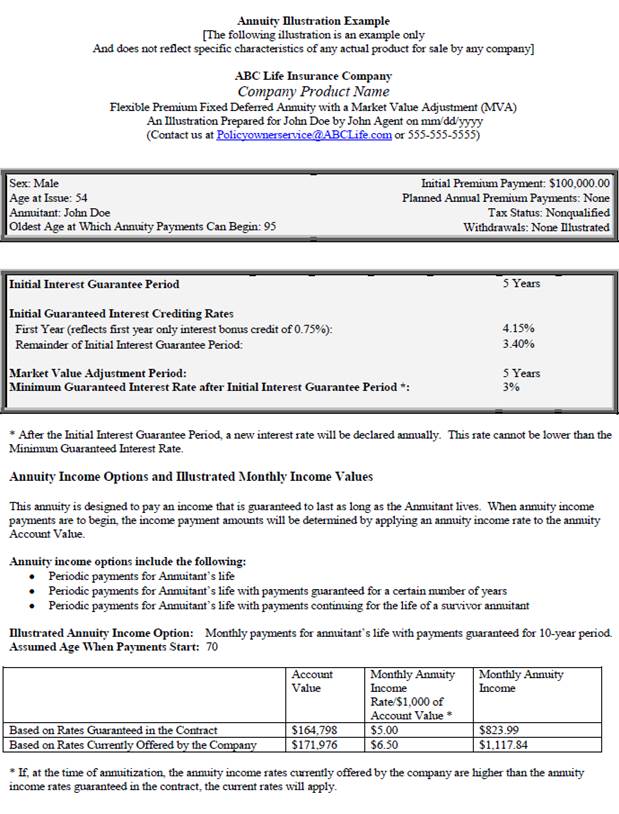
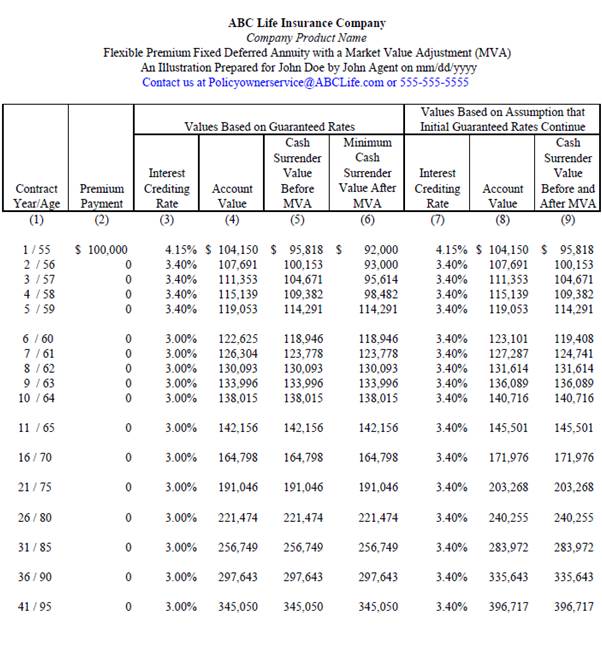
For column
descriptions, see next page
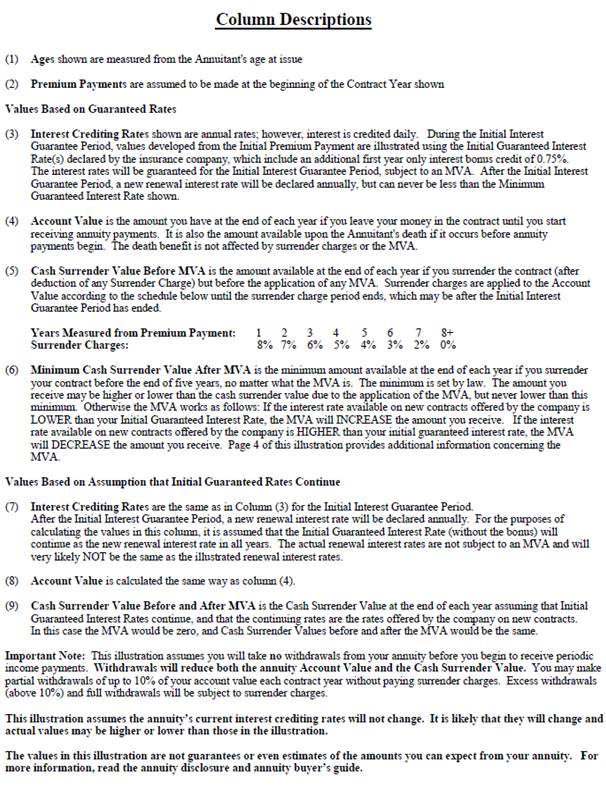
APPENDIX II
Sample illustrations of cash surrender values of
market value adjusted annuities
MVA-adjusted Cash Surrender Values (CSVs) Under Sample
Scenarios
The graphs below
show MVA-adjusted Cash Surrender Values (CSVs) during the first five years of the
contract, as illustrated on page 2 of the Annuity Illustration example
($100,000 single premium, a 5-year MVA Period) under two sample scenarios, as
described below.
Graph
#1
shows if the interest rate on new contracts is 3% LOWER than you
Initial Guaranteed Interest Rate, the MVA will increase the amount you receive
(upper line). The lower line shows the
Cash Surrender Values if the Initial Guaranteed Interest Rates continue (From
Column 9 on Page 2 of the Annuity Illustration example).
Graph
#2 shows
if the interest rate on new contracts is 3% HIGHER than your Initial Guaranteed
Interest Rate, the MVA will decrease the amount you receive, but not below the
minimum set by law (Column 6 on Page 2 of the Annuity Illustration example),
which, in this scenario, limits the decrease for the first 2 years (lower
line). The upper line shows the Cash
Surrender Values if the Initial Guaranteed Interest Rates continue (from column
9 on Page 2 of the Annuity Illustration example).
These graphs and
the sample guaranteed interest rates on new contracts used are for
demonstration purposes only and are not intended to be a projection of how
guaranteed interest rates on new contracts are likely to behave.
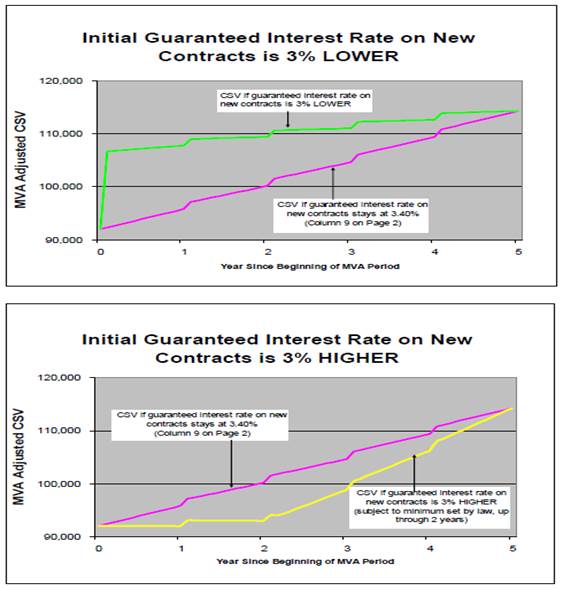
APPENDIX A
|
Rule |
Specific State Statute the Rule
Implements |
|
Ins 301.01 |
RSA 400-A:15, I;
RSA 417:1; RSA 417:3; RSA 417:4, I and III |
|
Ins 301.02 |
RSA
400-A:15, I; RSA 417:1, RSA 417:2; RSA 417:3; RSA 417:4, I and III; RSA 418:18, VI;
RSA 418:21, III; 29 U.S.C. Section 101 et seq |
|
Ins 301.03 |
RSA 400-A:15, I |
|
Ins 301.04 |
RSA 400-A:15, I;
RSA 417:4, I and III |
|
Ins 301.05 |
RSA 400-A:15, I;
RSA 417:4, I and III |
|
Ins 301.06 |
RSA
400-A:15, I; RSA 400-B:4; RSA 402-J:3; RSA 405:17-b; RSA 405:44-a; RSA 417:4, I |
|
Ins 301.07 |
RSA 400-A:15, I;
RSA 417:4, I |
|
Ins 301.08 |
RSA 400-A:15, I;
RSA 417:4, I; RSA 417:10 |
|
Ins 301.09 |
RSA 408:1; RSA
408:12; RSA 294-E; RSA 420-Q:2 |
|
Ins 301.10 |
RSA 400-A:15, I |
|
Ins 302.01 |
RSA 400-A:15, I;
RSA 408:51; RSA 408:53; RSA 408:55; RSA 417:4 |
|
Ins 302.02 |
RSA 400-A:15, I;
RSA 408:51; RSA 408:53; RSA 408:55; RSA 417:4 |
|
Ins 302.03 |
RSA 400-A:15, I;
RSA 408:51; RSA 408:53; RSA 408:55; RSA 417:4 |
|
Ins 302.04 |
RSA 400-A:15, I;
RSA 408:51; RSA 408:53; RSA 408:55; RSA 417:4 |
|
Ins 302.05 |
RSA 400-A:15, I;
RSA 408:51; RSA 408:53; RSA 408:55; RSA 417:4 |
|
Ins 302.06 |
RSA 400-A:15, I;
RSA 408:51; RSA 408:53; RSA 408:55; RSA 417:4 |
|
Ins 302.07 |
RSA 400-A:15, I;
RSA 408:51; RSA 408:53; RSA 408:55; RSA 417:4 |
|
Ins 302.08 |
RSA 400-A:15, I;
RSA 408:15; RSA 408:16; RSA 408:29; RSA 408:51; RSA 408:53; RSA
408:55; RSA 417:4 |
|
Ins 302.09 |
RSA 400-A:15, I
and III.; RSA 402-J:12; RSA 408:62; RSA 417:10 |
|
Ins 302.10 |
RSA 400-A:15, I |
|
Appendix A |
RSA 400-A:15, I |
|
Appendix B |
RSA 400-A:15, I |
|
Appendix C |
RSA 400-A:15, I |
|
Ins 303.01 |
RSA 417:1, RSA
417:2, RSA 417:3 and RSA 409-A:2 |
|
Ins 303.03 |
RSA 409-A:2, RSA
417:3, RSA 417:4 |
|
Ins 303.04 |
RSA 417:4 |
|
Ins 303.05 |
RSA 409-A:3 and
RSA 417:4 |
|
Ins 303.06 |
RSA 400-A:15,
RSA 417:10 and RSA 541-A:16 |
|
Ins 304.01 |
RSA 400-A:15, I;
415-B |
|
Ins 304.02 |
RSA 400-A:15, I;
15 U.S.C. 77 et seq. (Securities Act of 1933) |
|
Ins 304.03 |
RSA 400-A:15, I |
|
Ins 305.01 |
RSA 402:47;
408:27-29; 408:35; 408:51; 417:4, I., II. |
|
Ins 305.02 |
RSA 402:47;
408:19; 408:38; 408:40 |
|
Ins 305.03 |
RSA 401:1, III.;
405:1; 405:12 |
|
Ins 305.04 |
RSA 401:1, III.;
402-J:3; 408:27 |
|
Ins 305.05 |
RSA 402:12;
402-J:14, I., IV.; 405:17-b; 408:7; 408:38; 408:40;
408:42-43 |
|
Ins 305.06 |
RSA 401:12;
402-J:14, I., IV.; 405:17-b; 408:38; 408:40;
408:42-43 |
|
Ins 305.07 |
RSA 402-J:14,
IV.; 417:10, II. |
|
Ins 305.08 |
RSA 400-B:1, 3-4 |
|
Ins 305.09 |
RSA 400-A:15, I;
RSA 408:1 |
|
Ins 306.01 |
RSA 400-A:15,
I; RSA 408:52, II; RSA 417:3 & 4; |
|
Ins 306.02 |
RSA 400-A:15, I;
Securities Act of 1933 (15 U.S.C. Section 77a et seq.); Investment Company
Act of 1940 (15 U.S.C. Section 80a·l et seq.) |
|
Ins 306.03 |
RSA 400-A:15, I;
RSA 403-E; RSA 408-E |
|
Ins 306.04 |
RSA 400-A:15, I;
RSA 408:29; RSA 417:3 & 4 |
|
Ins 306.05 |
RSA 400-A:15, I;
RSA 417:3 & 4 |
|
Ins 306.06 |
RSA 400-A:15,
I; RSA 417:3 & 4 |
|
Ins 306.07 |
RSA 400-A:15, I
& III; RSA 417:3 & 4 |
|
Ins 306.08 |
RSA 400-A:15, I |
|
Appendix I |
RSA 400-A:15, I |
|
Appendix II |
RSA 400-A:15, I |
|
Ins 307.01 |
RSA 400-A:15, I; 410:2; 410:3; 410:4 |
|
Ins 307.02 |
RSA 400-A:15, I; 410:2; 410:3; 410:4 |
|
Ins 307.03 |
RSA 400-A:15, I; 410:2; 410:3; 410:4 |
|
Ins 307.04 |
RSA 400-A:15, I; 410:2; 410:3; 410:4 |
|
Ins 307.05 |
RSA 400-A:15, I; 410:2; 410:3 |
|
Ins 307.06 |
RSA 400-A:15, I; 410:4; 410:5; 410:6;
410:7; 410:8; 410:9; 410:12; 410:13 |
|
Ins 307.07 |
RSA 400-A:15, I; 410:4; 410:5; 410:6;
410:7; 410:8; 410:9; 410:12; 410:13 |
|
Ins 308.01 |
RSA 400-A:15, I; RSA 400-A:36; RSA 405:45; RSA 405:46; RSA 405:47;
RSA 405:48; RSA 405:49; RSA 405:50; RSA 405:51; RSA 405:52 |
|
Ins 308.02 |
RSA 400-A:15, I; RSA 400-A:36; RSA 405:45; RSA 405:46; RSA 405:47;
RSA 405:48; RSA 405:49; RSA 405:50; RSA 405:51; RSA 405:52 |
|
Ins 308.03 |
RSA 400-A:15, I; RSA 400-A:36; RSA 405:45; RSA 405:46; RSA 405:47;
RSA 405:48; RSA 405:49; RSA 405:50; RSA 405:51; RSA 405:52 |
|
Ins 308.04 |
RSA 400-A:15, I; RSA 400-A:36; RSA 405:45; RSA 405:46; RSA 405:47;
RSA 405:48; RSA 405:49; RSA 405:50; RSA 405:51; RSA 405:52 |
|
Ins 308.05 |
RSA 400-A:15, I; RSA 400-A:36; RSA 405:45; RSA 405:46; RSA 405:47;
RSA 405:48; RSA 405:49; RSA 405:50; RSA 405:51; RSA 405:52 |
|
Ins 308.06 |
RSA 400-A:15, I; RSA 400-A:36; RSA 405:45; RSA 405:46; RSA 405:47;
RSA 405:48; RSA 405:49; RSA 405:50; RSA 405:51; RSA 405:52 |
|
Ins 308.07 |
RSA 400-A:15, I |
|
Ins 309.01 |
RSA 400-A:15, I; 417:3; 417:4, I, II,
VIII, IX, XII |
|
Ins 309.02 |
RSA 400-A:15, I; 417:3; 417:4, I, II,
VIII, IX, XII |
|
Ins 309.03 |
RSA 400-A:15, I; 417:3; 417:4, I, II,
VIII, IX, XII |
|
Ins 309.04 |
RSA 400-A:15, I; 417:3; 417:4, I, II,
VIII, IX, XII |
|
Ins 309.05 |
RSA 400-A:15, I; 417:3; 417:4, I, II,
VIII, IX, XII |
|
Ins 309.06 |
RSA 400-A:15, I; 417:3; 417:4, I, II,
VIII, IX, XII |
|
Ins 309.07 |
RSA 400-A:15, I; 417:3; 417:4, I, II,
VIII, IX, XII |
|
Ins 309.08 |
RSA 400-A:15, I; 417:3; 417:4, I, II,
VIII, IX, XII |
|
Ins 309.09 |
RSA 400-A:15, I; 417:3; 417:4, I, II,
VIII, IX, XII |
|
Ins 309.10 |
RSA 400-A:15, I; 417:3; 417:4, I, II,
VIII, IX, XII |
|
Ins 309.11 |
RSA 400-A:15, I; 417:3; 417:4, I, II,
VIII, IX, XII; 417:10 |
|
Ins 309.12 |
RSA 400-A:15, I; 417:3; 417:4, I, II,
VIII, IX, XII |
|
Ins 310 |
10 U.S.C. 992
note; 15 U.S.C. 78o, 78o-3, 80a-27, 80b-10, 80b-3a and 80b-4; 38 U.S.C.
Chapter 19 |
|
Ins 310.01 |
RSA 408:1; RSA 417:4; RSA 417:5; RSA 417:5-a |
|
Ins 310.02 |
RSA 408:1; RSA 417:4; RSA 417:5; RSA 417:5-a |
|
Ins 310.03 |
RSA 408:1; RSA 417:4; RSA 417:5; RSA 417:5-a |
|
Ins 310.04 |
RSA 408:1; RSA 417:4; RSA 417:5; RSA 417:5-a |
|
Ins 310.05 |
RSA 408:1; RSA 417:4; RSA 417:5; RSA 417:5-a |
|
Ins 310.06 |
RSA 408:1; RSA 417:4; RSA 417:5; RSA 417:5-a |
|
|
Also: Military Personnel Financial Services Act
of 2006, Pub. L. No. 109-290, 120 Stat. 1317 |
|
Ins 311.01 |
RSA 400-A:15, I; 408:5; 408:13; 408:42;
408:51; 408:52, II; 408:55; 408:60; 408:62; 417:4, I, II, III, IV; 417:5-a |
|
Ins 311.02 |
RSA 400-A:15, I; 408:5; 408:13; 408:42;
408:51; 408:52, II; 408:55; 408:60; 408:62; 417:4, I, II, III, IV; 417:5-a |
|
Ins 311.03 |
RSA 400-A:15, I; 408:5; 408:13; 408:42;
408:51; 408:52, II; 408:55; 408:60; 408:62; 417:4, I, II, III, IV; 417:5-a |
|
Ins 311.04 |
RSA 400-A:15, I; 408:5; 408:13; 408:42;
408:51; 408:52, II; 408:55; 408:60; 408:62; 417:4, I, II, III, IV; 417:5-a |
|
Ins 312.01 |
RSA 400-A:15, I; RSA 408-D:8; RSA
408-D:17 |
|
Ins 312.02 |
RSA 400-A:15, I; RSA 408-D:17 |
|
Ins 312.03 |
RSA 400-A:15, I; RSA 408-D:2 |
|
Ins 312.04 |
RSA 400-A:15, I; RSA 408-D:8; RSA
408-D:17 |
|
Ins 312.05 |
RSA 400-A:15, I; RSA 408-D:17; RSA
541-A:22, IV |
Appendix B Incorporation by Reference Information
|
Rule |
Title of Material |
Publisher; How to Obtain; and Cost |
|
|
|
|
|
Ins 301.03 |
Life
Insurance Buyer’s Guide © 2018 developed by the National Association of
Insurance Commissioners |
Published
by the NAIC. Available at no cost at: https://content.naic.org/sites/default/files/publication -lig-lp-consumer-life.pdf |
|
Ins 306.03(a) |
Annuity Buyer’s
Guide © 1999, 2007,
2013 developed by the National Association of Insurance Commissioners |
Published by the
NAIC Available for no cost at: http://www.naic.org/documents/prod_serv_consumer_anb_la.pdf |
|
Ins
307.01 (a); Ins
307.03 (b); Ins
307.04 (a), (b), (d); Ins
307.05 (a) |
The 1983
Table “a” developed by the Society of Actuaries Committee to Recommend a New
Mortality Basis for Individual Annuity Valuation. |
Published
by Society of Actuaries Available
for no cost at: http://mort.soa.org/
|
|
Ins
307.01 (b); Ins
307.03 (e); Ins
307.05 (a), (b) |
The 1983
Group Annuity Mortality (1983 GAM) Table developed by the Society of
Actuaries Committee on Annuities. |
Published
by Society of Actuaries Available
for no cost at: http://mort.soa.org/ |
|
Ins
307.01 (c); Ins
307.04 (b), (c) |
Annuity
2000 Mortality Table developed by Society of Actuaries Committee on Life
Insurance Research |
Published
by Society of Actuaries Available
for no cost at: http://mort.soa.org/ |
|
Ins
307.01 (d); Ins
307.03 (b); Ins
307.04 (d) |
The 2012
Individual Annuity Reserving (2012 IAR) Mortality Table developed by the
Society of Actuaries Committee on Life Insurance Research |
Published
by Society of Actuaries Available
for no cost at: http://mort.soa.org/ |
|
Ins
307.01 (e); Ins
307.03 (f); Ins
307.05 (a), (b), (c); Ins
307.06 |
The 1994
Group Annuity Reserving (1994 GAR) Table developed by the Society of
Actuaries Group Annuity Valuation Table Task Force |
Published
by Society of Actuaries Available
for no cost at: http://mort.soa.org/ |
|
Ins
307.03 (b), (h) |
Projection
Scale G2 (Scale G2) developed by the Society of Actuaries Committee on Life
Insurance Research |
Published
by Society of Actuaries Available
for no cost at: http://mort.soa.org/ |
|
Ins
307.03 (b), (i) |
2012
Individual Annuity Mortality Period Life (2012 IAM Period) Table developed by
the Society of Actuaries Committee on Life Insurance Research |
Published
by Society of Actuaries Available
for no cost at: http://mort.soa.org/ |
|
Ins 309.10 (b) |
Actuarial Standards of Practice for
Compliance with the NAIC Model Regulation on Life Insurance Illustrations,
No. 24 |
Online for no cost:
www.actuarialstandardsboard.org |
|
Ins 311.04(b)(3) |
Accrediting
Agencies Recognized for Title IV Purposes, prepared by the U.S. Department of
Education; Publication date 9/1/98 |
Online for no
cost at: https://ifap.ed.gov/aagencies/doc0023_bodyoftext.htm |
|
Ins 311.04(d)(2) |
Investment
Company Act of 1940, an act of Congress in 1940 |
Online for no
cost at: https://www.sec.gov/about/laws/ica40.pdf
|